A coder who didsomething quiet
This is the story of 一一如是 — about one person who was moved by Eastern objects and decided to spend his life passing on their quiet power.
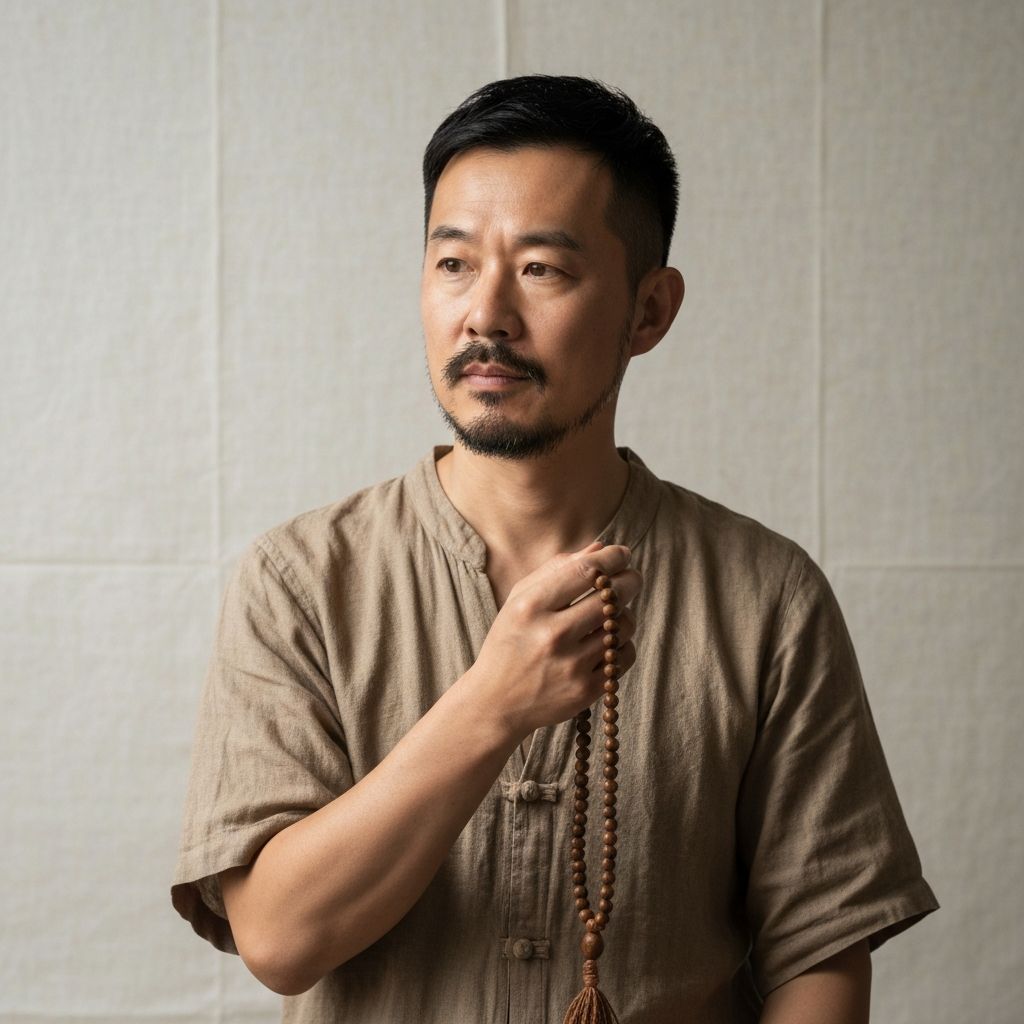
Chapter I: A Decade of Code
My name is Yuan Hao. I've been writing code for over a decade. From early websites to mobile apps, backend architecture, and data systems — code filled nearly my entire career. I loved the certainty of clear logic and immediate output. In the digital world, everything was controllable — as long as your logic had no holes, the program would run exactly as expected. That certainty gave me comfort, and it trained me to measure everything with reason and efficiency.
Chapter II: A String of Beads Changed Everything
One day at an antique market, I picked up a sandalwood mala and rolled the beads between my fingers. My mind went completely still. It felt different from the satisfaction of writing clean code — not a sense of accomplishment, but a sense of being held by something. It was a deep, wordless peace. In that moment I realized something was missing from my life. Not efficiency. Not achievement. But the feeling of being touched by objects, by time, by silence.
Chapter III: Seeing the Gap
After that day, I started paying attention to traditional objects. I noticed that many people overseas were drawn to mala beads, amulets, tea ceremony, and incense culture — but what they could find was either mass-produced commodity or Western brands offering a shallow take on Eastern traditions. Printing a lotus on a T-shirt and calling it "Zen." There was no bridge built by someone who truly understood the culture and spoke modern aesthetics. No one stood between East and West who understood both languages — not just words, but the language of beauty, the language of the soul.
Chapter IV: One Room, One Laptop
So I decided to build that bridge myself. One person, one laptop, one quiet study — and that's how 一一如是 began. No investor pressure. No marketing KPIs. Just me, quietly doing what I believe in. From product selection to design, copywriting to customer service — every step, my own hands. Sometimes it gets tiring. But every time a customer tells me our objects helped them find a moment of peace in their busy life — it makes everything worth it.
Chapter V: What "Yi Yi Ru Shi" Means
The brand name comes from the Diamond Sutra. "Ru Shi Wo Wen" — the opening phrase before the Buddha teaches, meaning "Thus have I heard." And "Yi Yi" means each and every thing, every individual being. "Yi Yi Ru Shi" means "each thing, just as it is." This is both the brand's attitude — honoring the inherent beauty of every object — and a life philosophy: accept yourself, accept the world, as it is. Another layer comes from "All sages and worthies differ only in their approach to the formless Dharma" — different paths, same destination. Everyone is finding their own way to inner peace.
Stillness · Vision · Legacy
Stillness
守静
In a noisy world, guard that inner quiet. Every object is a doorway back to yourself.
Vision
致远
No rush. Eyes on the horizon. We don't make fast fashion — we make things that accompany a lifetime.
Legacy
传承
Let ancient wisdom enter modern life with a new face. Tradition is not a museum — it's a living force in the present.
"Not a master, not a merchant. Just someone moved by these objects, trying to pass on their quiet power."
Continue Exploring
If you're also seeking a quiet depth, welcome into our world.