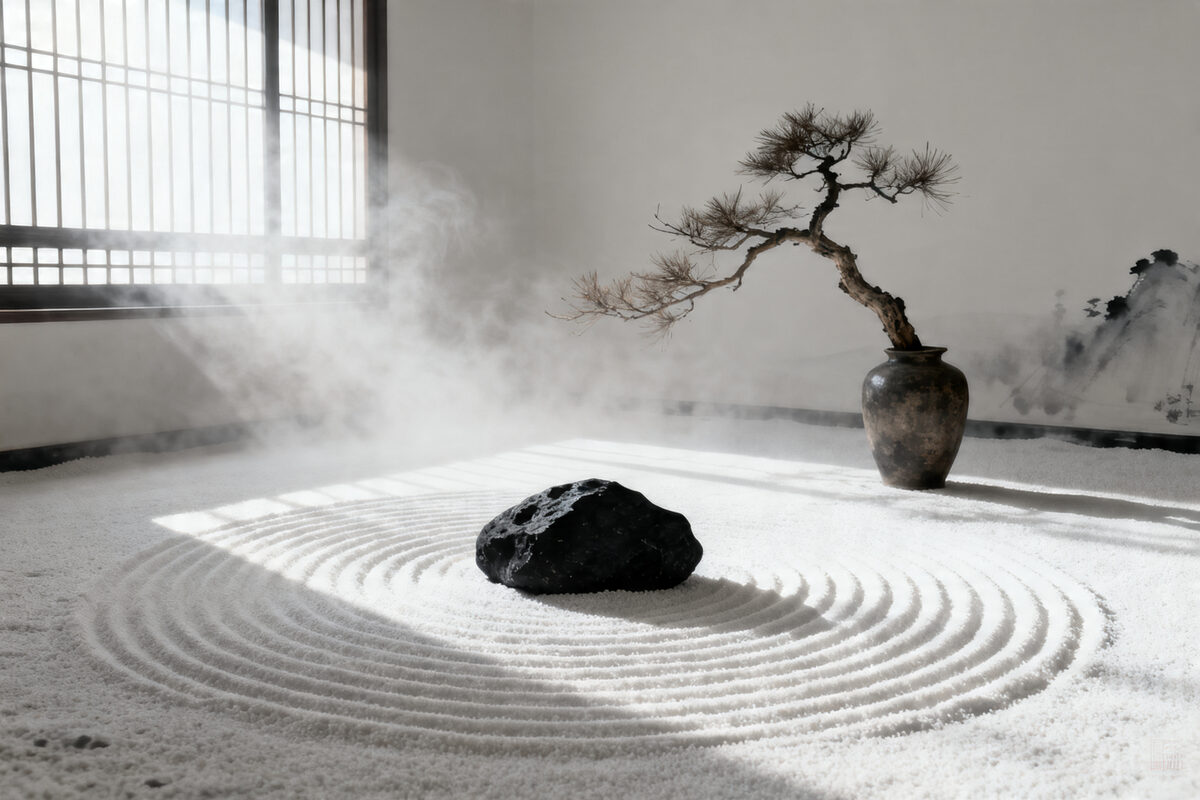
The Way in ObjectsThe Heart in Stillness
We believe that true objects are not merely material — they are vessels of spirit. Three levels, three realms, form our complete understanding of Eastern aesthetics.
Stillness
GUARDING STILLNESS
"Attain the ultimate emptiness, guard the truest stillness. As the ten thousand things arise together, I watch their return."
Stillness is the most fundamental yet most profound practice in the Eastern tradition of self-cultivation. Laozi says "attain the ultimate emptiness, guard the truest stillness" — this is not mere quietness, but the purification of mind to its very essence, holding onto the innate peace amid the chaos of ten thousand things arising. In modern society, we are besieged by information, desire, and the cult of efficiency. The inner voice has long been drowned out by noise. Guarding stillness is the active choice to return to that quiet origin.
Every object we create is an entrance to stillness. When your fingers glide across the grain of wooden beads, when a thread of aloeswood incense unfolds in the air, when you sit at your desk brewing a pot of tea — in that moment, the clamor of the world recedes, and you reconnect with yourself. Objects do not speak, but they tell you through their very presence: slow down, stop, feel this moment. Stillness is not escape — it is preparation for a better departure.
Vision
REACHING FAR
"Without detachment, one cannot clarify one's purpose; without stillness, one cannot reach far."
Vision builds upon stillness, casting one's gaze toward the distant horizon. Zhuge Liang's words were a family instruction to his son, yet they carry life wisdom that transcends millennia: without a detached mind, one's aspirations blur; without a still foundation, one cannot go far. In an age obsessed with instant gratification, "far" has become a forgotten dimension. People are accustomed to speed, fast consumption, and short-term returns. Few are willing to settle down for a goal ten years away.
Yi Yi Ru Shi chooses to do slow things. We collaborate with artisans — each piece requires dozens of processes, taking weeks or even months. We do not chase viral hits or traffic; we pursue only quality that stands the test of time. Because we believe that truly good things need time to come into being, just as a tree must pass through four seasons to send down deep roots. Vision is patience, resolve, and the courage not to follow the crowd. Our objects are not for today's trends — they are for tomorrow's legacy.
Legacy
PASSING ON THE LEGACY
"Though Zhou is an ancient state, its mandate is ever renewed."
Legacy is the highest of our three realms. The Zhou dynasty, though an ancient state, found its mission in constant renewal. This line reveals a profound truth: true legacy is not stubborn conservatism, but the act of breathing new life into tradition while honoring its roots. Tradition is not a museum specimen — it is a living force in the present. When a culture exists only behind glass, it has already died; only when it enters daily life, when it is touched, used, and felt, does it truly live.
Through our objects, we hope to bring millennia of Eastern wisdom into contemporary life. A mala is not only a symbol of faith, but a tool for meditation, an object of aesthetic contemplation, a medium for dialogue with oneself. An amulet is not merely a carrier of wishes, but the crystallization of an artisan's devotion, the continuation of cultural memory. Legacy is not nostalgia — it is giving ancient souls modern garments. What we build is a bridge — connecting past and future, East and West, objects and the soul.
Yi Yi Ru Shi & The Diamond Sutra
Thus Have I Heard
—— Opening of the Vajracchedika Prajnaparamita Sutra
"Thus have I heard" — these are the opening words the Buddha spoke before every teaching, meaning "I personally heard the Buddha say thus." These four characters are not merely a narrative device; they embody an attitude: truthfulness, thusness, neither adding nor subtracting. They tell us that truth needs no embellishment — the Way is in the suchness of this very moment. We chose "Ru Shi" to convey this spirit of truthful contemplation.
"Yi Yi" means "each and every one," "every single thing." In Buddhist context, "Yi Yi" represents the individuality of all things — every grain of sand, every drop of water, every living being has its unique value and meaning. Combined, "Yi Yi Ru Shi" means "each thing, just as it is." This is both the brand's attitude — honoring the inherent beauty of every object, no excessive design, no over-packaging, letting the material speak for itself — and a life philosophy: accept yourself, accept the world, as it is.
A deeper meaning comes from another line in the Diamond Sutra: "All sages and worthies differ only in their approach to the formless Dharma." All enlightened beings, though their methods differ, ultimately point toward the same truth. Different paths, same destination — everyone is finding their own way to inner peace. Whether through tea ceremony, incense, meditation, or a quiet afternoon with the touch of wooden beads, all are moving in the same direction. Yi Yi Ru Shi exists to be a quiet companion for these diverse paths.
Yi Yi Ru Shi: Each thing, just as it is. Accept yourself, accept the world, as it is.
Continue Your Journey
Philosophy lives not in books but in the details of everyday life. Discover our story or find your own quietude in our writings.