Two Mothers, One Child: A Wise Judgment
Two women claim the same baby as their own. A wise king decrees: cut the child in half, each gets a piece. One woman lets go — true love is not possession, but sacrifice.
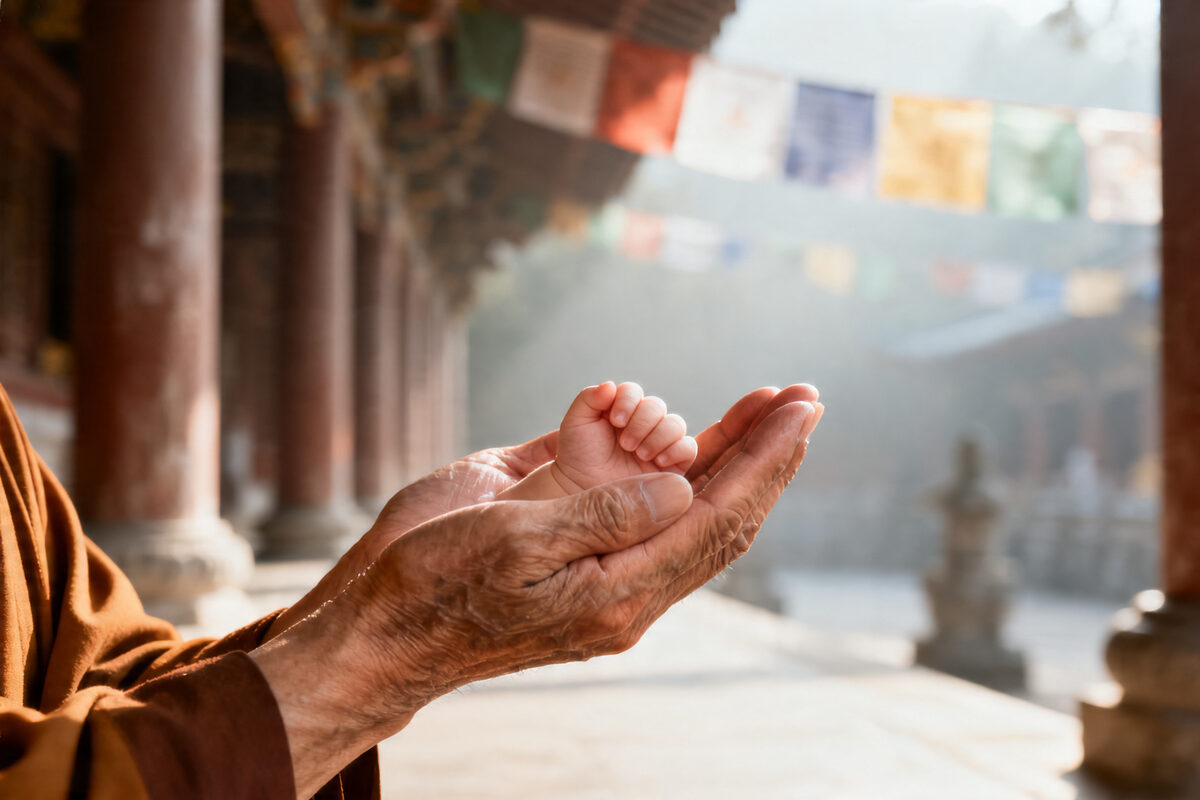
Two Women, One Baby
Long ago, two women came before a king, each holding the same infant.
Both claimed to be the child's mother.
One looked haggard, her eyes full of desperation. The other remained calm, her words measured and confident.
The king looked at them, then at the crying baby in their arms, and said nothing.
Each Tells Her Story
The first woman wept as she pleaded: "Your Majesty, this is my child! She stole him while I slept!"
The second woman replied coldly: "She lies. I have raised this child all along. She is the one trying to take him from me."
Each side stood firm. Neither could offer proof.
The ministers exchanged uneasy glances. No one could decide.
A Shocking Verdict
The king pondered for a long time. Then he spoke:
"Since both of you claim the child, let him be cut in two. Each shall have half."
A stunned silence fell over the court.
The guards obeyed and brought forth a sharp blade.
The baby was placed on the ground, his cries tearing through the hall.
A Hand Lets Go
The first woman lunged forward, screaming:
"No! Don't hurt him! Give the child to her! I don't want him anymore!"
Her voice trembled. Tears streamed down her face.
The second woman merely nodded and said calmly, "Fine. Half and half. That's fair."
The Truth Revealed
The king raised his hand and stopped the guards.
He turned to the woman who had let go and spoke softly:
"You are the child's true mother."
Silence filled the hall.
The king continued: "Only a true mother would rather lose her child than see him come to harm."
The one willing to split the child in two did not love the child — she loved winning.
A Buddhist Perspective
This story comes from the Wise and Foolish Sutra (Xianyu Jing), known as "Two Mothers Contest a Child."
The Buddha used this tale to teach his disciples: true compassion is not possession — it is letting go.
In Buddhism, there are two kinds of love:
- Craving (tanha): driven by desire to possess, centered on the self. It brings suffering when unfulfilled and anxiety when obtained.
- Compassion (karuna): centered on the well-being of all beings, given unconditionally, without expectation of return.
The moment the birth mother let go, she embodied the highest form of compassion — willing to endure the pain of separation to protect her child's safety.
This is the heart of a bodhisattva.
Modern Reflections
This ancient story still resonates in our relationships today.
How many parents control their children's lives in the name of "love"?
How many lovers strip away their partner's freedom under the guise of "caring"?
True love is not gripping someone tightly in your palm, but giving them room to grow.
- To love someone is not to possess them, but to wish them well.
- To raise a child is not to replicate yourself, but to help them become who they are.
- To cherish a relationship is not to bind the other person, but for both to become better versions of themselves.
Letting go does not mean you don't care.
It means you care so deeply — that you are willing to bear your own pain so the other may be safe.
Questions for Reflection
- Has there been a moment in your life when letting go required more courage than holding on?
- Is your "love" nurturing the other person, or fulfilling your own need for control?
- If true compassion means giving unconditionally, how can we practice it in our relationships?