Bring Me Your Mind, and I Will Pacify It: The Mystery of Damo and Huike
"My mind is uneasy. Please pacify my mind for me." Damo's response made the very mind Huike was desperately seeking completely vanish.
Bring Me Your Mind, and I Will Pacify It: The Mystery of Damo and Huike
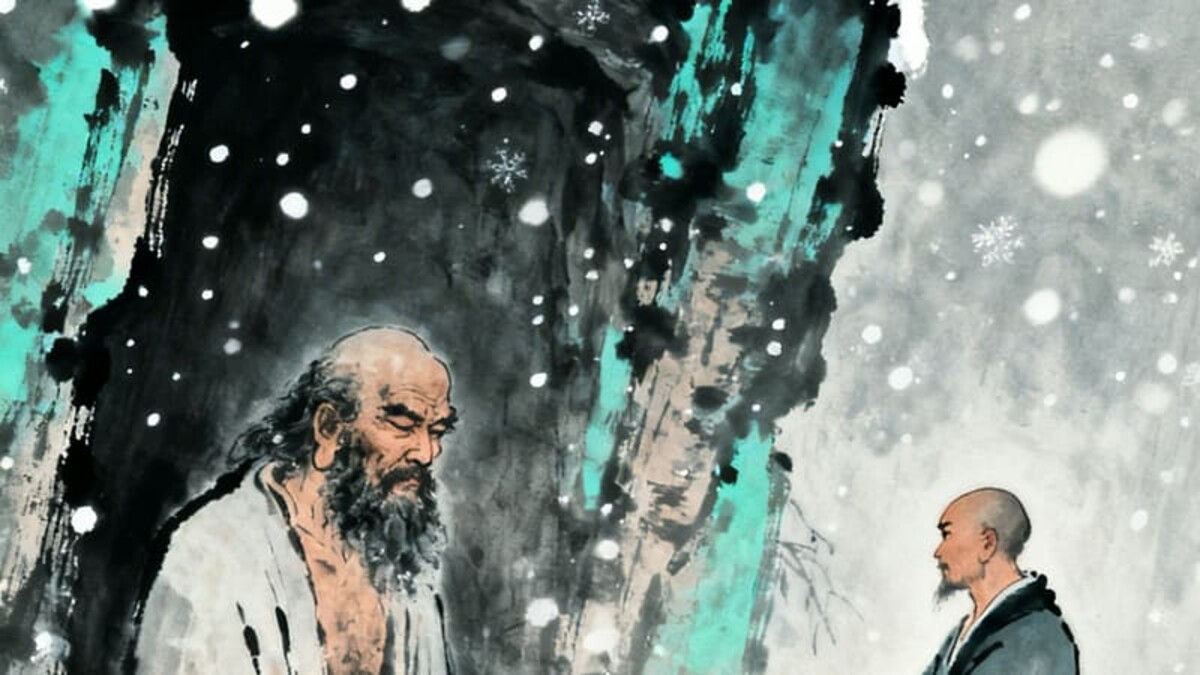
Winter. Snow knee-deep.
A monk stood outside the cave, motionless.
Inside sat an old man—Bodhidharma, the Zen master from the West. He sat facing the wall, not speaking a word.
The monk was named Shenguang. He had come seeking the Dharma, but Bodhidharma ignored him.
Shenguang thought: If my sincerity is not enough, I will prove it with blood.
He drew his knife and cut off his left arm.
Blood stained the white snow.
Bodhidharma finally spoke: What do you want?
Shenguang, enduring the pain, said: My mind is uneasy. Please, Master, pacify my mind for me.
Bodhidharma said: Bring me your mind, and I will pacify it for you.
Shenguang froze.
He turned his attention inward, searching for that "uneasy mind."
He searched and searched, but could not find it.
After a long while, he said: I cannot find the mind.
Bodhidharma said: There, I have pacified it for you.
Why Is "Not Finding Mind" the Same as "Pacifying Mind"?
This is one of the most crucial turning points in Zen.
Shenguang (later renamed Huike) came to Bodhidharma with a clear problem: My mind is uneasy, what should I do?
He assumed:
- Mind is a thing
- Mind can be uneasy
- Mind can be pacified
Bodhidharma's response made him see—
Mind is not a "thing" at all.
What Is Mind?
If you go looking for "mind," what do you find?
Is it that beating organ? That's the heart. Is it those arising thoughts? Thoughts come and go—which one is you? Is it that feeling? Feelings change too.
You cannot find a fixed, unchanging "mind."
Just as you cannot find "wind." You can only feel it blowing past. Just as you cannot find "time." You can only see change.
Mind is not a noun. Mind is a verb.
It is "awareness-ing," "knowing," "illuminating."
And this awareness itself has never been uneasy.
Then Where Does My Anxiety Come From?
Anxiety, fear, unease—
They are not "mind." They are "thoughts."
A thought says: "I'm terrible." A thought says: "I made a mistake." A thought says: "What about the future?"
You have mistaken these thoughts for "yourself."
But actually—
You are the one seeing these thoughts.
You are the sky. Thoughts are clouds.
Clouds come and go; the sky is never disturbed.
What Did Bodhidharma Do?
He did nothing.
He simply asked Shenguang to find the mind.
When Shenguang went to look, he had to step out of "thoughts" and become "the one watching thoughts."
In that moment of looking—
Thoughts dissolved. Anxiety dissolved. "Mind" also dissolved.
What remained was only pure awareness.
This is pacifying the mind.
"Pacifying Mind" Is Not "Solving Problems"
We habitually think:
- There's a problem → find an answer → solve it → peace
But Zen tells you:
The problem itself is an illusion.
You think there's an "uneasy mind" waiting to be fixed. But actually, that "uneasy mind" never existed.
It's like thinking there's a ghost in your room. The master says: Bring me the ghost, and I'll drive it away. You search everywhere and discover—there is no ghost.
The ghost was never there. You were never frightened.
What Does This Have to Do with My Life?
When you can't sleep, you think: "What should I do?" When you're anxious, you think: "What should I do?"
You're looking for a "solution" to a "problem."
But perhaps—
There is no problem.
Can't sleep? Then can't sleep. Anxious? Then anxious.
That "anxious you" is just a thought. The real you is watching that thought.
When you see it, you are free.
How to Use This Method?
Next time you feel uneasy, anxious, or afraid, try asking yourself:
"Who is uneasy?"
Go look for that "uneasy person."
What you find are only thoughts:
- "I'm terrible" (thought)
- "I made a mistake" (thought)
- "What about the future?" (thought)
There is no "you" there being uneasy.
Only the flow of thoughts, and your identification with them.
When you see this, you are no longer identified.
Non-identification is freedom.
Afterword
Shenguang cut off his arm seeking the Dharma and became Huike, the Second Patriarch of Zen.
Bodhidharma passed the lineage to him, saying:
"Outwardly I transmit the robe to establish the teaching." "Inwardly I transmit the mind seal, transmitting mind with mind."
This "transmitting mind with mind" transmits nothing mysterious.
It simply—
Lets you see: mind inherently has nothing to gain, nothing to lose.
Inherently pure, inherently neither arising nor ceasing.
Inherently complete, inherently unmoving.
In One Breath
Bring me your mind, and I will pacify it. I cannot find the mind. There, I have pacified it for you.
Three sentences, one circle.
Start from the problem, go around, discover the problem doesn't exist.
Zen is like this—
Giving you nothing, only letting you put down.
Reflections
- Right now, where is your mind? Go look for it.
- What have you been worrying about lately? Is that worry a fact, or a thought?
- What happens if you stop searching for "peace of mind"?
May you not find mind, may you be at peace everywhere.