The Burning House Parable: A Story of Fire That Reveals the Truth of Life
The most famous parable from the Lotus Sutra—a burning mansion, children oblivious to danger, and a father who uses skillful means to save them. This 2,500-year-old story reveals the nature of our delusion in the Three Realms and the path toward liberation.
The Burning House Parable: A Story of Fire That Reveals the Truth of Life
An Old Man and a Mansion Ablaze
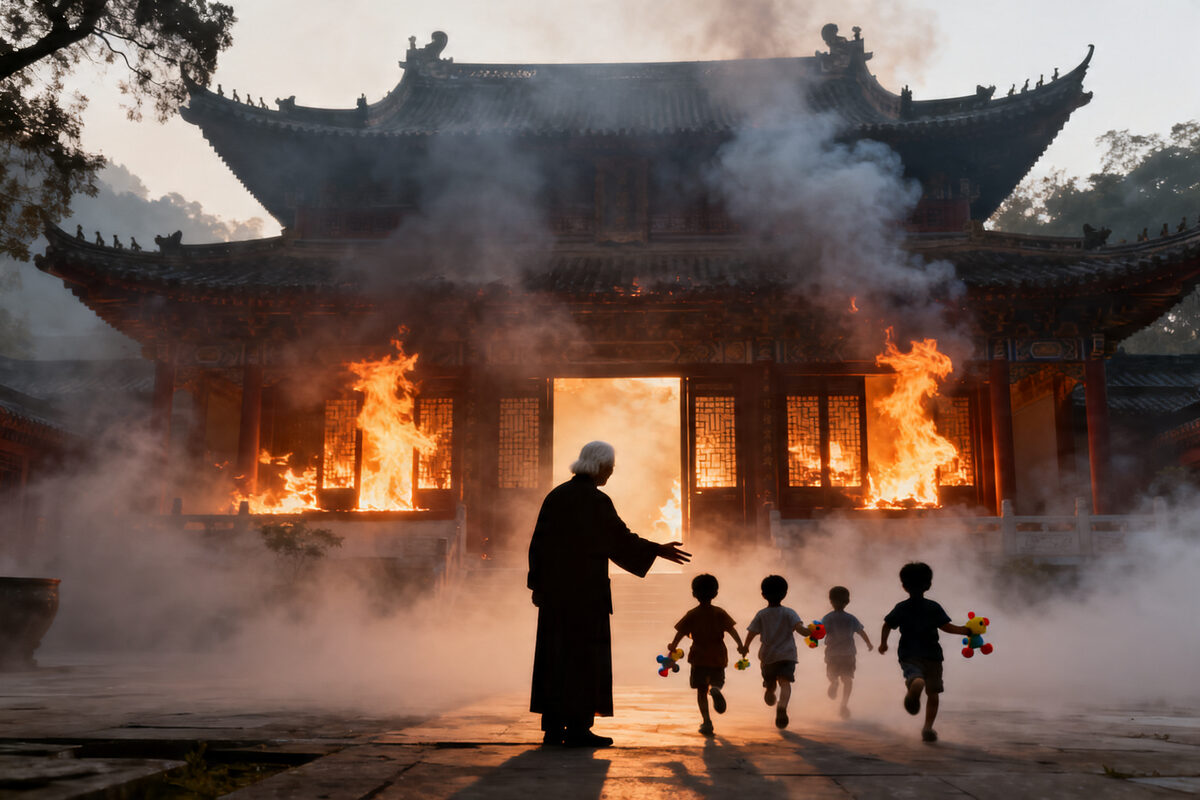
Long ago, there lived an elderly man of great wealth who owned a magnificent mansion. This estate was vast, with only a single door for entry and exit. The elder had hundreds of children, and one day, a great fire suddenly erupted from all four sides of the house at once.
The flames roared fiercely. Beams cracked and collapsed. Thick smoke billowed into the sky.
Yet the children were completely unaware. They played in their respective rooms—chasing butterflies, building with blocks, lost in games—oblivious to the danger closing in around them.
The elder, frantic with worry, shouted: "Run! The house is on fire! Come out quickly!"
But not a single child heeded him. They were too young to understand what "fire" meant, or how terrifying "death" could be. To them, the toys in their hands felt far more real than their father's warnings.
Skillful Means: Speaking the Language Children Understand
The elder thought to himself: I have the strength to carry them out one by one, but the door is narrow—only one person can pass through at a time. If I go in for this one, that one might be consumed by the flames. And the children, panicked, would scatter in every direction, making rescue even harder.
He had to find another way.
So the elder called out: "Children! Come out quickly! Outside, there are wonderful toys you've never seen before—goat carts, deer carts, and ox carts! Beautifully decorated, with bells that jingle and chime! Come out and claim them, or they'll be gone!"
At these words, the children dropped their toys at once and raced through the front door, pushing and shoving to be first.
When they burst outside, they saw that the great fire was indeed raging behind them. They were safe.
But outside, there were no goat carts, no deer carts, no ox carts.
The Elder's True Intention
The children turned to their father: "What about those carts you promised?"
The elder smiled. He felt no guilt, no sense of having lied. For his purpose was never to give them carts—his purpose was to bring them out alive.
Then, the elder gave each child an even more magnificent great white ox cart—far superior to the goat, deer, or ox carts he had originally promised.
The children rejoiced.
This is the famous "Parable of the Burning House" from the Lotus Sutra, Chapter on Similes and Parables.
Three Carts and One Vehicle
Behind this story lies a core teaching of Mahayana Buddhism—the principle of "uniting the three into one."
- The goat cart represents the Śrāvaka vehicle—those who awaken upon hearing the Buddha's teachings
- The deer cart represents the Pratyekabuddha vehicle—those who awaken by observing the interdependent nature of phenomena
- The ox cart represents the Bodhisattva vehicle—those who seek awakening not only for themselves but for all beings
The Buddha taught that these three paths may appear different, but they all converge on the same ultimate goal—Buddhahood. Just as the elder promised three kinds of carts, yet gave each child the finest great white ox cart of all.
This was not deception. It was skillful means.
What Is the Burning House?
The Buddha said that the burning mansion represents the Three Realms we inhabit—the Realm of Desire, the Realm of Form, and the Realm of Formlessness.
We are the children playing inside the burning house.
What are we chasing? Wealth, fame, romance, status... We lose ourselves in the games before our eyes, unaware that the entire structure is burning. Aging, illness, and death approach like flames from all four directions, yet we remain oblivious.
The elder is the Buddha.
His cries are the Dharma.
Why Didn't the Buddha Simply Tell the Truth?
This is the most thought-provoking aspect of the Burning House Parable.
The Buddha was entirely capable of telling beings directly: "All worldly existence is suffering; seek liberation at once." But just as those children couldn't comprehend their father's warnings, most beings cannot absorb teachings about suffering, emptiness, impermanence, and non-self.
Not because the Buddha was being dishonest, but because their hearts were not yet ready.
So the Buddha employed various skillful methods—the human and celestial vehicle, the Śrāvaka vehicle, the Pratyekabuddha vehicle—guiding beings step by step according to their individual capacities and readiness.
Think of a drowning person. You cannot simply tell them, "Relax, the water will hold you up"—thrashing in terror, they will only sink deeper. You must first offer a floating board, let them grab hold, and then slowly teach them to swim.
Modern Insights from Skillful Means
The Buddhist concept of upāya—skillful means—carries a depth far beyond its everyday usage. It is not about being "convenient" or "making do." It is using the most appropriate method to help someone move from suffering toward liberation.
This wisdom is especially vital in modern life:
In parenting—Rather than repeating "you must study hard," find what sparks your child's curiosity and let them run toward it willingly.
In leadership—Rather than imposing rules by force, help each person see their own stake in the outcome, so they act from genuine motivation.
In helping friends—Rather than offering unsolicited advice from above, first understand their situation, then communicate in a way they can actually hear.
In spiritual practice—There is no need to cling to a single method. Any practice that helps you let go of attachment and grow in wisdom is a good practice.
We Still Sit Inside the Burning House
After reading this story, we might ask ourselves honestly:
Are we, too, sitting inside a burning mansion, clutching our favorite toys, convinced that everything is fine?
The things we agonize over—promotions, mortgages, social media likes—are these not the toys?
And the things that truly matter—health, family, inner peace, the search for life's meaning—are these not the spreading fire we choose to ignore?
The Burning House Parable is not meant to make us despair. Quite the opposite—it is a clear-eyed reminder: you have the ability to leave; you simply haven't started moving yet.
The Symbolism of the White Ox Cart
At the end of the story, the elder doesn't give the children the three kinds of carts he promised. Instead, he gives each one an even more splendid great white ox cart.
In Buddhism, the white ox cart symbolizes the One Buddha Vehicle—the ultimate awakening.
What does this mean?
It means that no matter which path you walk—whether you chant the Buddha's name, sit in meditation, recite mantras, or practice acts of compassion—as long as you keep moving forward, you will arrive at the same destination.
There is no need to insist that "my method is superior to yours," nor to worry whether "my path is the right one."
Every sincere path leads in the same direction.
Layers of Meaning in a Single Parable
The Burning House Parable is revered as the foremost of the "Seven Parables of the Lotus Sutra" precisely because it nestles meaning within meaning, infinite in its depths:
First layer: A father rescuing his children—a story about love and wisdom
Second layer: The Buddha's skillful means for saving sentient beings—the art of spiritual education
Third layer: The core doctrine of three vehicles uniting in one—the ultimate goal of Buddhist practice
Fourth layer: A fundamental awareness of our existential condition—about what we are experiencing right now
Four layers of meaning, one story.
This is the power of parable in the Buddhist canon: it does not hand you answers directly, but gives you eyes to see the truth for yourself.
The Courage to Walk Out of the Burning House
Over two thousand five hundred years ago, the Buddha told this story on Vulture Peak.
Two and a half millennia later, we are still playing inside the burning house.
The difference is, we now have even more toys—smartphones, short videos, endless entertainment—that make it even harder to hear the elder's call.
But the call has never stopped.
It might be a sentence in a book, a word of caution from a friend, a sudden unease that rises in the depths of night, or perhaps this very moment—right now—as you read these words.
The door has always been open.
All we need is to set down our toys, rise, and walk through.
Reflections
- If your life were a burning house, what "toy" would you be most reluctant to let go of?
- Do you consider the Buddha's "skillful means" an act of compassion or a form of deception? Why?
- In your modern life, what is your "elder's call"? Are you truly listening?