Foreigners Think Cultivation Is Leveling Up. A Daoist Gave Me Four Words.
An American friend asked me: is immortality serious? I told him Chinese people have asked themselves that for two thousand years. Cultivation novels are huge overseas now, but hidden in the English comment sections is a misunderstanding — they think practice means becoming stronger. The Daoist path runs the other way: subtract and subtract, until you reach emptiness. A story about furnaces, fire-timing, five-element crystals, and one Daoist priest's answer.
I keep coming across foreigners learning to cultivate qi.
An American streamer, sitting cross-legged in front of his camera, a line of Chinese danmu on his screen: "sink the qi to the dantian." He reads it out loud, stumbling over the syllables, then takes a very serious breath and places his hand three fingers below his navel. Someone types in English: "Is this the dantian?" A row of replies: "Yes. Below the navel. Three fingers."
I watched and laughed. Not at him — at myself, somehow.
I spent years studying Daoism before I took refuge in Buddhism. Half my bookshelf is sutras, the other half Daoist texts. When people ask what I believe, I always say: to explain that, someone first needs to pour me a cup of tea. Tonight's cup is about xiu xian — cultivation. The thing an old friend of mine once called "Chinese wizard stuff."
An American once asked me: what are you actually cultivating?
Last year a friend of a friend, an American in China on business, heard at dinner that I "knew about these things." His eyes lit up. He'd read a translation of Journey to the West, watched cultivation anime, followed a "Cultivation" novel online. He asked me:
"So... immortality. Is that real? Do people actually train for this?"
Is immortality real. Do people actually train for it.
I said: Chinese people have been asking themselves that question for two thousand years.
He blinked. Probably not the answer he expected.
I said, go open the Daoist books — from the earliest alchemical texts to all the later classics — and you'll notice something. Half of them teach you how to become an immortal. The other half very seriously tell you which methods will kill you.
The elixirs made of minerals and metals killed many people, including a few emperors. When the outer alchemy road closed, people turned inward — inner alchemy. The body becomes the furnace, essence, qi and spirit become the ingredients, and you refine the elixir inside yourself. You stop swallowing lead and mercury; instead you tune your breath, your attention, your posture into a slow daily practice.
This isn't simply superstition, and it isn't simply science. It is a body of knowledge about what a human being is, tested over two thousand years, sometimes with lives. Some of it is wrong, some of it absurd — and some of it is strangely insightful. The inner alchemy tradition's precise handling of breath and attention echoes, faintly, much of what we now call mindfulness meditation. Jung pored over a Daoist inner alchemy text, The Secret of the Golden Flower, and wrote a long commentary on it. He couldn't read Chinese, but he understood what it was doing with the mind.
So I told my American friend: before you ask whether immortality is real, look at how much of this tradition is actually an answer to the question — how should I live?
He nodded and said nothing. Before he flew home, he bought an amethyst bracelet from me. He said he was going to start meditating. I said good. I didn't tell him that in the Chinese five-element way of seeing things, his amethyst and my amethyst are not the same thing. More on that later.
Hidden in the English comment sections of cultivation novels is one big misunderstanding
There's a word going around lately: Chinamaxxing. Foreigners picking up walnut rolling, hot water, baduanjin, feng shui — taking back, one by one, the parts of Chinese culture that settle a person down. Cultivation novels are one of the hottest threads of it. There are dedicated translation sites, readers waiting for daily updates, people using "qi," "dantian," "dao" as English words.
But reading those English comment sections, I noticed something interesting.
They read "cultivation" as a leveling system: qi refining, foundation building, golden core, nascent soul — level after level, like grinding an RPG. Spiritual roots as talent stats, money changing fate. The pleasure is "I am stronger than all of you."
That reading isn't exactly wrong — it really is the spine of the genre. But it's the fruit, not the root.
Real Daoist cultivation, the further it goes, the more the direction reverses.
Not becoming stronger and stronger — becoming less and less. Fewer thoughts, fewer desires, fewer fears. The Dao De Jing says: "For learning, add something every day. For the dao, subtract." Subtract and subtract again, until you reach non-doing. Inner alchemy speaks of refining essence into qi, qi into spirit, spirit returning to emptiness — notice the last word: emptiness. Not fullness. At the highest stage, you haven't gathered everything in; you've emptied yourself out.
There's a saying I love: the sage isn't the person with the greatest power, but the one who has subtracted the most. Subtract greed, subtract fear, subtract even the thought "I am better than they are." What remains at the end, Daoism calls the "infant," the "uncarved block" — wood no one has polished.
So foreigners think cultivation means More. Actually it means Less.
The misunderstanding is common because it runs with human nature. Who doesn't want to be stronger? The first time I read the Dao De Jing, I thought I was reading a book about how to become formidable. Only years later did I slowly understand — it's a book about how to put formidability down.
A novel is a novel; a path is a path. In the novels the hero swallows pills, collects artifacts, crushes rivals — great fun to read. But if someone finishes the novels and actually opens the old Daoist texts, they'll find no power fantasy there, only work: day after day, settle the mind, even the breath, sand down the temper. In two thousand years, nobody skipped a grade.
Tarot is mine, bazi is yours
That American friend with the amethyst later video-called me. He showed me his new "crystal grid" — seven or eight crystals arranged in a geometric pattern from a tarot book, supposedly to "align energy."
I said it looked nice. Then I couldn't help asking: do you know how crystals are sorted in China?
By color? he said.
By the five elements, I said. Metal, wood, water, fire, earth. Clear quartz is metal. Green is wood. Red is fire. Black is water. Yellow is earth. And you don't buy whatever is trending — you look at what your bazi chart lacks, what it favors, and choose accordingly. If your chart already burns too hot with fire and someone sells you a red crystal, that's pouring oil on fire. A Chinese shopkeeper won't tell you "this crystal has strong energy." He'll ask when you were born.
He was quiet a few seconds. "So it's... personalized?"
Yes, I said. But more than personalized — it's not just that you alone are special. It sets you inside a much larger picture. The year, month and hour you were born carry a certain proportion of the five elements' qi. You're born holding that proportion, like being dealt a hand of cards. Bazi is reading your hand. Feng shui is adjusting the table. Crystal bracelets and amulets are the plays you make based on your cards. None of it guarantees you'll win. It just keeps you from playing blind.
Then he said something I still remember: "Sounds like your system actually knows me. Mine just knows my star sign."
Your system actually knows me. Mine only knows my sign.
I said, let's not be too quick. Tarot has its own logic, star charts have their own language, and I won't claim one is more accurate. I only know one thing: the tools in your hands should connect to the ground under your feet. When they connect, a tool is a rope. When they don't, it's a toy.
I've thought about that rope a lot, making bracelets. Customers ask me, does this strand of beads really work? I say, first tell me — what do you want it to do? If it's luck you're after, I need to read your bazi first. If it's peace of mind — you already have it. You slowed down the moment you walked in.
The fire under the alchemy furnace, in the end, burns a little smaller
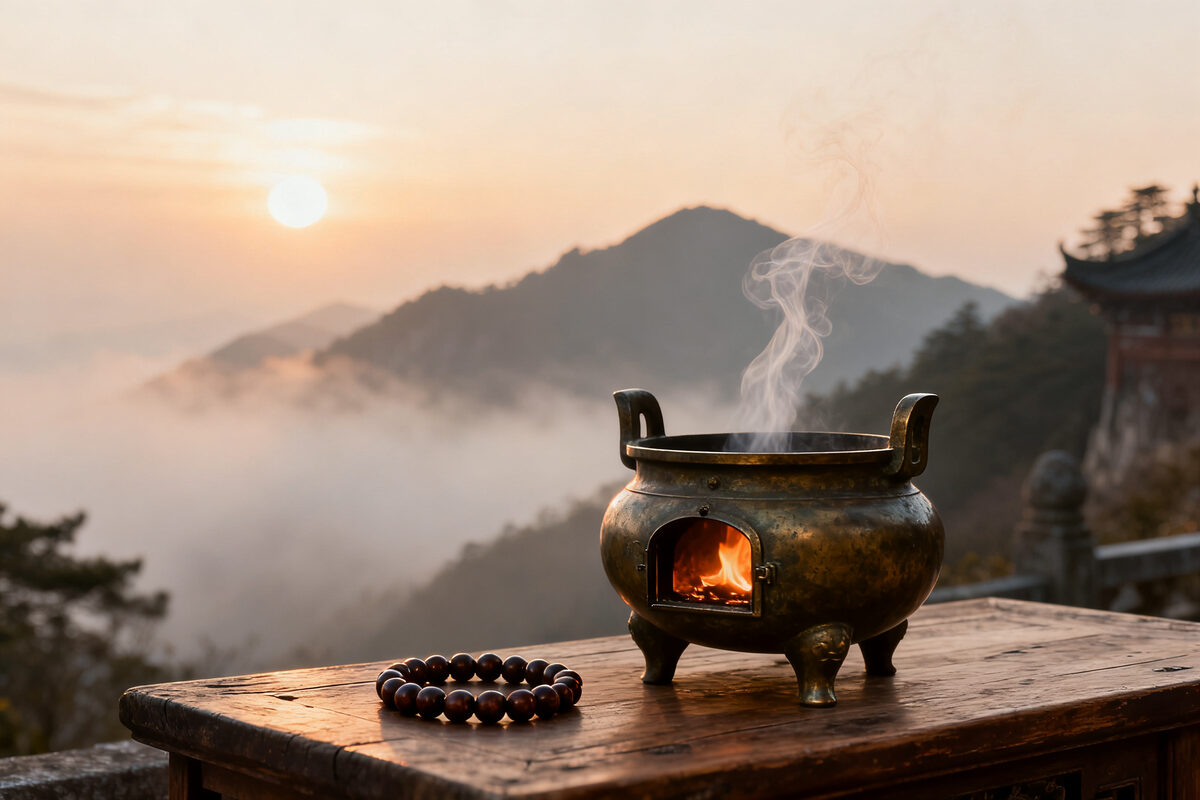
Daoism has a whole alchemical vocabulary. When outer alchemy turned inward, words like furnace and cauldron, and fire-timing, all moved into the body. Attention is the fire, breath is the bellows; there's gentle fire and strong fire, and the timing — off by a little, and the batch is ruined.
Sometimes I think this vocabulary is just saying something plain: any real transformation takes patience, and the right temperature. True in practice, true in life.
I know a Daoist priest at Mount Qingcheng. Over tea one year I asked him: after all these years of cultivation, what have you attained?
He didn't mention powers or stages. He said: my temper is a little better.
I laughed for a long time. And the more I think about it, the more it seems like the most honest answer cultivation can give. Two thousand years of scriptures, fire-timing described down to the finest detail — and when it finally lands on a living person, it comes down to four words: a better temper.
Not becoming someone else. Not immortality, not ascending in broad daylight. The same person, the same temper — just a smaller flame, less smoke, water boiling steady.
If that American friend ever asks me again whether cultivation is real, I think I'll say: the furnace is real, the fire is real, and so are the two thousand years. As for whether an elixir comes out — sit down first, and even out your breath. Come back in three months and tell me whether you sleep a little deeper, whether things catch you half a beat slower. That half beat is your elixir.
By the time I finish writing, the night is deep. I touch the beads on my wrist and suddenly think: across two thousand years, so many people kept watch over the furnace fire — and what they were really keeping watch over, in the end, wasn't an immortal. It was their own heart. Keep the fire small.
Three questions, for you, and for me:
- Is there something you do that started as "I want to be stronger" and quietly became "I want to need less"?
- If your anxiety were a pot of water on a stove, what's your flame right now — high or low?
- Your tools should connect to the ground under your feet. What was the first thing that ground ever taught you?