I Stuck Tiny Seeds on My Ears to Cure Anxiety. I Didn't Believe It Either.
A few days ago, I came across a video. A foreign girl looked into the camera and said, "Ear seeds changed my life." She had...
I Stuck Tiny Seeds on My Ears to Cure Anxiety. I Didn't Believe It Either.
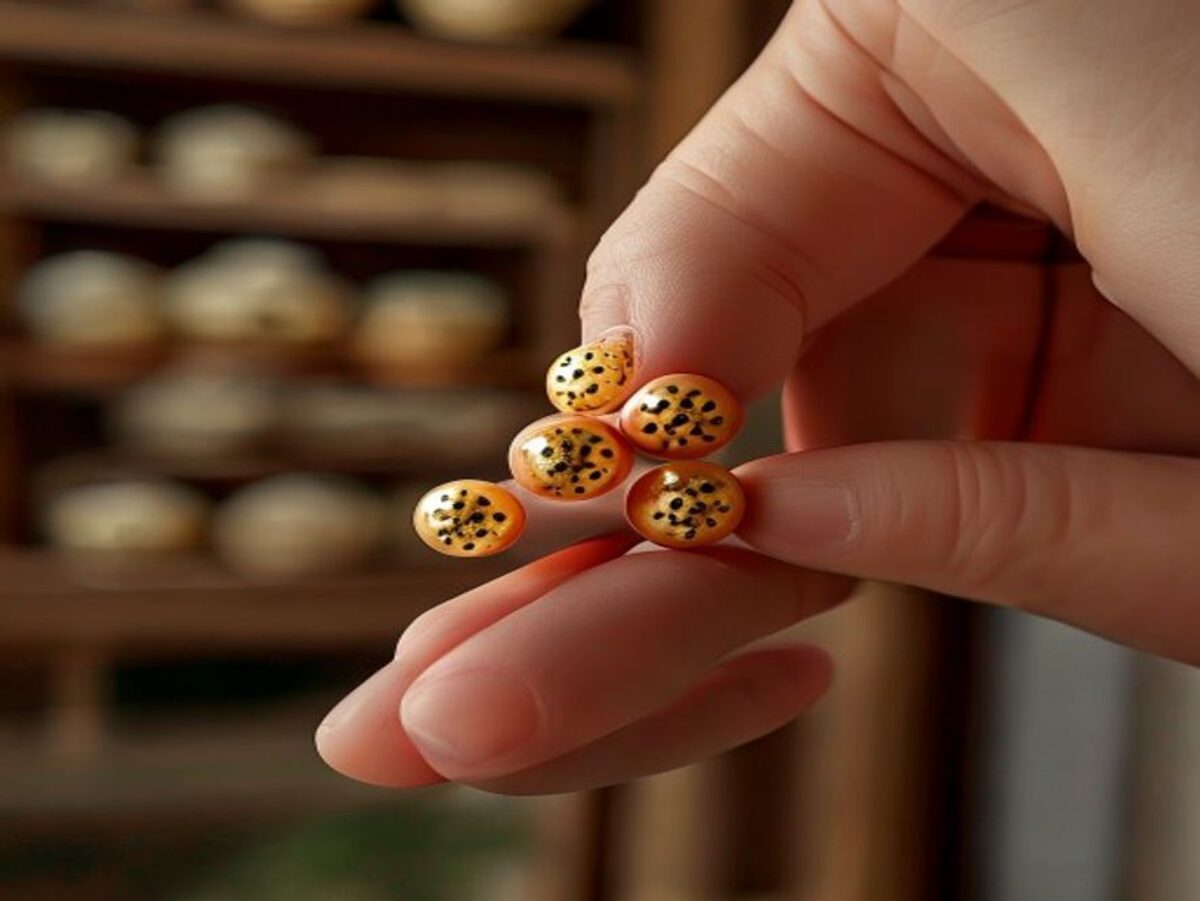
A few days ago, I came across a video. A foreign girl looked into the camera and said, "Ear seeds changed my life." She had small gold beads stuck on her ear, and she said that after three days, her anxiety decreased, her sleep improved, and even her period cramps got better.
The comments were full of people from all over. Someone said they felt "so zen" after using them. Someone else called it "witchcraft but it works." Others were seriously debating which spot to press for weight loss.
As I kept watching, something hit me. Ear seeds — wasn't that the thing I saw at the traditional medicine clinic when I was a kid? My mom took me to see an old doctor, and he used a metal probe to press around my ear, found some tender points, and stuck on these little black seeds called wang bu liu xing zi. He told me to press them three times a day. At the time, I thought it was the most embarrassing, old-fashioned thing in the world.
Now the whole world is chasing it.
There's a Map on Your Ear
In Chinese medicine, the ear is not just a hearing organ. It's a miniature map of the entire body — every organ, every body part has a corresponding "point" on the ear. This concept is called er xue — auricular points.
If you turn an ear upside down, it looks a bit like a curled-up fetus — head pointing down, bottom pointing up, spine curving along the outer ridge. The earlobe corresponds to the head and face. The concha corresponds to the organs in the chest — heart and lungs. The cymba conchae corresponds to the abdomen — stomach, intestines, kidneys. It's a complete micro-reflex system.
This sounds mystical, but it's not something Chinese medicine just made up. In 1957, a French doctor named Paul Nogier published a paper on a similar "ear map," claiming he'd discovered reflex zones on the ear shaped like an inverted fetus. His findings were partially adopted by the World Health Organization, and Western acupuncturists use this system today.
Who discovered it first — the French or the Chinese — has been debated for decades. I can't be bothered to investigate. All I know is: when my mom took me to get ear seeds, Nogier's paper hadn't even been translated into Chinese yet.
That Time I Got Ear Seeds
I was about eight or nine. I kept getting stomachaches. Not the kind that makes you double over — just a dull, recurring ache that was especially noticeable after meals. My mom took me to several hospitals. Ultrasound, blood tests — everything was normal. The doctor said it might be "intestinal spasms," common in kids, and I'd grow out of it.
My mom wasn't satisfied. She took me to a small community clinic. It was tiny — push open the door and you'd smell mugwort. The old doctor had completely white hair and spoke slowly. He had me sit on a stool and tilt my head. He took out a probe — really just a metal stick with a rounded tip — and slowly pressed along my ear.
"Does this hurt?" "No." "How about here?" " Nope." "Here?"
I hissed. Wow, that spot was incredibly tender. It was in the area of the cymba conchae — according to the fetal map, that corresponds to the digestive system.
The old doctor nodded and marked the spot. He found two more points — one was a little sore, one didn't feel like much. Then he took out small adhesive patches, each with a black seed in the center — later I learned they were wang bu liu xing zi — and stuck them on those three points.
"Press three times a day — morning, noon, evening. Three minutes each time, until it feels sore and warm. Come back in two weeks."
My mom paid about thirty yuan.
Honestly, I didn't believe it at all. But my mom watched me like a hawk, making sure I pressed three times a day. And each time, there was definitely a sensation — sore and swollen, sometimes a tingling that traveled down from the ear. After about a week, the stomachaches really did start to decrease. Two weeks later, I went back and the doctor adjusted the points. About a month after that, the stomachaches were basically gone.
Was it the ear seeds that healed me, or did I just grow out of it? I don't know. I really don't. But if I have to choose an explanation, I choose not to worry about it. It worked. That's enough.
Why Is the Ear So Special?
Growing up, I read bits and pieces here and there, and slowly came to understand how Chinese medicine views the ear.
The classic text Ling Shu says: "The ear is where all the meridians converge." That means the ear is a meeting point for all the body's energy pathways. Of the twelve main meridians, at least six pass through the ear directly or indirectly. So stimulating specific points on the ear can influence the corresponding organs through these meridians.
From a modern medical perspective, the ear has an incredibly rich nerve supply — the trigeminal nerve, facial nerve, glossopharyngeal nerve, and the vagus nerve all have branches reaching the outer ear. The vagus nerve in particular is one of the main highways connecting the brain to the internal organs. In recent years, quite a few studies have found that stimulating specific areas of the ear can regulate parasympathetic nervous system activity — which might explain why ear seeds seem to help with anxiety, insomnia, and other nervous-system-related symptoms.
In 2020, a paper published in Medical Acupuncture reported a randomized controlled trial showing that auricular acupressure significantly reduced anxiety scores. The sample size wasn't huge, so it's not iron-clad proof — but at least it's not pure placebo.
So those foreign girls saying they feel "so zen"? Maybe it's not all in their heads.
Can You Do It Yourself at Home?
Let me be clear about one thing: don't just buy ear seeds online and start sticking them randomly.
The locations of ear points are extremely precise. A difference of a few millimeters and you're on a different organ. You think you're pressing the "calming point," but you might be on the "stomach point." Nothing terrible will happen — the worst case is no effect at all — but you spent money and got nothing.
If you really want to try, there are two options:
First, go to a licensed acupuncturist or Chinese medicine practitioner and have them apply the seeds. This is the most reliable, because they'll use a probe to find your personal sensitive points — and note, everyone's ear points aren't in exactly the same spot. The textbook locations are averages; your points might be slightly off.
Second, if you can't get to a practitioner, you can buy ear point charts (lots available online) and follow along. But make sure to find an accurate one — ideally with a 3D diagram.
I started using ear seeds again recently because of insomnia. Not severe — just waking up around 3 or 4 a.m. every night, and once I'm awake, my brain kicks into gear. Work stuff, future anxiety, the meaning of life — the more I think, the more awake I get, and then it's dawn.
I went to a Chinese medicine clinic. The doctor found a point called Shenmen — "Spirit Gate." It's located in the upper part of the concha, at the outer edge of the triangular fossa. In Chinese medicine, Shenmen is the key point for calming the spirit — it can soothe, relieve pain, and ease anxiety.
The doctor also found two supporting points — one on the earlobe (corresponding to the head, to relieve mental tension) and one in the cymba conchae (corresponding to the liver, because I have "liver fire rising").
This time, the seeds were magnetic beads — a step up from the wang bu liu xing zi of my childhood. A tiny metal ball on medical tape. Press three times a day, and press a bit longer before bed.
Three Weeks Later
Honestly, the first week — nothing. I pressed dutifully, still woke up at 3 a.m.
The second week, a small shift. I still woke up around 3 or 4, but the agitation was less. Before, the moment I opened my eyes, my brain would boot up like a computer. Now, there'd be this brief blank space — a few minutes of fuzziness where sometimes I could drift back to sleep.
The third week, one night I slept straight through to 6 a.m. I hadn't woken once. When I opened my eyes, it was already light outside. I lay there for a moment, stunned, with this unfamiliar feeling of being completely recharged.
Of course, I still wake up sometimes. But the frequency is definitely lower. And that thing where my brain instantly switches on and won't stop spinning? That's much less common now.
The doctor said it's related to how ear seed stimulation regulates the parasympathetic nervous system — shifting your body from "fight or flight" mode to "rest and digest" mode. I don't fully understand the mechanism, but the first time I heard the phrase "rest and digest," I thought: isn't this what Chinese medicine has been calling "yin-yang balance" for thousands of years?
A Few Common Misconceptions
Since ear seeds have gone viral abroad, there's a lot of mixed information. Let me share what I think matters:
First, ear seeds are not a cure-all. They're a complementary therapy, not a replacement for treatment. Anxiety disorders, severe insomnia, chronic pain — see a doctor. Ear seeds can help, but they can't do everything.
Second, more is not better. Usually 3 to 5 points at a time is enough. Covering the whole ear just creates interference. It's like medicine — ten pills aren't ten times better than one.
Third, don't apply ear seeds if your ear is inflamed, broken, or has frostbite. If you're allergic to adhesive, be careful — choose hypoallergenic tape or reduce the wearing time.
Fourth, pregnant women should not self-apply ear seeds. Some ear points can stimulate uterine contractions and must only be handled by a qualified practitioner.
In Closing
Right now, there are three tiny magnetic beads on my ear. I press them morning, noon, and night. It's become a habit. Sometimes when I'm out and it's inconvenient, I sneak into the bathroom and press them quickly.
Do you believe in it? I'm still not sure how to answer.
I don't believe the mystical claims — "press this point to change your luck," "cure ten years of insomnia in three days." Those sound exactly like the exaggerated titles on those foreign videos.
But I do believe one thing: the human body is more intricate than you imagine. Those few square centimeters of skin on your ear connect to the nervous system of your entire body. Something discovered by Chinese people thousands of years ago is only now being slowly understood by the rest of the world.
Sometimes I think about how funny it is — when I was a kid, I was mortified by ear seeds. Now foreigners can't get enough of them. The world goes round, and somehow it comes back.
Either way, if you can't sleep tonight, maybe look into your ears. Not to be superstitious about anything — just in case it helps.
Three questions for you:
1. Have you ever pressed a spot on your ear and felt a response somewhere else in your body?
2. In your view, are acupuncture points a real physical structure, or an empirical treatment method that happens to work?
3. If Western science eventually proves how ear seeds work, would you see it as proof of Chinese medicine's brilliance — or just science eventually explaining everything?