Why I Pour Out the First Cup of Tea: A Friend Thought I Was Wasting Money
My friend watched me pour tea and dump the first steep. He looked horrified. Then an old man in a signless tea house in Chaozhou said one sentence that changed everything.
 1|My friend watched me pour tea for the first time, and when I dumped out the first steep, his whole face froze.
 2|
 3|"Why are you throwing it away?" He looked at me like I'd just tossed money into a trash can.
 4|
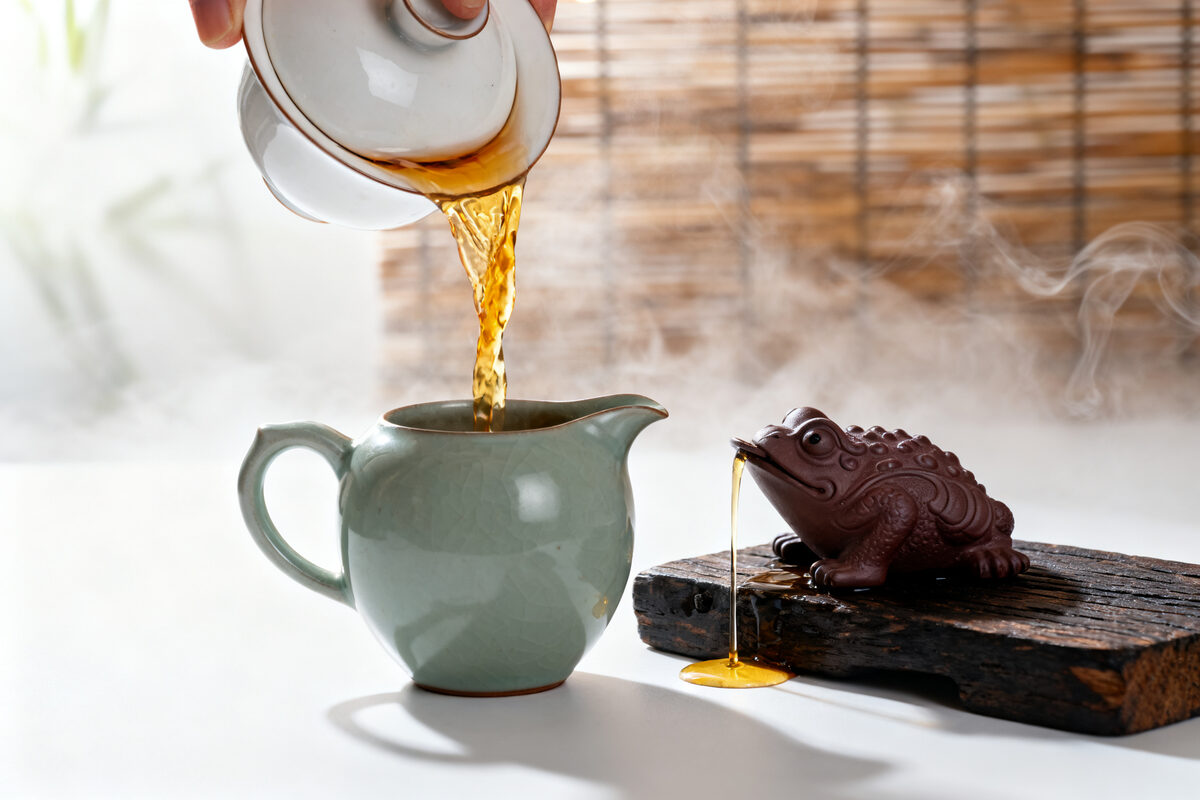
 5|I was scooping tea leaves into a gaiwan — Phoenix Dancong, a gift from another friend, the Duck Shit aroma variety. The water had just boiled. I lifted the kettle and poured slowly along the inner wall of the gaiwan. The leaves tumbled once, and a wave of fragrance hit me like a wall. Then I tilted the gaiwan slightly, letting the tea pour into the fairness pitcher — but I didn't drink it. I poured it straight onto the little golden toad perched on my tea tray.
 6|
 7|I still remember my friend's expression. That "are you doing some kind of ritual" look.
 8|
 9|I smiled. Not mocking him. Because the first time I saw someone pour out the first steep, I had the exact same face.
10|
11|## "It's Not Waste"
12|
13|Later I realized — that's actually a great question.
14|
15|Why pour out the first steep? There are plenty of explanations online, all very logical: it's called the "warming rinse," or "awakening the tea." The idea is to let the leaves unfurl, wash off surface dust, and help subsequent steeps come out more evenly. Some more poetic accounts talk about "waking the tea from sleep," like greeting it, letting it know it's time.
16|
17|All true. But I always felt something was missing.
18|
19|What really made me understand wasn't a tea book, or a teacher's lecture. It was an ordinary experience.
20|
21|One winter, I was traveling in Chaozhou. A friend took me to an old tea house — small, tucked deep in an alley. No sign out front, just a hand-painted wooden board that read "Drink Tea." The owner was a quiet man in his sixties. He nodded when we walked in, then started heating water.
22|
23|I sat and watched him brew. His hands moved so slowly, like a film playing at half speed. He picked up a pinch of leaves, placed them in the gaiwan, poured water, waited — maybe five seconds — then poured it out. The motion was unhurried, as natural as breathing. I asked him: "Why do you pour out the first steep?"
24|
25|He didn't answer right away. Instead, he brewed a second round, poured the tea into the small cup in front of me, and said:
26|
27|"Smell the cup."
28|
29|I picked it up and inhaled. The fragrance was gentle. Not sharp. Like the tea was speaking softly.
30|
31|"That first steep," he said, gesturing toward the tea pet still glistening with golden tea, "the aroma is too aggressive. Like someone who just woke up in a bad mood. You pour it out not because it's bad — but because it's not ready yet."
32|
33|I didn't think much of it at the time. But the more I sat with it, the more it meant.
34|
35|## What Does "Not Ready" Mean?
36|
37|I brewed a lot of tea after that, and slowly I understood what the old man meant.
38|
39|The first steep isn't bad. In fact, it's often the most intense. Dried tea leaves have been storing concentrated aromatic compounds for months. The moment hot water hits them, everything releases at once. The taste — how do I describe it — it's like a person who's been holding something in for too long and suddenly starts talking. Everything comes out fast and loud.
40|
41|But good tea isn't like that. Good tea takes time.
42|
43|From the second steep on, the leaves slowly unfurl, returning to the shape they had when they were alive. That's right — every leaf you brew was once a living leaf on a hillside somewhere. It soaked in sunlight, got rained on, was picked and rolled and roasted by human hands. When you wake it with hot water, it needs a moment to go from "dried and dormant" back to "alive."
44|
45|That process is the awakening.
46|
47|The first steep is the wake-up call. It's not the finished product. It's the transition.
48|
49|I started wondering — what does this have to do with how we live?
50|
51|## Some Things Can't Be Rushed
52|
53|We live in an age where everything is fast. Fast information, fast relationships, fast meals, even meditation comes with an app and a timer. You open a video, and if it doesn't grab you in three seconds, you scroll past. You send a message, and if there's no reply in two minutes, the anxiety sets in.
54|
55|Brewing tea — gongfu tea — has one fundamental rhythm: **slow**.
56|
57|Not artificially slow. Not for ceremony. Slow because it genuinely needs to be.
58|
59|The water has to come to a rolling boil, then cool slightly. Too hot and you'll scorch the tender buds. When you pour, you don't aim directly at the leaves — you let the water run along the inside wall of the gaiwan, letting it rise gently from the bottom, cradling the leaves. And the waiting time changes with each steep — the first might need only three to five seconds, while later steeps get progressively longer, because the leaves have opened up and can release slowly.
60|
61|You can't rush it. Rush, and the water's too hot — the tea turns bitter. Rush, and you pour too late — the tea turns astringent.
62|
63|I think about this sometimes. The good decisions in my life — they never came out of anxiety. The ones I regret were almost always too fast. I didn't wait. I didn't give myself the grace of a "first steep."
64|
65|Pouring out the first steep is really saying: **Wait. Let it get ready. Let yourself get ready, too.**
66|
67|## The Gesture I Almost Missed
68|
69|I noticed a detail later.
70|
71|When the old man in Chaozhou poured out the first steep, he poured it over the tea pet. Not into the drain, not carelessly — over the tea pet.
72|
73|Tea pets are those tiny clay figures on a tea tray — a toad, an elephant, a lotus, a laughing Buddha. They're made of unglazed clay or zisha, rough and porous on the surface. Every time you brew, you pour the first steep over them. Over weeks and months, the clay slowly absorbs the tea, and the surface becomes smooth, lustrous, almost alive.
74|
75|This is called "nourishing a tea pet."
76|
77|When I first learned this, it fascinated me. The tea you don't drink isn't wasted — it goes onto the tea pet, day by day, transforming a dull gray lump of clay into a glossy, warm little toad.
78|
79|Time changes things. Some changes simply can't be rushed.
80|
81|My friend eventually bought a tea pet of his own — a little pig. Every morning, he'd pour the first steep over it. Three months later he sent me a photo. The pig had gone from chalky white to a warm amber brown, with a natural sheen. He said, "I think it's slowly getting prettier."
82|
83|I said, "It's you who's changed. Three months of brewing tea — your hands are steadier, and so is your mind."
84|
85|He laughed.
86|
87|## The Tea Isn't in the Cup
88|
89|There's a Zen story I read once. It didn't land at the time, but after years of brewing tea, it came back to me.
90|
91|A monk asked Zhaozhou: "What is the Way?"
92|
93|Zhaozhou said: "The one outside the wall."
94|
95|The monk said: "I'm not asking about that kind of way."
96|
97|Zhaozhou said: "Then which way are you asking about?"
98|
99|The monk said: "The Great Way."
100| 101|Zhaozhou said: "The Great Way leads to Chang'an." 102| 103|People interpret this koan in all sorts of ways — "the Way is in the everyday," "don't seek outside yourself." All fair, but I don't want to make it too mystical. 104| 105|My understanding is simple: If you want to go to Chang'an, start walking. The road is already there. Just go. 106| 107|Brewing tea is the same. If you want a good cup of tea, just brew it. Get the temperature right, get the timing right, and the leaves will tell you their flavor. You don't need to overthink the "why" or study the "most correct method." Brew it a hundred times, and your hands will know. Your heart will know. 108| 109|That old man in Chaozhou never took a tea course. He'd just been brewing for decades. 110| 111|And then it hit me — pouring out the first steep might also mean this: Some first impressions aren't meant to be acted on. 112| 113|The first time we encounter something — a person, a situation — our reaction is often raw, instinctive. Like the first steep: intense and overwhelming. But if we wait, let things unfold, let our impressions settle, the second and third rounds reveal something entirely different. 114| 115|Not everything needs an instant response. Some things are worth waiting for the second steep. 116| 117|## That Poured-Away Tea 118| 119|One evening, I was brewing tea alone at home. Rain against the window. I placed leaves in the gaiwan, poured water, then tipped out the first steep over the tea pet. 120| 121|I watched golden tea run down the toad's back, gather on the tray, and slowly drift away. 122| 123|And suddenly, it was very quiet. 124| 125|Not because of the rain. Because I had done a small thing — pouring out the first steep — that required no thought, no speed, no obligation. 126| 127|I was just brewing tea. 128| 129|And in the second steep, I tasted what those leaves had been trying to say all along. 130| 131|--- 132| 133|A few questions for you: 134| 135|1. What "first steep" in your life do you keep gulping down in a hurry? 136|2. What might happen if you gave yourself ten more seconds of patience? 137|3. Is there anything on your desk — or in your life — that you've been slowly nourishing into something beautiful?