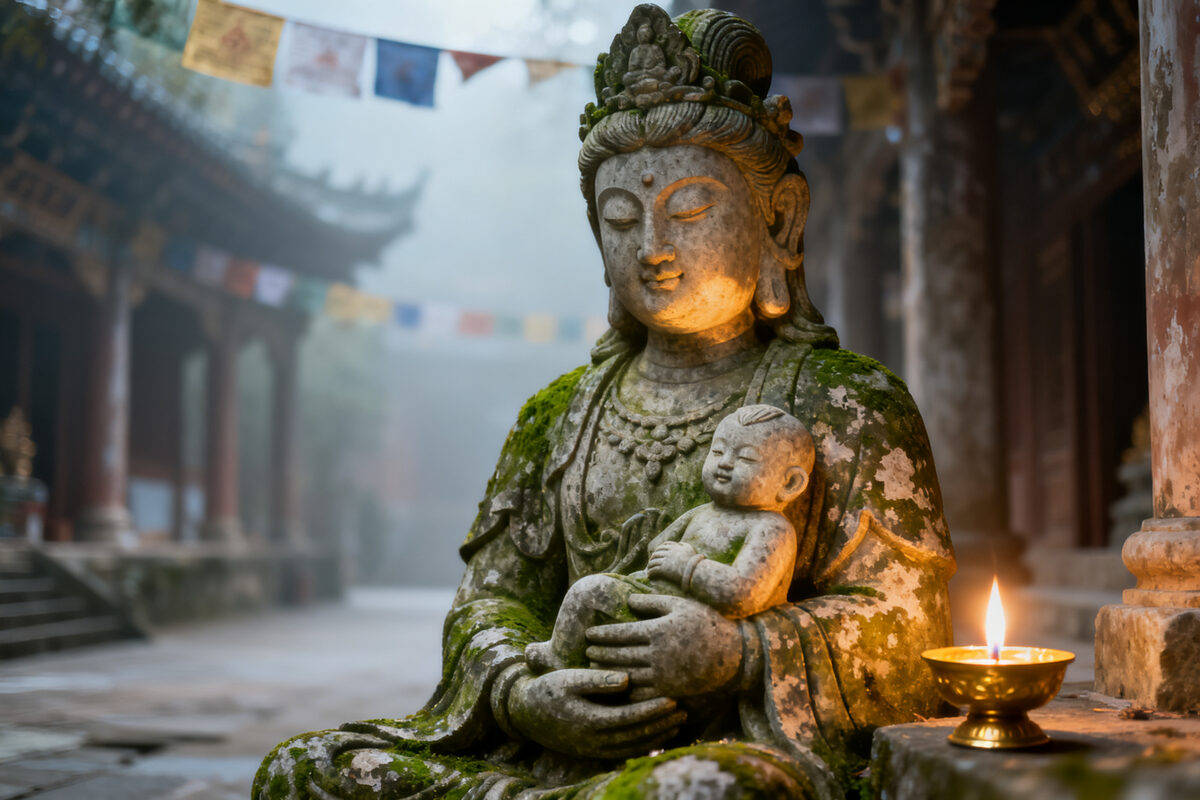
Who is Guanyin: From Indian Prince to Chinese Goddess of Mercy
Guanyin was originally depicted as male in India. Over centuries, the bodhisattva transformed into China's beloved Goddess of Mercy. This article traces this cultural legend and explores the modern relevance of Guanyin devotion.

Who is Guanyin: From Indian Prince to Chinese Goddess of Mercy
In China, almost everyone knows Guanyin (观音). Whether you are Buddhist or not, you may have a Guanyin statue in your home. The name "Greatly Compassionate Guanshiyin Bodhisattva Who Saves from Suffering and Responds to All Prayers" is known to virtually every Chinese person.
But what you may not know is this: Guanyin was originally depicted as male. How did this Indian prince transform into the motherly Chinese bodhisattva? Behind this lies a cultural legend spanning over a thousand years.
The Origin: India's Avalokiteśvara
Guanyin's Sanskrit name is Avalokiteśvara, meaning "The Lord Who Looks Down" or "Perceiver of the World's Sounds" — observing the cries of the world and responding to suffering.
In Indian Buddhism, Guanyin was originally male. Early Buddhist art depicts Guanyin as a handsome prince with a small moustache, adorned with elaborate jewelry. In the murals of Dunhuang's Mogao Caves, you can still see Guanyin with a characteristic moustache.
Guanyin's original image comes from Buddhist scriptures, particularly the Lotus Sutra's Universal Gate chapter and the Infinite Life Sutra. In these texts, Guanyin is the embodiment of compassion in Mahayana Buddhism, serving as the right-hand attendant of Amitabha Buddha.
Why Did Guanyin Become Female?
The transformation from male to female was a gradual process spanning centuries. Several key factors drove this change:
1. Compassion and Motherhood
In Buddhism, Guanyin represents great compassion (Mahakaruna). The most intuitive expression of compassion in human experience is a mother's love for her child. Feminizing Guanyin made the abstract concept of compassion concrete and approachable.
2. The Legend of Princess Miaoshan
Chinese folklore tells a beautiful story:
Once there was a King Miaozhuang with three daughters. The youngest, Miaoshan, was devoutly Buddhist from childhood. She refused marriage and insisted on becoming a nun.
The king was furious. He burned down the temple and forced Miaoshan to return to secular life. She was blinded and her hands were cut off, but her devotion moved heaven and earth. She eventually attained enlightenment at Baique Temple.
Later, King Miaozhuang fell gravely ill. The cure required the hands and eyes of his own flesh and blood. The two older sisters refused, but Miaoshan willingly sacrificed her hands and eyes to save her father. The king repented, and Miaoshan transformed into the Thousand-Armed, Thousand-Eyed Guanyin.
Though not from Buddhist scripture, this legend deeply resonated with Chinese culture, perfectly merging Guanyin with the Chinese value of filial piety.
3. Cultural Transformation in Tang and Song Dynasties
The feminization of Guanyin began around the Northern and Southern Dynasties and was largely complete by the Tang and Song periods. Key factors included:
- The Fish-Basket Guanyin legend: A Tang dynasty beauty who chose a husband through a fish basket, later revealed as Guanyin in disguise
- White-Robed Guanyin devotion: The female Guanyin in white robes became increasingly popular
- Child-Giving Guanyin: Meeting Chinese families' desire for children, Guanyin acquired a "child-bestowing" function
4. The Inevitable Result of Buddhism's Sinicization
As Buddhism entered China, it underwent a process of cultural adaptation. Guanyin's feminization is a prime example of Buddhism's deep integration with Chinese culture:
- Chinese culture values maternal love and compassion
- Chinese people needed a warm, approachable savior
- A female Guanyin better suited Chinese emotional needs
The Thirty-Three Manifestations
The Lotus Sutra states that Guanyin can appear in thirty-three different forms to save different beings:
"To those who should be saved in a particular form, Guanyin appears in that form to teach the Dharma."
This means Guanyin can appear as:
- Buddha, pratyekabuddha, or sravaka — for practitioners
- Brahma or Indra — for celestial beings
- Layperson or official — for ordinary citizens
- Monk or nun — for renunciants
- Woman, boy, or girl — for common folk
- Even as yaksas or spirits — for beings in lower realms
The core message: Guanyin is everywhere, always appearing in the most appropriate form for you.
Guanyin and the Heart Sutra
Guanyin has a direct connection to one of Buddhism's most important texts — the Heart Sutra. It opens with:
"When Avalokiteśvara Bodhisattva was practicing the profound Prajna Paramita, he illuminated the five skandhas and saw that they are all empty, thereby crossing over all suffering."
Here, "Avalokiteśvara Bodhisattva" is Guanyin. In this sutra of only 260 characters, Guanyin is the protagonist who, through deep wisdom (prajna), sees the emptiness of all phenomena and transcends all suffering.
This shows that Guanyin is not merely a symbol of compassion but also a representative of wisdom — compassion and wisdom are the two wings of Buddhist practice.
Why Does the Modern World Need Guanyin?
In the 21st century, Guanyin devotion has not declined. If anything, modern anxiety and stress have made it more relevant:
1. Unconditional Love
In an increasingly transactional world, Guanyin represents unconditional compassion — no matter what you have done, if you sincerely call out, Guanyin responds. For many, this is immense psychological comfort.
2. A Listener
"Guanshiyin" — perceiver of the world's sounds. In an age where no one truly listens to you, having a being who always listens is itself healing.
3. Inner Strength
Psychology tells us that personifying compassionate qualities aids inner peace. Guanyin is not an external savior but a projection of your own compassionate nature. When you call upon Guanyin, you awaken the compassion and wisdom within yourself.
How to Connect with Guanyin
Buddhism doesn't demand blind faith but emphasizes heart-to-heart connection:
- Recite the name: Sincerely chant "Namo Guanshiyin Bodhisattva" — not mechanically, but with gratitude and trust
- Learn compassion: Guanyin's compassion is not just about receiving but giving — practice compassion in your own life
- Cultivate awareness: Like Guanyin, "observe" — observe your inner world, observe the world's suffering
- Emulate Guanyin: Become someone else's "Guanyin" — listen and help others within your capacity
Conclusion
From Indian prince to Chinese mother of mercy, the evolution of Guanyin's image is a beautiful story of civilizations and faiths merging. But regardless of how the image has changed, the core has never wavered:
Unconditionally listening, unconditionally compassionate, unconditionally saving.
In this uncertain world, perhaps we all need a "Guanyin" — or better yet, become one for others.
"A thousand prayers answered in a thousand places, a ferry across the ocean of suffering for all beings." — Guanyin's great vow is the warmest refuge for all sentient beings.