Ordinary Mind Is the Way: Nanquan Puyuan's Everyday Zen
Someone asked Nanquan Puyuan: What is the Way? Nanquan said: Ordinary mind is the Way. The person pressed: Can I aim for it? Nanquan replied: Once you aim, you've already strayed.
Ordinary Mind Is the Way: Nanquan Puyuan's Everyday Zen
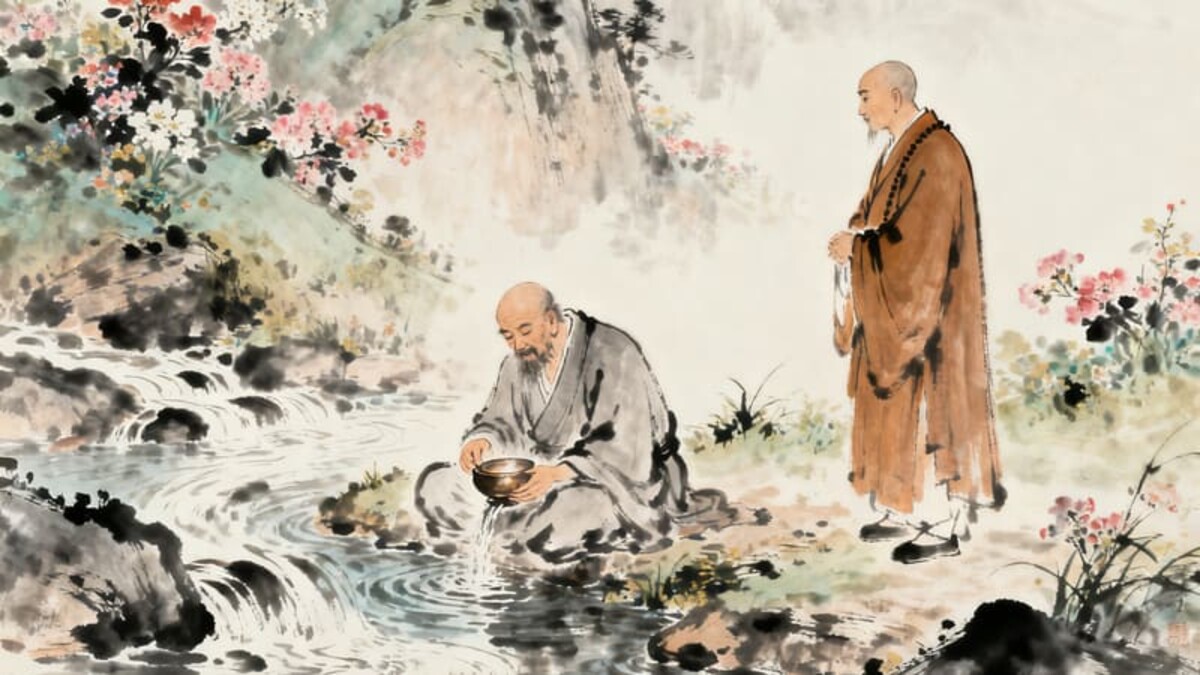
When Zhaozhou Congshen (yes, the same Zhaozhou of "Have some tea") was young, he asked his teacher Nanquan Puyuan.
Zhaozhou asked: What is the Way?
Nanquan said: Ordinary mind is the Way.
Zhaozhou asked: Can I aim toward it?
Nanquan said: Once you think of aiming, you've already strayed.
Zhaozhou was confused: If I don't aim, how will I know the Way?
Nanquan said: The Way does not belong to "knowing" or "not knowing."
Knowing is delusion. Not knowing is blankness.
If you truly penetrate the Way of no-doubt, it's like vast space—
Wide open and clear. Where can you divide "right" and "wrong"?
At these words, Zhaozhou awakened.
What Is "Ordinary Mind"?
Not "ordinary" as in "average." Not "ordinary" as in "mediocre." Not "ordinary" as in "feeling nothing."
Ordinary mind is "the mind that is exactly as it is."
Hungry? Eat. Tired? Sleep. Happy? Laugh. Sad? Cry.
No extra commentary. No artificial polish. No over-interpretation.
What is, is.
Why Does "Aiming" Make You Stray?
Have you ever experienced this—
The more you try to sleep, the more you can't. The more you try to relax, the more tense you get. The more you try to be natural, the more unnatural you become.
Because "trying" itself is the obstacle.
You think "I want ordinary mind"—that's already not ordinary. You think "I want to be natural"—that's already not natural.
The Way is not a goal you need to reach.
The Way is this very breath you're taking right now.
So Do I Still Need to Practice?
Yes. But practice is not "aiming."
Practice is "seeing."
Seeing that you're aiming. Seeing that you're clinging. Seeing that you're not present.
The moment you see, you return.
It's not "I shouldn't aim," but—
"Oh, I'm aiming."
Seeing, you let go. Letting go, you're ordinary. Being ordinary, you are the Way.
The Traps of "Knowing" and "Not Knowing"
Nanquan said: "Knowing is delusion. Not knowing is blankness."
What does this mean?
The Trap of "Knowing"
You think you "know" the Way.
You've read sutras, heard teachings, and feel you understand.
But that "understanding" is the mind's understanding.
The true Way is not a concept.
Like you can read about "the taste of an apple" ten thousand times, but without taking a bite, you'll never know.
The Trap of "Not Knowing"
You think "not knowing" is the answer.
So you stop thinking, stop doing anything, becoming like a log.
This is called "blankness"—empty, numb, unconscious.
The true Way is not blankness.
It's crystal clear, fully aware.
Not clinging to "knowing," not escaping into "not knowing."
The Metaphor of Vast Space
Nanquan said: "Like vast space, wide open and clear."
What are the characteristics of space?
- It doesn't reject anything—clouds can pass, birds can fly
- It doesn't grab anything—clouds leave no trace, birds leave no mark
- It doesn't judge—not saying this is good or bad, high or low
Your mind should be like this.
Thoughts come—let them come. Thoughts go—let them go.
No chasing, no resisting, no holding, no judging.
This is ordinary mind.
Why Did Zhaozhou Awaken?
Because Nanquan broke through Zhaozhou's "aiming."
Zhaozhou asked "What is the Way"—he was looking. Nanquan said "Ordinary mind"—the Way is right here.
Zhaozhou asked "Can I aim?"—he still wanted to "do" something. Nanquan said "Once you aim, you stray"—nothing to do.
Zhaozhou asked "How will I know if I don't aim?"—he was stuck on "knowing." Nanquan said "The Way doesn't belong to knowing or not knowing"—breaking his concept.
Layer by layer peeled away, until no concept, no aiming, no clinging.
In that moment, Zhaozhou saw—
The Way was always here.
Eating is the Way. Walking is the Way. Sleeping is the Way. Asking questions is the Way.
No need to find it. It's right now.
What This Means for Modern People
You're Always "Wanting to Be Better"
You want to be calmer. You want to be wiser. You want to be healthier.
These "wants" themselves are suffering.
Not that you can't pursue improvement. But—
When you pursue, know you're pursuing.
Don't make "pursuing" into "should."
You're Always "Waiting"
When I have money, then it'll be okay. When I have time, then I'll start. When I'm ready, then I'll do.
But "now" has been waiting for you all along.
You don't need to be ready. You don't need to be better. You don't need any conditions.
This breath right now is the Way.
You're Always "Judging"
This is good, that is bad. This is right, that is wrong. This is high, that is low.
Judgment makes the mind uneasy.
Clouds have no good or bad. Wind has no right or wrong. Space has no high or low.
Ordinary mind is non-judging mind.
In One Breath
Ordinary mind is the Way.
Once you aim, you stray.
Not aiming doesn't mean doing nothing.
It just means—
Seeing what is, as it is.
Acknowledging whatever state you're in.
Neither adding nor subtracting, neither welcoming nor resisting.
Reflections
- Right now, is your mind "ordinary"? If not, what makes it uneasy?
- What are you pursuing right now? Does that pursuit bring you closer or push you further away?
- If you stopped pursuing today, what would change in your life?
May you find the Way in the ordinary, and see the ordinary in the Way.
May you not pursue ordinariness, and let ordinariness come naturally.