The Flower and the Smile: A Moment When Nobody Spoke
The Buddha picked up a flower at Vulture Peak and said nothing. Mahākāśyapa smiled. A moment of silence from 2,500 years ago became the origin of Zen. What really happened? Maybe no lesson at all — just someone truly seeing a flower.
The Flower and the Smile: A Moment When Nobody Spoke
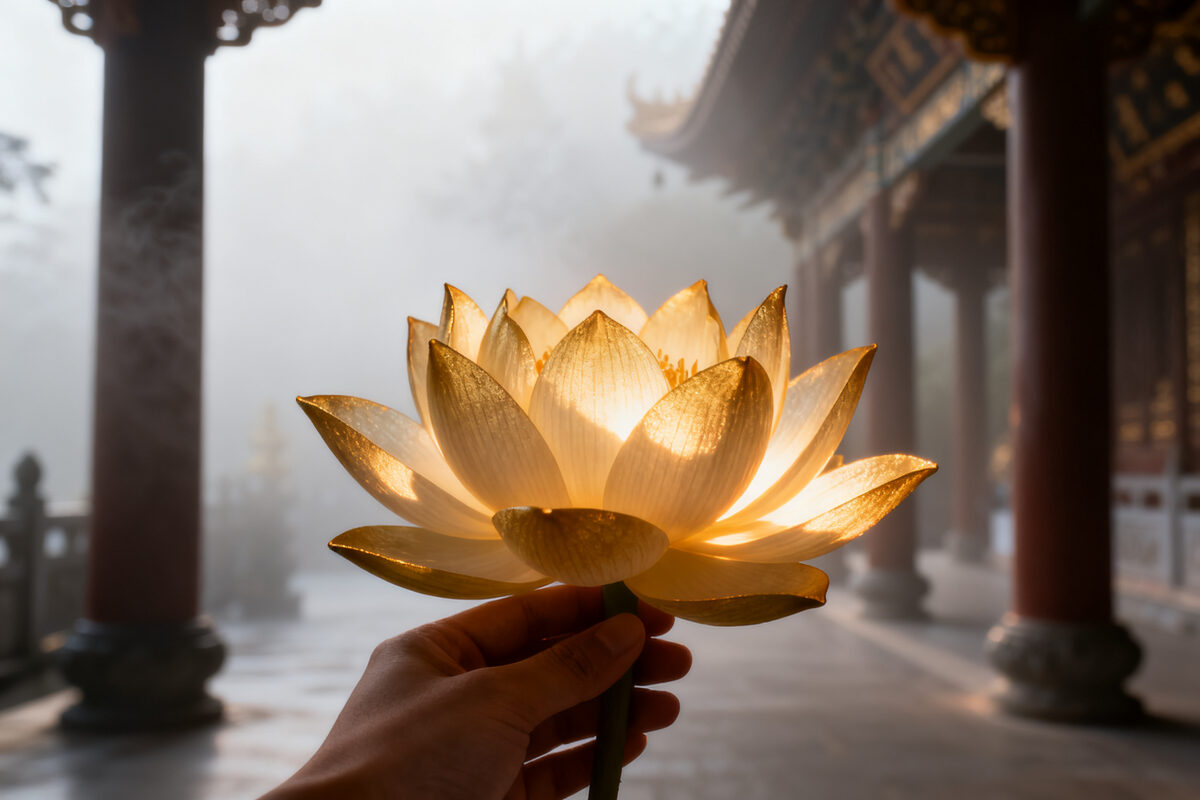
Today, while arranging flowers at the shrine, I held a white lotus and thought of this story.
It wasn't sudden, really. Every time I hold a flower, it comes to mind. But today the thought lingered a bit longer, and I decided to sit down and write about it.
The Assembly on Vulture Peak
The story goes like this.
One day, the Buddha was giving a teaching at Vulture Peak. Many people had gathered — disciples, lay followers, practitioners of all kinds — sitting in rows, waiting. They were waiting for the Buddha to speak, waiting to hear some profound truth.
The Buddha took his seat and looked at everyone.
Then he said nothing.
He picked up a flower.
Just held it up, turning it slightly.
Nobody knew what was happening. Some waited, some looked confused. Someone probably thought the Buddha was having an off day.
Only one person in the crowd — Mahākāśyapa — smiled.
Not a big laugh. Not the kind of "I get it" smile that comes from solving a puzzle. Just a smile. The kind that happens when you look at an old friend and neither of you says anything, and you both smile at the same time. That kind.
The Buddha saw him smile and said:
"I have the True Dharma Eye, the wondrous mind of nirvāṇa, the formless true reality, the subtle gateway of the Dharma. It does not rest on written words. It is transmitted outside the scriptures. I now entrust it to Mahākāśyapa."
Roughly translated: I have something that can't be spoken, can't be written down, doesn't belong to any language or text. And now I'm handing it to you.
That was the beginning of Zen. Not a sutra, not a theory. A flower and a smile.
I Thought for a Long Time About What That Smile Meant
Honestly, the first time I read this story, I didn't feel much. I thought — okay, a mystical story. Zen people like this sort of thing.
Later, one summer, I was volunteering at a temple. In the evening, the old master was watering plants in the courtyard, and I was helping. Halfway through, he suddenly stopped and looked at the horizon — the sun was setting, and the sky had turned the whole courtyard orange.
I stopped and looked too.
He didn't say anything. I didn't either.
After a while, he said, "Alright, let's keep watering."
That night, back in my room, I understood something about that smile. Not a concept or a lesson — I understood a kind of thing. There are moments when words are unnecessary. Not inadequate. Unnecessary.
A sunset doesn't need an explanation. You saw it. That's enough.
What "Not Relying on Words" Actually Means
"Not relying on words" — this phrase comes up again and again in Zen. For a long time, I thought it was anti-intellectual. That Zen was about not reading, not studying, just sitting around waiting for enlightenment.
Later I realized I had it backwards.
"Not relying on words" doesn't mean rejecting words or opposing study. It means — words are the finger pointing at the moon. Don't confuse the finger for the moon.
The Buddha taught for forty-nine years. He spoke plenty. He gave countless sutras, explained countless doctrines. But in the end, when he picked up that flower, he was saying: everything I've said is not as good as what you can see for yourself.
Scriptures are maps, not destinations.
There was a period when I was really fixated on reading sutras. I'd set daily page targets, take notes, highlight passages. The more I read, the better — or so I thought. Then one day I came across a line in the Diamond Sutra: "Even the Dharma must be relinquished, let alone what is not Dharma." I froze.
Once you've crossed the river, you put down the raft. Carrying it ashore isn't practice. It's attachment.
Kāśyapa's Smile Wasn't "I Understand"
I've come to think that Kāśyapa's smile wasn't "Ah, I get it."
If it were, then he wasn't different from the confused people around him — he just happened to grasp one more meaning than the others. In that case, the Buddha should have praised his intelligence, not "entrusted" him with something.
That smile was more like a response.
Like when you give a friend a gift. You don't need to explain what it means. Your friend opens it, looks at you, and smiles. That smile contains everything — gratitude, understanding, warmth, and "you don't need to explain. I know."
When the Buddha held up the flower, he wasn't giving a test. He was sharing something. A flower. Here. Now. Can you all see it?
Kāśyapa saw it. And he smiled.
Not because he was smarter than everyone else. But because in that moment, he happened to let go of all his "waiting" and "expecting," and simply saw what was in front of him.
We Have These Moments Too
I've noticed that these moments happen more often than we think.
Drinking tea, watching steam rise, staring at it for a while without thinking anything. That's one of those moments.
Walking, noticing a tree swaying in the wind, stopping to look. That's one too.
Sitting with a friend in silence, not feeling awkward at all. That's even more of one.
We're so used to "understanding," "gaining something," "learning a lesson." So when nothing happens, we feel empty. We feel like we've wasted time.
But maybe those moments when nothing seems to happen — those are the moments when something actually did.
The Buddha With the Flower Was Saying Something Very Simple
I've thought about this for a long time, and I think the core of this story isn't some profound Zen theory.
When the Buddha picked up the flower, he was just saying: Look.
Just look.
No need to analyze the flower's species, its symbolic meaning, its connection to Buddhism. No need to wonder if the Buddha was hinting at something.
It's just a flower.
You saw it.
Kāśyapa saw it. That's why he smiled.
I'm Still Learning to See
Writing this, I feel a bit embarrassed. Because honestly, most of the time, I'm still the person at the assembly waiting for the Buddha to speak. When I hold flowers, I'm thinking about whether they're arranged correctly. When I chant sutras, I'm thinking about whether I'll finish the assigned pages.
Truly "seeing" requires a quiet mind. Not the kind of quiet where there are no thoughts — I can't do that — but the kind where thoughts come and go, and you don't chase them or push them away.
This is hard.
But sometimes, once in a while, I manage.
Once during meditation, it was raining outside. I heard the rain hitting the eaves, and suddenly the sound was so clear — clearer than it had ever been. Then a thought popped up: "I'm listening to the rain." And just like that, the clarity was gone, replaced by the concept "I'm listening to the rain."
That experience taught me something: true awareness doesn't carry judgment. The moment you start thinking "I am being aware," awareness has already become a concept.
Like Kāśyapa's smile — if in that moment he had thought, "Ah, I understand the Buddha's meaning," he probably wouldn't have been able to smile at all.
Is the Flower Still There?
Sometimes I wonder something silly: What happened to that flower the Buddha held on Vulture Peak?
It must have withered. All flowers do.
But that moment remained. More than 2,500 years later, someone is still sitting at a desk, thinking all these thoughts because of a flower and a smile.
Maybe that's what "transmitted outside the scriptures" means. Not a secret passed down. Not a doctrine. But a possibility — that one person can connect with another through nothing but a flower.
We've all experienced this. Most of the time, we just don't notice.
Or we notice, and quickly forget.
So I wanted to write it down. Not because writing it means I understand it, but because the act of writing is like saying to that moment — I saw you. I couldn't smile. But I know you were there.
The white lotus from the shrine today has withered too. I placed it on the windowsill. Dried, its shape is still quite lovely.
Some things don't need to stay fresh. The fact that they once bloomed — that's enough.
Three questions for myself, and for you:
- Have you ever had a moment where "everything was understood but nothing was said"? Where were you?
- If someone handed you a flower, would your first instinct be to admire it, or to wonder "what does this mean"?
- When was the last time you truly, quietly, just looked at something?