ChatGPT Asked Me What "I" Means. I Told It the Answer Zen Spent 2,000 Years On
A friend was chatting with ChatGPT when it turned the tables: "When you say 'I,' what do you mean?" Fifteen hundred years ago, a man knelt in the snow asking the same thing. Bodhidharma said: bring me your mind, and I will pacify it. Huike searched — and could not find it. The moment of not-finding is the peace. Not wordplay. You can actually try it.
ChatGPT Asked Me What "I" Means. I Told It the Answer Zen Spent 2,000 Years On
Last week a friend sent me a screenshot.
He'd been chatting with ChatGPT, and near the end, ChatGPT asked him a question — not him asking ChatGPT, ChatGPT asking him: "When you say 'I,' what do you mean?"
He said he froze for a second. He originally wanted my help crafting an elegant comeback, but I stared at the screenshot for a long time and sent back one line: You can't answer that. Neither can I. The sharpest minds among humans have been trading blows over this question for two thousand years.
It sat with me for a week. Tonight, while making tea, I remembered someone. Fifteen hundred years ago, at Shaolin Temple, in a cave, a conversation was recorded. The second half of that conversation is almost a carbon copy of ChatGPT's question.
The Man Kneeling in the Snow
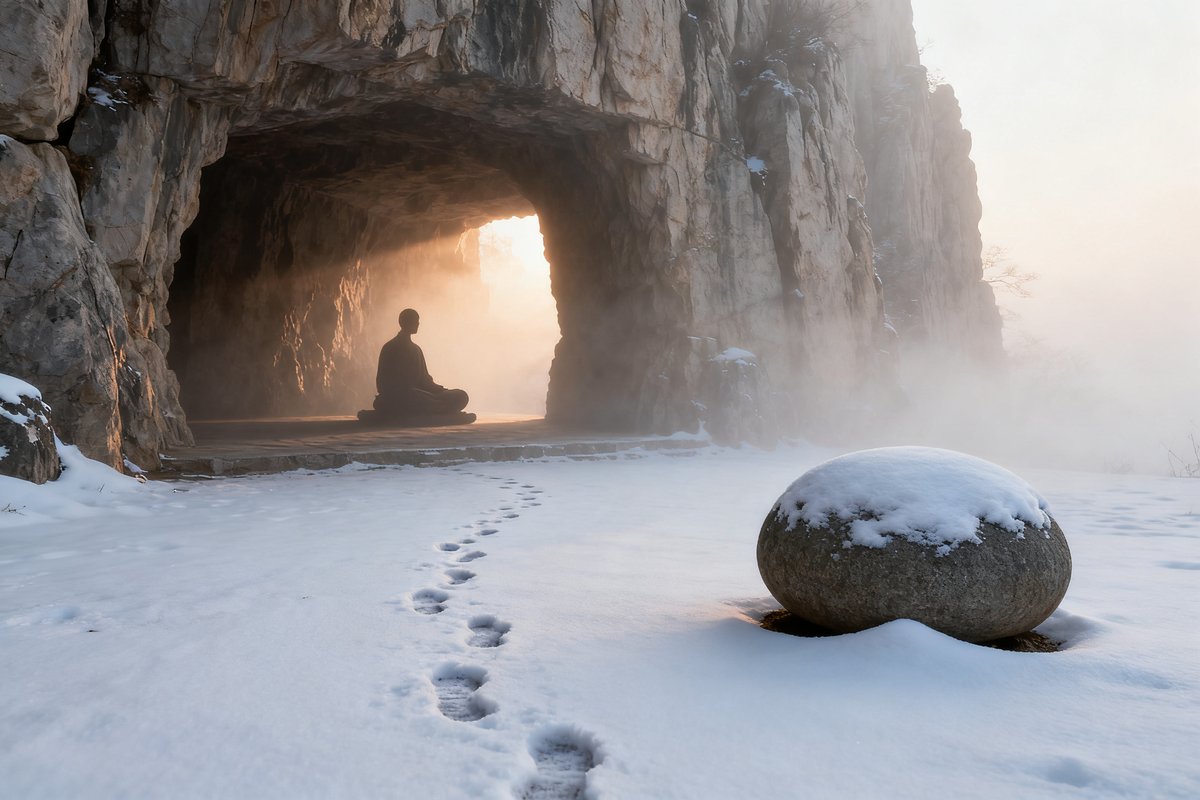
Around 527 CE, an Indian monk named Bodhidharma crossed the ocean to China and eventually sat facing a wall in a cave behind Shaolin Temple on Mount Song — nine years of sitting. A monk named Shenguang from the south came to ask for his teaching. Bodhidharma ignored him. Shenguang waited outside the cave. It was the twelfth lunar month, and the snow rose past his knees. Bodhidharma came out and said: Only when red snow falls will I teach you.
Shenguang went back, took a knife, cut off his own left arm, and let the blood stain the snow — red snow.
Bodhidharma accepted him, and gave him a new name: Huike.
You may have heard this story. Most people remember the arm, the snow, the pain. Very few keep asking the next question: what did Shenguang — Huike now — actually want?
He wanted something very small. He said:
"My mind is not at peace. Please, Master, pacify it."
My mind is not at peace. Please bring it to rest.
You see — fifteen hundred years ago, people wanted the same thing we want today. Not enlightenment, not siddhis, not Buddhahood. Just a little peace of mind. The "I can't keep living like this" after a whole night of scrolling. The "what am I even doing" at 3 a.m. The "is this all there is" on the Monday-morning subway. All of it is those four characters: my mind is not at peace.
What Huike asked for is what we ask for every day.
Bodhidharma's Reply
What did Bodhidharma say?
Today we'd get a full package: a mindfulness app subscription, a meditation course, cognitive behavioral therapy, SSRIs, moving to Dali, quitting to "take a gap half-year." All effective, all reasonable. I've tried a few myself.
Bodhidharma used four words:
"Bring me your mind, and I will pacify it."
Bring your mind here. I'll settle it for you.
The first time I read this, I reacted the way most people do: isn't that just being contrarian? The man came in earnest, and you tell him to "bring his mind" — the mind isn't a wallet, how do you bring it?
But Huike took it seriously. He was silent for a long time — picture it: a man with a freshly severed arm, blood still dripping, standing at the mouth of the cave, actually looking. Looking inward. Looking for the thing that was "not at peace."
Then he said the words that echo through the centuries:
"I have searched for the mind, and it cannot be found."
I looked for my mind. It can't be found.
Note — not "hard to find," but cannot be found: having searched everywhere, there simply is no thing called "mind" that can be taken out and handed over. When it's disturbed, you can feel it burning; when you go looking for it, it has no shape, no location, no color — like grabbing a handful of water.
Then Bodhidharma said the last line of the whole dialogue:
"I have pacified your mind."
There. It's done. Your mind is at peace.
End of conversation. And with those words, Huike woke up.
ChatGPT's Question, and What Zen Does With It
Back to the screenshot.
ChatGPT asked my friend: "When you say 'I,' what do you mean?"
He couldn't answer. When he asked me, my first instinct was to give him the modern script — "the self is a narrative model constructed by the brain." But I swallowed it, because I realized: this is not a new question.
Huike searched the snow for his unpeaceful mind, and it could not be found.
Now you try. Look for the "I."
Your name? Two characters your parents chose, that other people call out. Your job? A line on an employment contract; five years ago it was a different line. Your thoughts? Last second's thought is already gone, next second's hasn't arrived — what is the thing "thinking" in between? Your memories? Memory can be distorted, implanted, lost — is it "you," or your collection?
Peel away name, job, thoughts, memories, bodily sensations — layer after layer — where is the one crying "my mind is not at peace"?
The mind cannot be found.
This is not wordplay. Go look for real, once, and you'll know. The act of looking matters more than finding anything.
I'm Not Saying You Don't Have a Mind
Here I have to stop and check myself.
Because I'm afraid this piece will turn into another one of those — "the self is an illusion, let go of attachment, and you'll be free." The internet is full of that, and half the people saying it don't believe it themselves. It's too fast, too slick — like looking at the view from the summit without ever walking the trail.
Huike cut off an arm to reach the mouth of that cave.
My understanding: Bodhidharma never said "you have no mind." What he said was — the thing you cannot produce does not need to be "settled" anywhere. When we're not at peace, we always want to do something: fix the problem, vent to someone, scroll it away, buy something to wear on our wrist. All of it is trying to pin the mind down, nail it to a stable nail.
Bodhidharma said: first, go look for the thing that needs pinning down.
Look. Genuinely look. Not finding it is not failure — the moment of not-finding is the peace.
Because in that moment, there is no "victim" standing there suffering.
I know how abstract that sounds. I tested it with a very unglamorous method.
A Very Unglamorous Experiment
A while ago I was badly anxious — about what, I've forgotten; the usual suspects: work, age, the bank account, what other people think of me. Couldn't sleep at night, my head full of tomorrow and the day after and the day after that.
Lying in bed, I suddenly wanted to try Huike's clumsy method. I asked myself: right now, where is this "anxiety"?
I really looked. The chest? Only tightness. The head? Only pressure. Then the "subject" of the anxiety — the "me" that felt it was all falling apart — where? I peeled, layer by layer: if I didn't have this name, would I still be me? Without this job? If nobody knew I was anxious?
Peeling to the end — I can't say which layer it was — the knot in my chest suddenly mattered less. It hadn't vanished; it was still there, but it receded, like a tide going out, into "a bodily sensation" instead of "my doom." I still didn't fall asleep, but in that moment, the person lying there was relaxed.
The next day I was anxious again, as usual. Don't misunderstand — this is not a one-time liberation. Zen has a name for one-off high moments: "light and shadow at the gate" — pretty, useless. But that night confirmed one thing for me: the unpeaceful mind truly cannot be produced. And if it cannot be produced, nothing can wound it.
"I Have Pacified Your Mind"
ChatGPT asks what "I" means, and my friend can't answer.
Now I think: not being able to answer is the most honest answer to that question.
Fifteen hundred years ago, Huike answered "the mind cannot be found," and Bodhidharma said "I have pacified your mind." For two thousand years, countless people have rediscovered this in different vocabularies: Buddhism calls it no-self, Daoism calls it sitting-in-forgetting, modern psychology calls it "the self as narrative," neuroscientists hunt for "self-referential neurons." Different mountains, same climb — and when the clouds part, probably the same moon.
I don't dare claim I understand. I'm just an ordinary lay practitioner, counting beads through my days, anxious like everyone else. But since that night, those four characters — my mind is not at peace — have a bit of body-feel to me now:
When you're not at peace, don't rush to pacify it. First, look for it.
If you find it, bring it and get it settled. If you can't find it —
congratulations. It's already settled.
The snow at the mouth of the cave would melt that spring. Huike later inherited Bodhidharma's robe and became the Second Patriarch of Chan in China. The histories don't record his mood after the severed arm; only those four lines of dialogue. I like to think that a man willing to cut off an arm for peace of mind — smiled, the moment he got his answer.
Tonight, if you can't sleep either, if your mind is churning — try the clumsy method. Consider it searching one more time, on behalf of that man in the snow, fifteen hundred years ago.
Look for me, and see if you can find it.
Three questions, left for you:
- When was the last time you genuinely looked for "the anxious me"? Did you find it?
- If you set down your name, your job, your memories for a moment — what do you feel is left?
- If ChatGPT asked you "what do you mean by 'I'" — what would you say now?