Chinese Dragons Don't Breathe Fire. They Breathe Rain.
A foreign vlogger held up a Chinese dragon lantern and said it breathes fire. I paused the video. That golden dragon with deer antlers and fish scales didn't look like anything that would breathe fire. It looked more like a cloud.
A few days ago I came across a video. A foreign vlogger was holding a Chinese dragon lantern, looking into the camera, saying: "In China, dragons breathe fire and guard gold."
I paused the video.
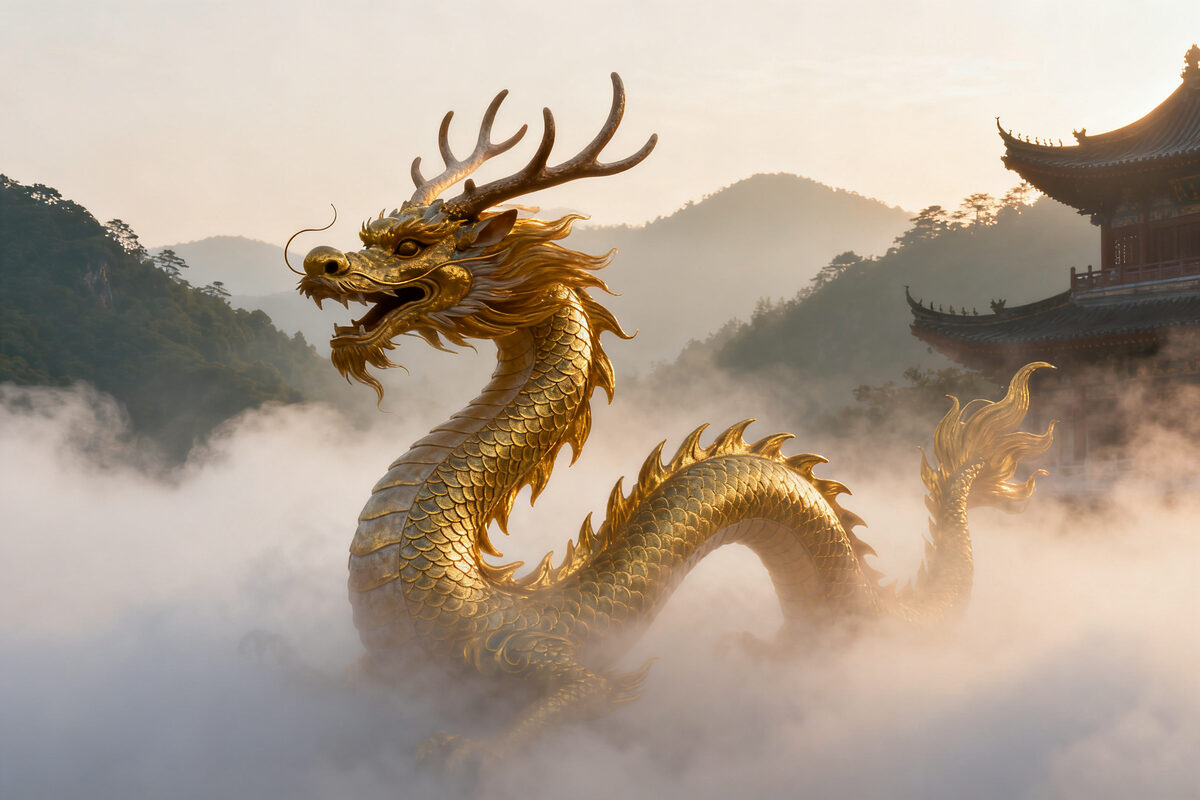
Stared at that golden dragon for a long time. It had deer antlers, a snake's body, eagle talons, fish scales. It didn't look like anything that would breathe fire.
It looked more like — a cloud.
Western dragons and Chinese dragons are not the same creature
I'd never seriously thought about this before. In English, the word "dragon" crams two completely different beings into one translation.
Western dragons come from Norse mythology and Christian culture. They are usually monsters — bat wings, reptilian bodies, breathing fire, living in caves hoarding gold, waiting to be slaughtered by knights. Saint George and the dragon, the Norse Nidhogg gnawing at the roots of the World Tree — all of them follow this script.
And the Chinese dragon?
The ancient dictionary Shuowen Jiezi describes it: "The dragon, chief of all scaled creatures. It can be dark or bright, thin or massive, short or long. At the spring equinox it ascends to heaven; at the autumn equinox it dives into the deep."
Notice those words: it can be dark or bright, short or long.
This isn't describing a monster. This is describing something — hard to say if it's matter or spirit. It can hide or appear, be tiny or enormous. In spring it flies to the sky, in autumn it sinks into the abyss.
When I first read this, I froze for a second. Isn't that just — a cloud? Water vapor?
A creature made of water doesn't breathe fire. What it breathes is rain.
Every part of it has a story
Honestly, I used to think the Chinese dragon's appearance was pretty random — antlers like a deer, head like a camel, eyes like a rabbit, neck like a snake, belly like a clam, scales like a carp, claws like an eagle, paws like a tiger. Isn't that just a mashup?
Then I dug into it and realized this "mashup" is itself a worldview.
The Song dynasty scholar Luo Yuan listed the dragon's "nine resemblances" in his commentary on the Erya: horns like a deer, head like a camel, eyes like a rabbit, neck like a snake, belly like a sea serpent, scales like a fish, claws like an eagle, paws like a tiger, ears like an ox.
Each part represents a certain kind of power.
Deer antlers for longevity and spiritual connection — the ancients believed deer could communicate with the divine. Camel head for endurance — camels cross deserts, they are the embodiment of stamina. Snake body for flexibility and transformation — snakes shed their skin, symbolizing rebirth. Fish scales for abundance — the word for fish sounds like the word for "surplus." Eagle claws for strength — the power of diving from the sky.
Nine animals combined into one equals a collection of the most vital traits in all the world.
So the Chinese dragon isn't a single animal. It's a poem — written with life itself.
It's in charge of rain
I sort of knew this growing up in the countryside. Every summer, if the drought lasted too long, the old folks in the village would go to the Dragon King Temple to burn incense.
As a kid I thought this was superstition. Looking back now, it's actually the most basic understanding of an agricultural civilization that stretches back thousands of years: crops need water to survive; water comes from the sky; and where does the sky's water come from?
From the clouds. From the dragon.
The Classic of Mountains and Seas mentions Yinglong, the "responding dragon," who could store water and helped the Yellow Emperor defeat Chiyou. When Yu the Great tamed the flood, legend says a dragon went ahead, drawing lines in the earth with its tail to show where the water should flow.
Dragon King beliefs in folk culture are even more practical. Ao Guang of the East Sea, Ao Qin of the South Sea, Ao Run of the West Sea, Ao Shun of the North Sea — four dragons governing the seas in four directions. They don't guard gold, kidnap princesses, or get hunted by knights. Their job is: making rain.
Rain was a monumental matter in agricultural society. When the crops were thirsty, people went hungry. If the dragon could bring rain, it meant the dragon could keep people alive.
So when Chinese people worship the dragon, they're not worshipping a monster. They're worishing a lifeline.
Why is the dragon the "Son of Heaven"
The emperor was called the True Dragon Son of Heaven. Dragon robes were embroidered with dragons. Palace columns were coiled with dragons. Steps were carved with dragons.
I used to think this was just power decoration — the emperor felt powerful, so he used the dragon to aggrandize himself.
Then I understood something deeper.
In Chinese culture, the dragon represents the "heaven" part of "the unity of heaven and humanity." It flies in the sky yet sinks into the water. It moves through clouds and mist yet governs the rain that nourishes the earth. It is a messenger between heaven and earth, a physical embodiment of cosmic order.
When the emperor called himself the dragon, he wasn't saying "I'm fierce." He was saying — I carry the Mandate of Heaven. I am the bridge between heaven and earth.
Of course, many emperors in history didn't deserve this. But the symbol itself carries an ideal: the ruler's power comes from heaven and earth, not from violence.
Western dragons are meant to be slain. Chinese dragons are meant to be gazed up at.
This difference is the difference between two civilizations' foundational logic.
The dragon has nine sons, each with its own temperament
There's something particularly fascinating about this. Chinese people say "the dragon has nine sons," and not one of the nine looks like a dragon. What's more, each one has its own peculiar obsession.
The eldest is Bixi, shaped like a turtle, loves carrying heavy things — so the turtle-like base under stone steles is him. The second is Chiwen, fish-like, loves gazing upward with its mouth open — so the roof-ridge beast swallowing the eaves is him. The third is Pulao, like a small dragon, loves to roar — so the beast knob on bells is him.
There's also Bi'an, tiger-like, loves justice, standing at the gates of government offices. Taotie, the glutton, draped across bronze cauldrons. Yazi, who loves battle, inlaid into sword guards.
When I read about these, I felt something deeply.
The dragon never forced its children to all become copies of itself. Nine little dragons, each with its own personality, its own passion, its own place. Some carry steles, some stand guard, some watch doors — they don't compare themselves to each other, and they don't try to live as the same kind of dragon.
This is probably the most tender expression of "individual differences" in all of Chinese culture.
If even the dragon knows not to demand that nine children be identical, shouldn't we parents think about that too?
People born in the Year of the Dragon
Every Dragon Year, China gets especially lively. Weddings, births, business openings, moving house — everyone rushes to do it in this year.
Among the twelve zodiac animals, the dragon is the only one that doesn't exist in reality. Rat, ox, tiger, rabbit, snake, horse, goat, monkey, rooster, dog, pig — they're all creatures you can touch. Only the dragon is a being of imagination.
Yet this nonexistent dragon sits right in the middle of the zodiac (fifth position), and is the most sought after.
Why?
Perhaps because those eleven animals represent what already exists in the real world, while the dragon represents — possibilities that haven't arrived yet.
Whether it exists or not doesn't matter. What matters is that every Chinese person saying "I hope my child becomes a dragon" isn't expecting their child to turn into a fire-breathing lizard.
They're hoping for a soaring, a transparency, a freedom to move between heaven and earth.
That night I had a dream
Nothing profound. I dreamed I was standing on a vast expanse of water, and there were clouds on the surface. The clouds moved slowly, gradually forming a shape — very long, very curved, with antlers.
Then it rained.
Not a storm. That fine, dense drizzle. It didn't feel cold on my face. It felt gentle on my hands.
In the dream I wasn't afraid. I just stood there, feeling —
Ah, so this is the dragon. Not a monster. Water. Cloud. Favorable winds and timely rain. The reassuring promise between heaven and earth.
When I woke up, it was indeed raining outside.
Have you ever wondered why, of all things, it's the dragon that became the totem of the Chinese people?
In your own culture, is there an animal — real or imagined — that carries a similar weight?
If you were a dragon, what would you want to be in charge of? Not rain — what else would you choose?
I keep it in my heart. Some things can't be clearly explained, but they're always there. Like the dragon at the bottom of the abyss — diving down at the autumn equinox, returning at the spring.