Can't Stand Your Own Selfie? He Crossed a River and Saw the Person in the Water
At a gathering we took group photos, and when I reached mine, my thumb paused — then swiped past. Twelve hundred years ago, the Zen master Dongshan crossed a river, saw his own reflection in the water, and woke up. He said: the reflection is truly me, but I am not it. Maybe that line was written for everyone who can't stand their own photos.
Can't Stand Your Own Selfie? He Crossed a River and Saw the Person in the Water
A few days ago, some friends and I took group photos at a gathering. When the pictures landed in the group chat, I looked through them one by one. When I got to the one with me in it, my thumb paused for a second — then quickly swiped past.
I don't know if you've ever felt this. Everyone else looks fine in the photos. Then it's your turn, and something is just... off. Why is my face crooked? Why do my eyes look dead? Why is my smile so fake? We look in mirrors every day. We know that face. But the moment it shows up in a photo, it becomes a stranger.
Turns out I'm not alone in this. One friend said he can't even look at himself in video calls — he always turns off the self-view. Another said she edits her photos until she doesn't recognize herself anymore — and only then does she feel okay posting them. The comfort doesn't last long, though.
That night I thought of a story. Twelve hundred years ago, a man also saw himself in a kind of "photo." He didn't swipe away.
A River
In the Tang dynasty there was a monk named Liangjie. People later called him Dongshan Liangjie — "Dongshan" means Cave Mountain, in Jiangxi, where he eventually founded his own school of Zen. The Caodong lineage starts with him.
When he was young, he was stuck on one question: can inanimate things teach the dharma? Stones, walls, flowing water — do they speak? The sutras say "the insentient preach the dharma." So he went around asking teacher after teacher. None of the answers settled him. Not because the answers were wrong — but the knot inside him never came undone.
He carried that question for years.
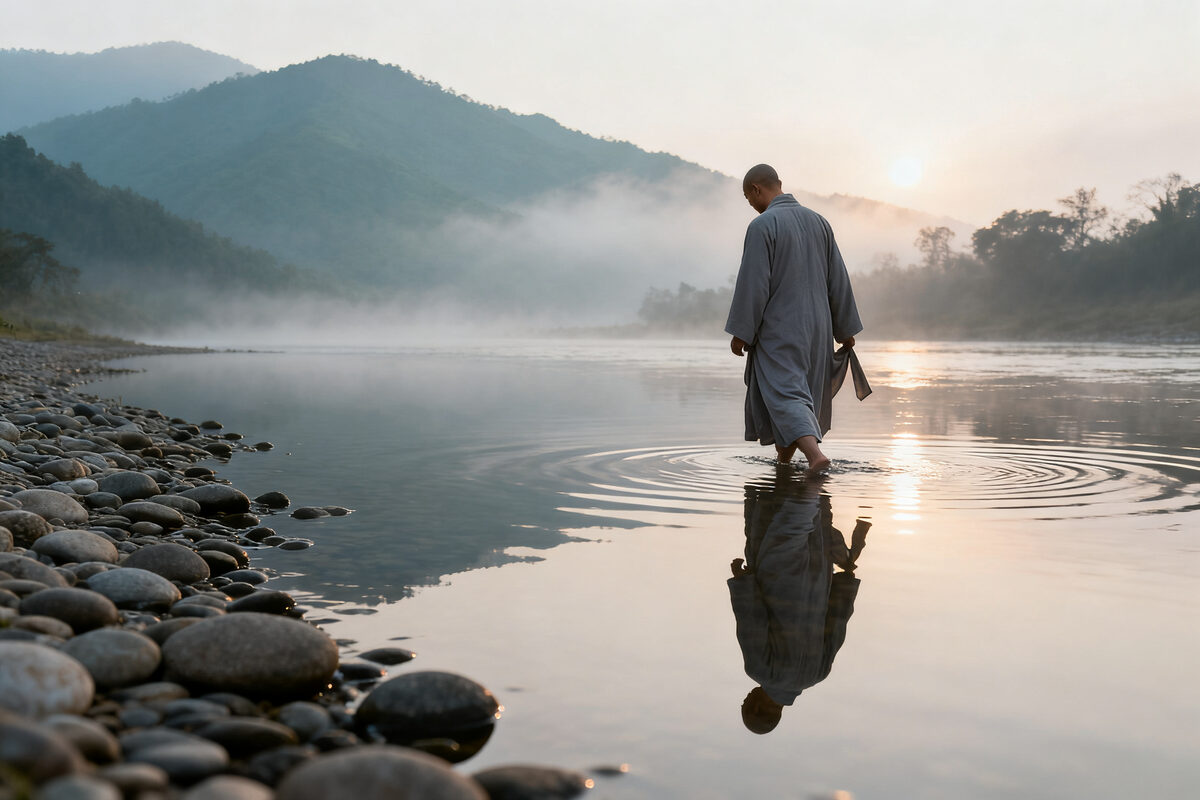
Then one day he had to cross a river. The records don't say which river. Just an ordinary crossing, like the streets we cross every day without thinking.
The river had water. The water held his reflection.
He saw it.
In that one glance downward, something broke open. The thing he'd been dragging around for years untied itself on that water. He stood in the river and spoke a verse:
Seek it from others — never do it. The farther you search, the farther you drift from you. Now I walk on alone, and meet him everywhere I go. He is truly me — right now, right here. But I am not him. See it this way, and only this way, and you touch what has always been so.
I know, classical Chinese sounds intimidating. The first time I read it, it did nothing for me either. But one night I chewed through it word by word, and then sat there for a long time without moving.
Don't Look Outward
The verse opens: never seek yourself from outside. The more you search out there, the further you drift from yourself.
"Outside" means other people. Mirrors. Photos. Other people's opinions. Likes. The "me" you imagine in other people's heads.
All those years Dongshan had been searching — the teachers, the scriptures — it was all "seeking from outside." Asking someone else to hand him an answer, asking a text for proof, asking the world to confirm him. Then he crossed that river, saw the figure in the water, and suddenly understood: I've been asking everyone else who I am. And the thing in the water — that's just my reflection.
Then the line that moves me most: Now I walk on alone, and meet him everywhere I go.
He is the reflection. Only when he was truly alone — not performing, not comparing, not calibrating — did he begin to meet himself. Not a better self. The self that had been there all along.
He Is Me, But I Am Not Him
The third couplet is the heart of it: he is truly me, but I am not him.
That reflection really is me — it follows my every move. I raise my hand, it raises its hand. I lower my head, it lowers its head. Nothing could be more faithful. But I am not it.
The difference between us is an entire world: I am alive. It is an image. It is my appearing — it is not my entirety.
Honestly, I think this verse was written for our era.
The me in the photo truly is me — that is my face, my expression, how I looked that day. No faking it. But it isn't me. It's a slice: one second, one angle, one kind of light. And we treat that slice as a verdict. We use one photo to judge ourselves — "not photogenic," "bad day," "I look terrible" — the way pointing at a reflection and saying: see, that's all you amount to.
When Dongshan saw his reflection, he didn't think it ugly. He didn't fall in love with it either. He simply saw one thing clearly: this is my shadow. I am not my shadow.
Once that's clear, you can cross the river.
What Are We Really Editing?
Back to selfies.
I've thought hard about why we can't stand our own photos. Psychologists have a name for part of it: the "frozen face effect." A still face naturally looks worse than a moving one, because a living face is continuous — full of micro-expressions, always speaking. A photo freezes all that into a thousandth of a second. So the photo looks worse because compression happened, not because you did.
That helps a little. But I think there's a deeper layer.
What we can't stand might not be the face. It's the act of seeing ourselves from the outside. Because the self seen from out there doesn't match the self in here. Inside, I feel warm, bright-eyed, decent-looking. The person in the photo looks so... ordinary. Even a bit sorry.
That mismatch is what rattles us.
So we edit. Slim the face a little, smooth the skin a little, nudge the outside-self closer to the inside-self — then we can post it. We're not editing the face. We're editing the gap.
I'm not against editing. I edit too. My point is that line of Dongshan's: he is truly me, but I am not him. Edited or not, the photo is a reflection. You don't need it to look good in order to be good — because it was never you to begin with. Reflections are faithful, but reflections are limited.
A person's full weight has never lived inside a one-second slice.
See It This Way
The verse ends: you must see it this way — then you touch what has always been so.
"See it this way" means: the reflection is the reflection, I am I. No need to seek yourself outside. No need to fear seeing yourself from the outside either.
What has always been so — the self that doesn't move when the water moves. To touch it is to rest as it.
When I got this far, the river suddenly seemed kind to me. All those years, all those teachers — and in the end, the answer came from his own reflection. And it came when he was alone.
We "seek from outside" so easily now. What others think of me. What the numbers say. How the camera renders me. We look down at our phones far more often than Dongshan looked down at water. Except there's no reflection of us in there — only other people's lives.
So here's a tiny practice, if you want it: next time you catch your own photo and want to swipe away — pause three seconds first. Look at that slightly awkward person and say quietly: he is me, but I am not him.
That's him. That's also me. But I am more than him.
Then swipe if you want to. No one is asking you to fall in love with the photo. After his awakening, Dongshan still had to cross the river. The water was cold, so he gathered his robe and walked on. Awakening isn't standing in the river forever.
Three Questions for You
As usual, I'll leave three questions. No rush to answer. Just let them sit:
-
When was the last time you saw a photo of yourself and wanted to swipe away? In that moment, what exactly did you dislike?
-
If seeing yourself from the outside is always going to distort a little, could you be a bit more forgiving of that photo?
-
Is there a moment — alone, no mirror, no camera — when "I" feels clearest to you? What kind of moment is that?
The river keeps flowing. The reflection stays. May you cross your river too.