The Four Invisible Animals in Your Living Room: Azure Dragon, White Tiger, Vermilion Bird, Black Tortoise
After moving my couch from the west wall to the east, something felt off for a week. A friend said I had a tiger behind me. That sent me into the Four Symbols — four creatures the ancients saw in the stars, and what they say about the space around us.
The Four Invisible Animals in Your Living Room: Azure Dragon, White Tiger, Vermilion Bird, Black Tortoise
A few days ago I rearranged my living room, moving the couch from the west wall to the east wall. For a whole week after that, something felt off. I couldn't name it, but every time I sat down to read, my back felt cold and my mind wouldn't settle.
Then a friend who studies architecture came over, frowned the moment he walked in, and said: "You've made the White Tiger position your backrest."
I stared at him. He explained: the old saying goes "Azure Dragon on the left, White Tiger on the right, Vermilion Bird in front, Black Tortoise behind." By putting the couch against the west wall, I had a tiger crouching right behind me. No wonder I couldn't relax.
It sounded mystical to me. But when I actually looked into it, I found that this system has been around for over two thousand years. And it's not just superstition — it encodes an ancient intuition about how space and the body are connected.
Today I want to talk about those four directions, and the four invisible animals that live in them.
First: where do they actually come from?
These four animals are called the Four Symbols, or Four Guardians. And their origin isn't mythological imagination — it's astronomy.
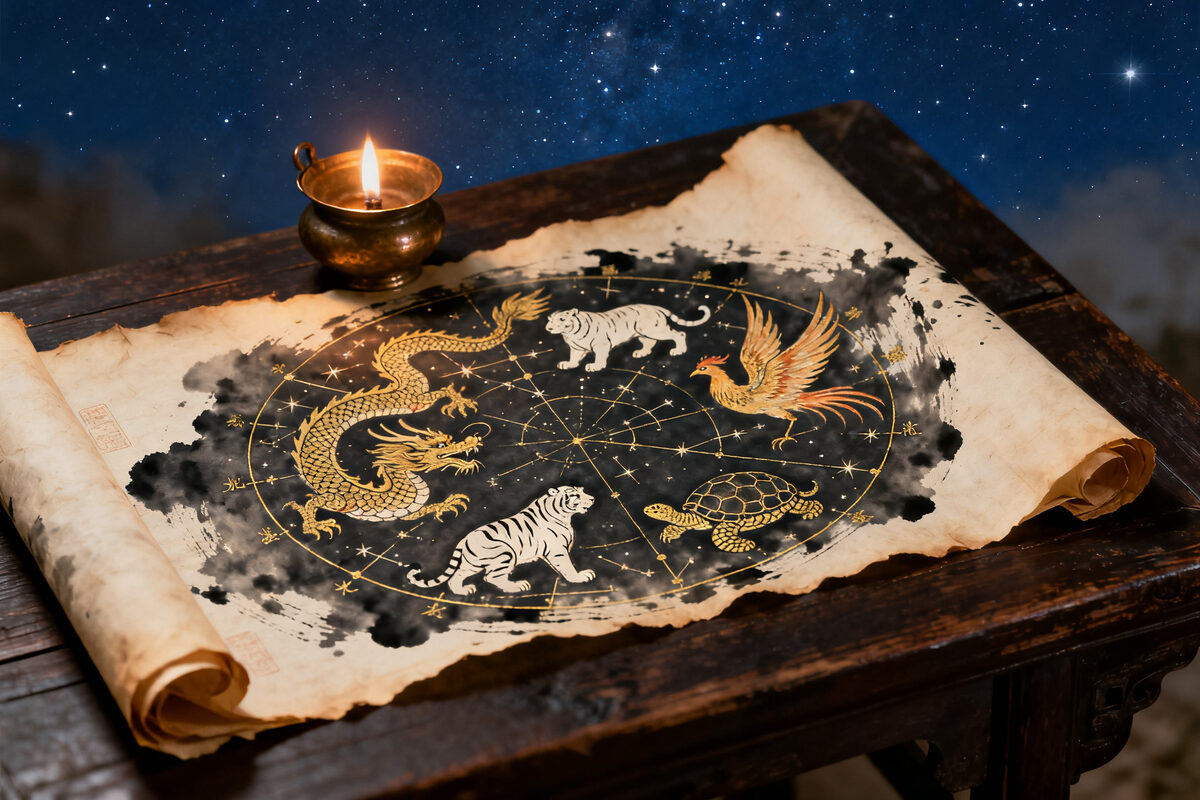
In the ancient world, without streetlights or light pollution, the night sky was overwhelming. To make sense of it, people divided the stars into four regions — east, west, south, north — and named each cluster after the animal its shape resembled:
- The eastern stars formed a winding dragon — the Azure Dragon;
- The western stars looked like a crouching tiger — the White Tiger;
- The southern stars spread out like a bird in flight — the Vermilion Bird;
- The northern stars resembled a turtle entwined with a snake — the Black Tortoise.
So these creatures began as a way of reading the sky. Like how we look at clouds today and say "that one looks like a rabbit." They looked at stars and said "that looks like a dragon."
But over time, this astronomical observation got mapped onto directions, seasons, colors, even the human body — until it became a complete worldview.
Azure Dragon: East, Spring, the force that reaches upward
The Azure Dragon represents the east, spring, the element of wood, and the color green.
What does spring feel like? Seeds breaking through soil, shoots pushing up, the stiffness of winter loosening as something inside you wakes up wanting to stretch.
That's the Dragon's power — emergence.
This is why feng shui says "the left side should be active." The traditional Chinese orientation has you facing south. Your left is the east, the Dragon's domain. The Dragon likes movement, openness, light, flow. So the space on your left should ideally be a window, a door, somewhere bright and airy.
In practical terms: if you're sitting at your desk and your left side has a window, some plants, some openness — you feel good, energized. But if your left is crammed with a wall of books, heavy and full, after a while you feel stifled. Not because of superstition, but because your body is telling you the "direction of growth" is blocked.
White Tiger: West, Autumn, the force that gathers inward
The White Tiger represents the west, autumn, metal, and white.
Autumn is falling leaves, contraction, the quiet settling after harvest.
The Tiger's power is the exact opposite of the Dragon's — gathering.
This is why feng shui says "the right side should be still, should be low." The right is the west, the Tiger's domain. A tiger is a fierce creature — you don't want it leaping around on your right. So the right side suits low, stable, quiet things: a short cabinet, a cushion, heavy curtains.
My friend said my couch against the west wall was bad because the Tiger position shouldn't be the "seat of power." The main seat should back the north — the Tortoise's position.
Vermilion Bird: South, Summer, the force of brightness and openness
The Vermilion Bird represents the south, summer, fire, and red.
Summer is when the sun is strongest, when everything spreads outward, bright and open.
The Bird's power is the mingtang — the open space in front of you.
Feng shui places great importance on "an open hall." Wherever you sit, there should be open, bright, unobstructed space ahead. Not empty — but breathing.
This makes real sense. Think about it: if you sit at your desk and there's a wall half a meter from your face, how do you feel? Compressed, irritable, wanting to escape. But if there's a window, a view, even just a painting — you sit differently.
The Bird's position is the "future" in front of you. It should be bright, and it should breathe.
Black Tortoise: North, Winter, the force of weight and stability
The Black Tortoise represents the north, winter, water, and black.
In winter, all things retreat. The earth goes quiet. Everything returns to its root. The Tortoise's image is the strangest of the four — a turtle intertwined with a snake. The turtle means stability. The snake means some hidden vitality.
The Tortoise's power is the backing.
This is why feng shui keeps repeating "you need support behind you." Your seat, your bed, your couch — behind them should be a solid wall, something stable. If your back is to a window, a door, or empty space, you feel unsettled — even if you can't say why.
This isn't superstition. It's a kind of safety your body has remembered for thousands of years: with solid backing, the mind can rest.
Animals in the wild sleep the same way. They always find a spot with cover behind them. It's instinct.
The afternoon I moved the couch back
After hearing all this, half-doubting, I moved the couch back to its old spot — against the north wall, facing the open living room, with the balcony and plants on my left, a low bookshelf on my right.
The moment I sat down, I paused.
It really was different.
I couldn't explain what changed, but my body seemed to exhale. As if I'd been holding a taut string all week without noticing, and moving back was what finally let it go.
I'm not sure if it was the "White Tiger" at work. Maybe the old spot just didn't get the harsh afternoon western sun. Maybe the couch held my scent and my habits. But that release — that was real.
What the Four Symbols are really trying to say
The more I think about it, the more I feel that this system isn't really about "how to arrange your furniture." It's an ancient, poetic reminder:
The space you inhabit is not just physical. It's connected to your body, your mood, your state of being.
The Dragon in the east reminds you to leave room for growth; The Tiger in the west reminds you that some things need to be contained; The Bird in the south reminds you to keep what's ahead bright; The Tortoise in the north reminds you to keep what's behind solid.
And this doesn't have to be about literal directions. You can understand it as a sense of balance in life:
You need to grow (Dragon), and you need to gather (Tiger); You need to look forward (Bird), and you need backing (Tortoise).
Always charging ahead with no foundation, you scatter. Always hiding in a corner with no light, you wither.
The Four Symbols speak of a "just right."
In the end
I printed an old star chart and pinned it to my study wall.
Not to "ward off evil." But to remind myself —
In a place where you could still see the stars, someone two thousand years ago was already wondering about the relationship between the dragon, tiger, bird, and turtle up there, and the person down here.
That question hasn't gone out of date.
Three questions for you:
1. Is there a corner in your home where you always feel uncomfortable the moment you walk in? Maybe it's not your fault — maybe that space is missing something.
2. Where you're sitting right now — is there a solid wall behind you? If not, try shifting. See if it feels different.
3. Between the ancients' imagination of the stars and our modern understanding of the universe — which do you find more romantic?