I Couldn't Sleep From Anxiety. My Mom Said: Go Make a Bowl of Millet Porridge.
At eleven at night, my brain was full of work. My mom said: go make millet porridge. When your stomach is warm, you settle down. Those twenty minutes at the stove worked better than any meditation app.
I Couldn't Sleep From Anxiety. My Mom Said: Go Make a Bowl of Millet Porridge.
It was eleven at night, and I was tossing and turning in bed. My brain was full of work stuff — a project deadline looming, a client suddenly changing requirements, someone on the team about to quit. None of these things were catastrophic on their own, but crammed together, they felt like a room piled so high with clutter you couldn't even turn around.
I picked up my phone to scroll for a while, to empty my head. But the more I scrolled, the more anxious I got. The algorithm is smart — it kept pushing "how to achieve financial freedom before 35" and "your peers are leaving you behind." I put the phone down and stared at the ceiling.
Then I called my mom.
"Go Make a Bowl of Millet Porridge"
She was already getting ready for bed when she picked up. I just wanted to hear her voice, to feel a little grounded. But after listening to me vent, she went quiet for two seconds, then said something I didn't expect:
"Go to the kitchen, grab a handful of millet, and make yourself some porridge."
I thought she was brushing me off. I said, "Mom, I'm talking about anxiety. I'm not hungry."
She said, "I know. Go make it. Millet nourishes the stomach. When your stomach is warm, you settle down."
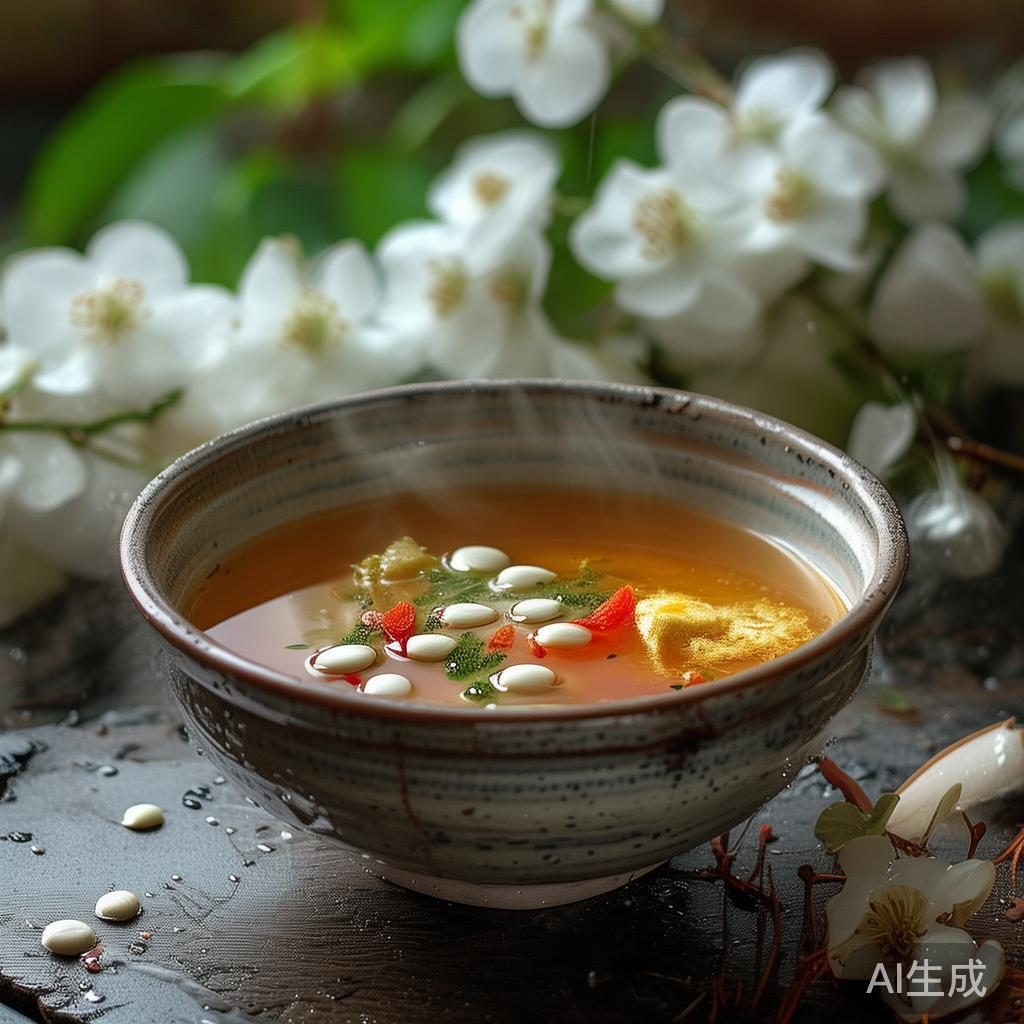
I didn't really believe her. But at midnight, standing alone in the kitchen, listening to the pot bubbling — it was a strange feeling. The sound was low and steady, like someone breathing evenly beside you. I turned the heat down and watched the millet rolling in the boiling water, each grain splitting open, the liquid slowly thickening.
When the porridge was done, I was genuinely less anxious.
Not because millet has some magical compound — though I looked it up later, and it turns out millet does contain tryptophan, a precursor to serotonin, which in theory helps with mood. But what actually calmed me down probably wasn't the porridge itself. It was the twenty minutes of making it.
For those twenty minutes, I didn't look at my phone. I didn't think about work. I just stood at the stove and watched a pot of water become a bowl of porridge. That simple.
Food and Medicine, Same Root
Later I talked to my mom about it, and she said something very plain: "Chinese people don't eat just to get full."
She said when she was little, if my grandmother had an upset stomach, she wouldn't take medicine — she'd make yam porridge. If you had "internal heat," mung bean soup. A cold? Ginger and brown sugar water. Insomnia? Lotus seed and lily bulb soup. None of these were medicine. They were food. But in the Chinese tradition, the line between food and medicine has never been that clear.
Chinese medicine has a concept called yaoshi tongyuan — "food and medicine share the same root." It means many foods are themselves medicine, and many medicines are themselves food. Yam, red dates, goji berries, barley, lotus seeds, ginger, longan… These things in the market and in the pharmacy are often the exact same things.
I used to think this was old-person superstition. But gradually I realized this way of thinking is actually quite wise.
It doesn't treat the body like a machine — fix whatever's broken. It treats the body as a system that needs daily maintenance. You don't wait for your car to break down before servicing it. You don't wait for the roof to leak before fixing it. The body is the same. What you put in every day either nourishes it or harms it.
Why Millet "Nourishes the Stomach"
I looked into millet later.
In Chinese medicine, millet is considered a food that "strengthens the spleen and harmonizes the stomach." The Bencao Gangmu, a 16th-century pharmacopoeia, says it can "treat reflux and feverish dysentery; cooked as porridge, it tonifies the dantian, replenishes deficiency, and opens the stomach." In plain terms: if your stomach feels off, millet porridge helps.
From a modern nutrition standpoint, millet makes sense too. It's rich in vitamins B1 and B2, has decent fiber, and is packed with minerals. And that layer of "rice oil" — the thick film that forms on top of well-cooked porridge — does seem to coat and soothe the stomach lining.
But I think the real reason my mom told me to make millet porridge wasn't about nutrients.
She told me to make it myself, not to order takeout.
There's something important hidden in that: the process.
When you're anxious, your mind is scattered, fragmented, chaotic. You can't focus. Your brain is full of disconnected thoughts buzzing like a swarm of mosquitoes. What you need is to do one thing — one simple, concrete thing with clear steps. Rinse the grain. Add water. Turn on the heat. Wait. It doesn't require thinking, but it requires your hands and your eyes. It pulls your attention away from the mess in your head and anchors it to the pot in front of you.
Standing at the stove, watching porridge slowly thicken for twenty minutes — that's a very primitive form of meditation.
Every Emotion Has a Food
My mom has a simple "theory." She says your emotions and your body are connected. When you're angry, your liver heat rises, and you need light, cooling foods. When you're afraid, your kidney energy is depleted, and you need warming, nourishing foods. When you're sad, your lung energy is weak, and you need moistening foods.
She talks about this in a flat, easy tone, like saying "nice weather today." But I later realized her little theory maps almost exactly onto the Chinese medicine framework of "the seven emotions and the five organs."
Chinese medicine holds that anger harms the liver, excessive joy harms the heart, overthinking harms the spleen, grief harms the lungs, and fear harms the kidneys. And conversely, the state of your organs affects your emotions. So regulating the body is regulating the emotions, and regulating the emotions is regulating the body.
This isn't mysticism. Think about it — when you haven't slept enough, aren't you more likely to snap at people? When you've eaten too much, don't you get drowsy? When you've had too much coffee, aren't you more jittery? Everyone has experienced the link between body and mood. Chinese medicine just organized that link into a system and matched it with specific foods.
My grandmother lived to ninety-three. She never took supplements, but she was thoughtful about every meal. Not expensive — right. Mung beans in summer, lamb in winter, chives in spring, pears in autumn. She didn't know any nutrition terms, but she knew what to eat in which season, and what to eat in which state of body.
My mom said that's the wisdom Chinese people distilled over thousands of years. Not written in books — simmered in pots.
After That Bowl
That night, after I finished the porridge, washed the bowl, and got back into bed.
I didn't fall asleep right away, but that feeling of being blocked, of something stuck — it had loosened. The same thoughts were still turning in my head, but slower. Like an engine downshifting from high gear to low. The hum was still there, but less piercing.
I remembered when I was little and had a fever, my mom would also make porridge. Not white rice porridge — millet porridge, with a few red dates. She said it had to cook until the oil rose to the top to count as done. I'd sit up in bed holding the bowl, taking tiny sips. I didn't know anything about food-medicine synergy or spleen-stomach theory back then. I just knew the porridge was hot, fragrant, thick, and after drinking it I'd sweat, and the fever would go down a little.
Looking back, what that bowl really cured probably wasn't the fever. It was the feeling of "someone is taking care of me."
Twenty-plus years later, in a different city, a different kitchen, I made myself a bowl of porridge. But the taste was the same. The feeling was the same.
When your stomach is warm, you settle down.
My mom was right.
Three questions to sit with:
- When was the last time you cooked a real meal for yourself, with your full attention?
- When you're anxious, is your first instinct to eat, or to not eat?
- If your mood today were a food, what would it taste like?