The Six Realms of Existence: Buddhist View of Life
The Six Realms are not just destinations after death but metaphors for six psychological states. This article interprets the realms symbolically and psychologically, exploring how to recognize and transcend cyclic existence in daily life.
The Six Realms of Existence: Buddhist View of Life
"Samsara" or "cyclic existence" is one of the most important concepts in Buddhist cosmology. But what exactly are the Six Realms? Is it literally about being reborn as animals or hungry ghosts after death? Or are the Six Realms present right here and now? This article explores the symbolic meaning, psychological interpretation, and how to transcend cyclic existence in daily life.
What Is Samsara?
Samsara, from the Sanskrit meaning "continuous flow" or "wandering," refers to the state of beings cycling through birth and death — due to ignorance and karma, sentient beings are repeatedly born, die, and are reborn in various forms of existence.
But Samsara is not an external punishment system; it is a state of existence — being trapped in greed, hatred, and delusion, unable to attain true freedom and liberation.
The Six Realms
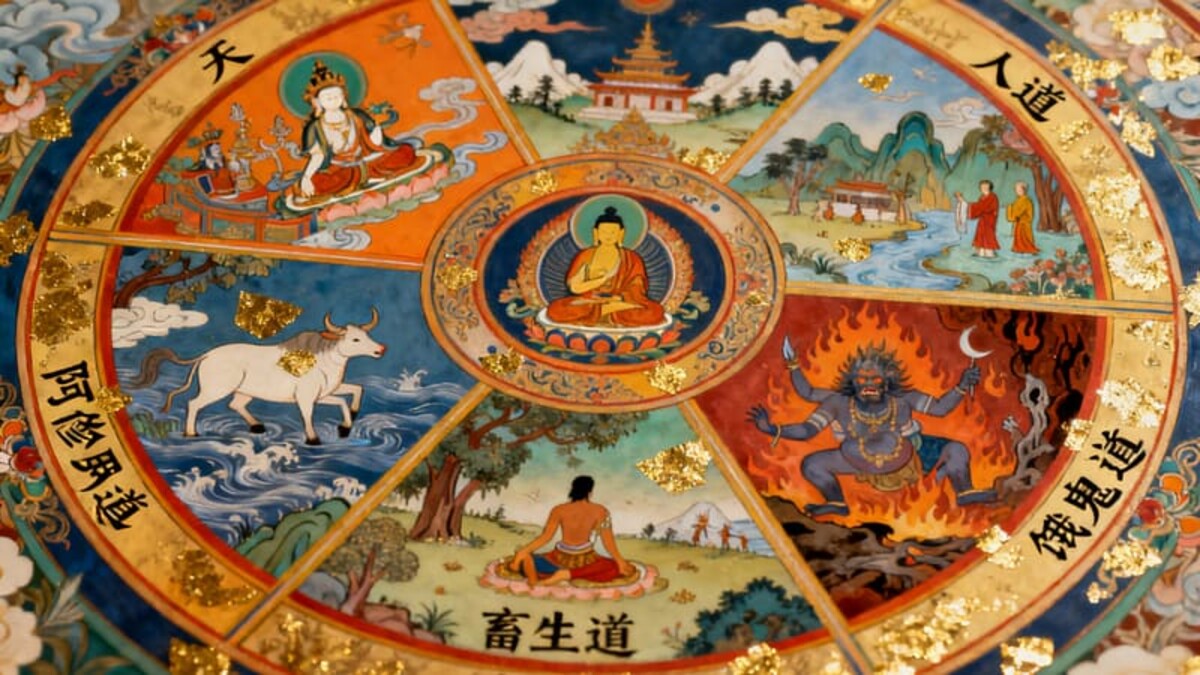
Buddhism divides cyclic existence into six levels, called the "Six Realms":
1. The Heavenly Realm (Deva) — Pleasure and Bliss
Characteristics: Immense happiness, long life, beauty, psychic powers
Devas inhabit various heavenly worlds, enjoying immeasurable merit. They possess supernatural abilities, can fly, live in magnificent palaces, and have extremely long lifespans.
The Trap: So absorbed in pleasure that they forget to practice. When their merit is exhausted, they will fall.
Modern equivalent: Those who are extremely wealthy, have everything, yet feel empty inside. Material satisfaction at its peak without meaning in life.
2. The Asura Realm — Jealousy and Conflict
Characteristics: Great power, aggression, jealousy, constant warfare
Asuras have the merit of devas but lack their virtue. They constantly wage war against the devas, their minds filled with jealousy and anger.
Modern equivalent: Those who have wealth and status but are never satisfied, always comparing themselves to others, filled with competitive drive. They "have everything except the ability to see others doing better than them."
3. The Human Realm — The Field of Practice
Characteristics: A mix of pleasure and pain, capable of spiritual practice
The human realm is considered the most favorable for practice. Because there is suffering, there is motivation for liberation; because there is pleasure, there is hope. Humans have enough wisdom to understand the Dharma and enough suffering to motivate practice.
Modern equivalent: Most of us. Experiencing both frustrations and joys, seeking meaning in life's ups and downs.
4. The Animal Realm — Driven by Instinct
Characteristics: Ignorance, controlled by instinct, survival of the fittest
Animal realm beings are controlled by instinct, lacking rational thinking. Their primary drives are fear and desire — fear of being preyed upon, desire for food and reproduction.
Modern equivalent: People completely controlled by desire and fear — constantly seeking sensory stimulation, brainwashed by consumerism, lacking independent thought.
5. The Hungry Ghost Realm — Insatiable Craving
Characteristics: Extreme hunger and thirst, never satisfied, greed
Hungry ghosts have enormous bellies and needle-thin throats. They are perpetually starving but cannot eat. Water appears as pus; food turns to flames when they try to consume it.
Modern equivalent: Those who are never satisfied — making one million and wanting ten million, having a house but wanting a bigger one. Desire is like a bottomless pit that can never be filled.
6. The Hell Realm — Intense Suffering
Characteristics: Extreme pain, torment, despair
Various tortures exist in hell, where beings undergo intense suffering. But hell is not eternal; when karma is exhausted, beings are reborn elsewhere.
Modern equivalent: Severe depression, despair, painful mental states. That feeling of "living is suffering."
Psychological Interpretation
Modern psychology resonates deeply with Buddhism. The Six Realms can be understood as six mental states:
| Realm | Mental State | Characteristics |
|---|---|---|
| Deva | Euphoric state | Extreme pleasure, losing oneself |
| Asura | Competitive state | Jealousy, anger, comparison |
| Human | Normal state | Mixed pleasure and pain, awareness |
| Animal | Instinctual state | Driven by desire, unconscious |
| Hungry Ghost | Craving state | Never satisfied, anxious |
| Hell | Painful state | Despair, torment |
Which realm are you in right now?
- Just won the lottery, ecstatic → Deva realm
- Saw colleague promoted, feeling jealous → Asura realm
- Peacefully eating breakfast, present in the moment → Human realm
- Can't stop scrolling on phone, controlled by algorithms → Animal realm
- Can't get what you want, anxious → Hungry ghost realm
- Severely depressed, life feels meaningless → Hell realm
The Six Realms are not destinations after death; they are present psychological realities.
Transcending Samsara
Since the Six Realms exist in the present moment, transcending Samsara is not something that happens after death — it is awakening right now.
1. Recognize Your Present State
This is the first step. When you become aware that you are in a "hungry ghost" state of craving or a "hell" state of suffering, you have already taken the first step toward transcendence.
2. Don't Identify with the State
When you say "I am anxious," you identify with anxiety. Try saying "anxiety is arising" — this is different. You are not your emotions; you are the awareness in which emotions arise.
3. Return to the Human Realm: Balance and Awareness
The human realm is the best field for practice. Finding balance between pleasure and pain, maintaining awareness — this is the starting point of practice.
4. Cultivate Mindfulness and Compassion
Mindfulness allows us to see our present state clearly; compassion softens us toward ourselves and others. Both are keys to transcending Samsara.
5. Move Toward Nirvana: Complete Liberation
Nirvana is not another "realm" but a state beyond all realms. No longer controlled by any mental state — complete freedom.
The Story of Sakka's Question
Once, Sakka (ruler of the devas) came to ask the Buddha a question:
"Lord, what is the true refuge?"
The Buddha replied:
"Taking refuge in one's own pure mind — this is the supreme refuge. The heavenly realm offers pleasure but eventual decline; Asuras have power but are trapped by jealousy; even the suffering of hell is not permanent. Only the purity of mind is the true other shore."
Upon hearing this, Sakka attained the first stage of enlightenment.
This story teaches us: True liberation is not elsewhere; it is in the present mind.
Conclusion
The Six Realms are not a terrifying picture of hell meant to frighten people. They are a mirror reflecting our inner state:
- When you are greedy, you are a hungry ghost
- When you are jealous, you are an Asura
- When you are ignorant, you are an animal
- When you are suffering, you are in hell
- When you are happy but lose yourself, you are in heaven
- When you maintain awareness, you are human — the starting point of practice
Understanding the Six Realms is not about fearing rebirth, but about seeing clearly in the present moment and choosing freedom.
"If one wishes to know all Buddhas of the three periods of time, one should contemplate the nature of the Dharma-world: everything is created by mind alone." — The Six Realms are not distant; they exist in this very mind.