Huineng: The Illiterate Sixth Patriarch of Zen
Huineng could not read a single character, yet became the greatest Zen patriarch in Chinese history. From woodcutter to Zen master, his story shows that true wisdom transcends knowledge and awakening is here and now.
Huineng: The Illiterate Sixth Patriarch of Zen
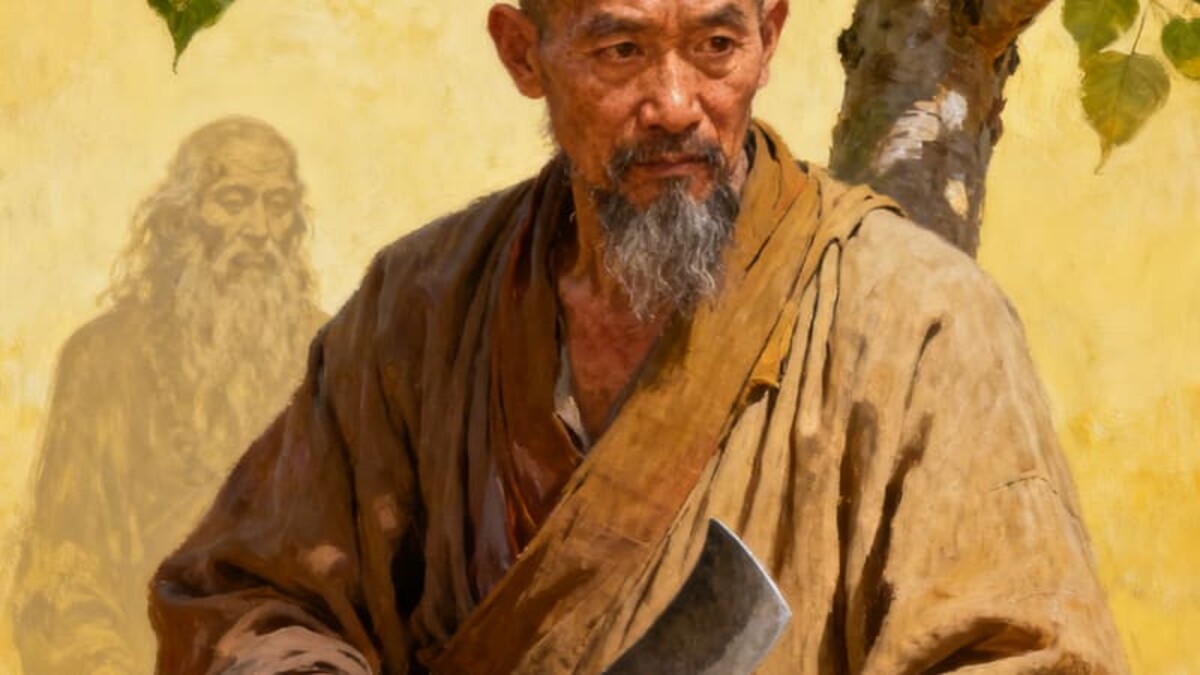
In the history of Chinese Buddhism, one person's story surpasses all legends. Born into poverty, he made a living chopping firewood. He could not read a single character. Yet he became the Sixth Patriarch of Chinese Zen Buddhism. His words and deeds were recorded by disciples into the only Buddhist text in China titled "Sutra" — the Platform Sutra of the Sixth Patriarch.
His name was Huineng (638-713), the most revolutionary figure in Zen history.
A Woodcutter from Humble Origins
Huineng was born in 638 CE in Fanyang (modern-day Zhuozhou, Hebei). After his father was exiled to Lingnan (modern-day Guangdong), the family settled in Xinzhou.
His father died early, leaving Huineng and his mother to survive by chopping and selling firewood. He never attended school, could not read, and lived at the bottom of society.
Fate intervened one day when Huineng was selling firewood at the market. He heard someone reciting a line from the Diamond Sutra:
"One should give rise to a mind that dwells nowhere."
With just this single line, Huineng suddenly awakened. He felt a clarity and awareness he had never experienced before. He decided to travel to Huangmei's East Mountain Temple to study under the Fifth Patriarch, Hongren.
First Meeting: The Most Famous Dialogue
Huineng journeyed across mountains and rivers to reach East Mountain Temple. When Fifth Patriarch Hongren saw him, he asked:
Hongren: "Where do you come from? What do you seek?"
Huineng: "I am a commoner from Xinzhou in Lingnan. I have come from afar to pay respects to you. I seek only to become a Buddha, nothing else."
Hongren (testing him): "You are from Lingnan, a southern barbarian. How can you become a Buddha?"
Huineng (without arrogance or humility): "People may have north and south, but Buddha-nature has no north or south. My barbarian body may differ from yours, but what difference is there in our Buddha-nature?"
Hongren was secretly pleased, recognizing Huineng's deep spiritual capacity. To protect him, he sent him to the back courtyard to split firewood and pound rice — manual labor.
The Most Famous Verse Contest
Later, Fifth Patriarch Hongren decided to transmit the Dharma. He asked his disciples to each write a verse demonstrating their understanding of Buddhism.
The senior disciple Shenxiu wrote:
The body is the Bodhi tree, The mind is like a bright mirror stand. At all times diligently wipe it, Do not let dust collect.
The meaning: Our body is sacred like the Bodhi tree, our mind is pure like a bright mirror. We must constantly work to clean it so that dust (afflictions) doesn't tarnish it.
This verse was good, and the Fifth Patriarch acknowledged it. But when Huineng heard it, he knew Shenxiu had not yet truly seen his nature. He asked someone to write a verse for him:
Bodhi originally has no tree, The bright mirror also has no stand. Fundamentally there is not a single thing, Where could dust arise?
The meaning: Enlightenment (Bodhi) originally has no tree, the bright mirror is not a stand. Fundamentally nothing exists — where could dust collect?
This verse shook the entire monastery. It pointed directly to emptiness — no attachment to any form of practice, because our nature is originally pure.
Fifth Patriarch Hongren saw this verse and knew Huineng had truly awakened. He secretly transmitted the robe and bowl to him, making him the Sixth Patriarch.
Escape and Teaching
After the transmission, Huineng's life was in danger. Shenxiu's followers refused to accept him and sent people to kill him. Huineng was forced to flee, hiding among hunters for fifteen years.
Fifteen years later, Huineng arrived at Faxing Temple in Guangzhou, where Master Yinzong was lecturing. A breeze blew through, causing the temple banners to flutter.
One monk said: "The wind is moving." Another monk said: "The banner is moving."
They argued endlessly.
Huineng stepped forward and said:
"It is not the wind moving, nor the banner moving. It is your minds that are moving."
This became one of the most famous koans in Zen history — Wind, Banner, Mind Moving.
Master Yinzong was astonished. Upon learning Huineng was the Sixth Patriarch, he respectfully invited him to teach. From then on, Huineng began thirty-seven years of teaching.
Huineng's Core Teachings
Huineng's Zen is called the "Southern School" or "Sudden Enlightenment" approach. His core ideas:
1. Sudden Enlightenment
Huineng taught that Buddha-nature is inherent in everyone. No gradual practice is needed. Simply recognize your own nature, and in that very moment, you are Buddha.
"A single moment of delusion makes you an ordinary person; a single moment of awakening makes you a Buddha."
2. Direct Pointing to Mind
No scriptures, no writing, no elaborate rituals needed. Point directly to your mind — your mind is Buddha.
"Not thinking of good, not thinking of evil — right at this moment, what is your original face?"
3. Dharma in the World
Huineng opposed leaving daily life to pursue awakening:
"The Dharma is in the world; to awaken you must not leave the world. Seeking Bodhi apart from the world is like looking for horns on a rabbit."
Awakening is not escaping life but maintaining awareness within daily life.
4. No-Thought, No-Form, No-Abiding
- No-thought: Not having no thoughts, but not being bound by thoughts
- No-form: Not being deceived by appearances
- No-abiding: Not clinging to any state
Lessons for Modern Life
Your Origins Don't Define You
Huineng was illiterate and impoverished, yet became the greatest Zen patriarch. Your starting point doesn't determine your destination.
True Wisdom Transcends Knowledge
Huineng had no formal education but possessed the deepest wisdom. Knowledge is learned; wisdom is realized. Don't confuse knowledge with wisdom.
Face Your Own Mind
Huineng's teaching points directly to the mind — don't seek outside, look within. All the answers you seek are already in your own heart.
Practice in Daily Life
Huineng opposed leaving the world to practice. Practice happens in daily life: eat when eating, sleep when sleeping, work when working. Full engagement with the present moment is the best practice.
Conclusion
A firewood-chopping illiterate who produced the greatest work in Chinese Buddhist history. His life tells us:
Becoming a Buddha is not about becoming someone else — it's about recognizing that you are already Buddha.
This truth requires no literacy, no monasticism, no external conditions. It only requires — turning around to look at your own mind.
"Who would have thought that my original nature is inherently pure? Who would have thought that my original nature neither arises nor ceases? Who would have thought that my original nature is inherently complete? Who would have thought that my original nature is immovable? Who would have thought that my original nature can produce all things?" — Huineng's five exclamations upon awakening reveal the secret of all practice.