The Ten Oxherding Pictures: The Person in the Paintings Is Me
A couple of days ago I was flipping through an old book and came across a set of woodblock prints. Black and white, very simple. A person, an ox, ten pictures. I wasn't looking at the pictures anymore. I was looking at myself.
The Ten Oxherding Pictures: The Person in the Paintings Is Me
A couple of days ago I was flipping through an old book and came across a set of woodblock prints. Black and white, very simple. A person, an ox, ten pictures.
I'd seen them before. But that evening, sitting under the lamp, something was different. I wasn't looking at the pictures anymore. I was looking at myself.
The series is called the "Ten Oxherding Pictures," and it was drawn by a Song Dynasty Zen master named Kuòān. Using the metaphor of a person searching for an ox, chasing it, taming it, riding it home, and eventually forgetting the ox entirely, it tells the story of spiritual practice.
I don't think it's about anything lofty. It's about one person learning to live with themselves.
First Picture: Searching for the Ox
A man stands in the wilderness holding a rope, looking around. The ox is gone.
I'm like that sometimes. Not searching for an ox, but searching for a feeling—that sense of being at peace. Everything was fine a few days ago, and then suddenly it's empty. Like something got lost, and I can't say what it is.
Kuòān wrote a poem beside this picture. The gist of it is: the ox never went far. It's the person who wandered off, carried away by thoughts.
I read those lines several times. The ox didn't go anywhere. I'm the one who left.
Second Picture: Finding the Tracks
The picture is similar, but now there are hoofprints on the ground. The man looks down, as if he's found a clue.
This reminds me of meditation. I'll sit for a long time and feel nothing, and then, for one brief second, the mind goes quiet. Just one second. But I know what that is. It's like seeing a footprint in the mud—something was here.
This stage is the most frustrating. You know it exists, but you can't hold onto it. You know you don't have to be anxious, you don't have to be irritated, and yet you still are.
But at least you've seen the tracks.
Third Picture: Seeing the Ox
The man finally sees the ox. Through the branches, in the distance, it stands there.
I had this feeling the first time I really read a sutra. I came to the line "All conditioned things are like a dream, an illusion, a bubble, a shadow," and something in me shifted. Not that I understood anything—it was more like being touched by something.
It's a strange feeling. Like spotting someone you know across a crowded room. You haven't even called their name yet, but they've already seen you.
Maybe practice is like that. You think you're the one searching, but it's been waiting for you all along.
Fourth Picture: Catching the Ox
The man finally grabs the ox with the rope. It takes all his strength. The ox struggles, the man pulls.
This is the most honest picture.
So many people think "enlightenment" means being effortlessly serene from that point on. But this picture says otherwise. Catching the ox doesn't mean the ox obeys. You just managed some stillness, and the next day you lose your temper just the same. You thought you'd let go of something, and then one careless remark sends you spinning again.
Catching the ox is just the beginning. Now you have to tend it.
Fifth Picture: Tending the Ox
The man follows the ox with a whip, carefully. The ox has stopped running, but it still needs watching.
I relate to this stage deeply. You know what's right and what's wrong, but you still make mistakes. You know you shouldn't get angry, but you do. You know you shouldn't be greedy, but you still want.
So you learn to "watch." Not suppress, not fight—just watch. Anger arises, and you know anger has arisen. Greed comes up, and you see it.
Slowly, the ox starts to listen. Not because it was beaten into submission, but because it got used to the path.
Sixth Picture: Riding the Ox Home
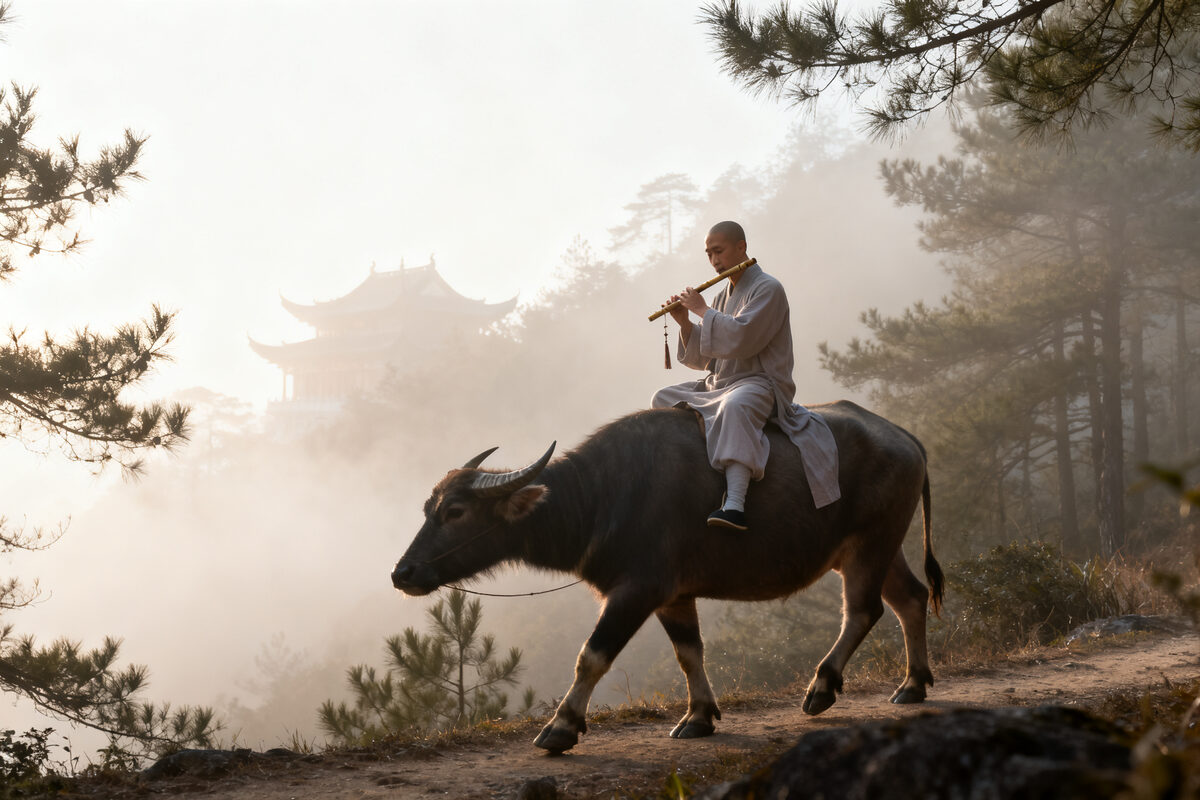
This one is beautiful. The person rides on the ox's back, playing a flute, heading home unhurriedly.
No more chasing. No more pulling. The person and the ox are one thing. Practice is no longer something you "do"—it's just your life. Sweeping the floor is practice, washing dishes is practice, walking is practice.
To be honest, I'm mostly somewhere between the fourth and fifth pictures. But I've glimpsed the sixth. Occasionally—truly occasionally—there's a moment of profound stillness. Not the absence of thoughts, but thoughts coming and going like clouds in the sky.
In those moments, I feel like the person in the painting, riding the ox home, nothing to do, just going.
Seventh Picture: The Ox Forgotten, the Person Remains
Only the person is in the picture now. The ox is gone. He stands there, very still.
Where did the ox go? The ox isn't needed anymore. You no longer need to "tame" anything, because the impulse to tame has itself disappeared.
This state is far beyond where I am, and I won't pretend to understand it. But it reminds me of something: sometimes I get so attached to the idea of "I need to calm my mind" or "I need to practice" that I make myself tense. Practice itself becomes a new cage.
Maybe one day, even the concept of "practice" will fall away. Not that I'll stop, but I'll forget I'm doing it.
Eighth Picture: Both Forgotten
This is the most unusual one. The picture is empty. Just a circle.
No ox, no person.
All dualities dissolve. No separation between "me" and "affliction," no separation between "practice" and "life." Even "letting go" has been let go of.
The first time I saw this picture, I laughed. Drawing a circle—is that even a picture? But thinking about it, maybe emptiness is the most honest expression. Anything you draw would be too much.
Ninth Picture: Returning to the Source
Streams, trees, flowers appear in the picture. Everything is ordinary, natural.
Back to the beginning. But it's not the same beginning. The first time around, the origin was hazy. Now it's clear.
The mountains are still mountains, the rivers are still rivers. But you are no longer who you were.
Tenth Picture: Entering the Marketplace with Helping Hands
The last picture held me for a long time.
A person comes down from the mountains and walks into the marketplace. Dressed plainly, smiling, hands extended, as if helping someone.
I thought enlightenment meant staying on the mountain. I thought letting go meant not caring.
But Kuòān placed the final scene in the busy streets. You complete the entire journey not to stay on the summit, but to return to people.
It reminds me of something: true compassion isn't looking down from above. It's being in it with everyone.
I looked at the ten pictures for a long time that night.
Then I realized something interesting. These aren't ten steps in a straight line. You don't finish and arrive. They're more like a circle. Right now, I might be in several pictures at once—in some ways still searching, in others already riding, and sometimes slipping back.
I think that's what practice really looks like. Not a steady climb, but a back-and-forth, a sometimes-going-in-circles kind of thing.
And that's okay.
The ox has been there all along.
Three questions, for myself, and for you reading this:
Which picture are you in right now?
What is the "ox" you've been searching for?
If the ox never actually went missing, what makes you think it did?