Can Humans Really Fly? A Conversation with a Real Taoist
After binge-reading a cultivation novel, I wandered into a small Taoist temple. The priest there told me what real practice actually means. No flying swords, no immortality — but something that moved me more than any novel could.
Can Humans Really Fly? A Conversation with a Real Taoist About What Cultivation Actually Means
A few days ago I stayed up all night reading a cultivation novel.
Honestly, it's a little embarrassing. The kind of person I am — I read Buddhist sutras, I recite the Heart Sutra — and then I fell straight into one of those stories where the useless nobody rises up to become an immortal. I read until three in the morning.
When I closed my phone, the sky outside was already turning pale. I lay in bed, head full of it — riding a sword through the sky, forming a golden core, heavenly lightning splitting you open.
Then I started thinking about something.
Are those things, actually real?
First, What I Think "Cultivation" Means
The world in those novels goes something like this: an ordinary person practices cultivation, gathers more and more qi inside their body — first you build a foundation, then you form a core, then you birth an inner spirit, then you transform into a god — climbing up level by level. Each level you rise, your life gets longer. In the end, you ascend in broad daylight, free from the wheel of rebirth.
Along the way there's fighting, and pill-making, and people dying, and people living for tens of thousands of years.
I got really into it. Because that leveling-up system — from weak to strong, from mortal to immortal — is honestly not so different from what we all want in real life. Who doesn't want to rise above all the things weighing them down, and fly to some higher place?
But a novel is a novel. And I got curious: does real Taoist cultivation actually look like this?
I Went and Found a Taoist Priest
"Found" isn't quite right. It was more like I bumped into him.
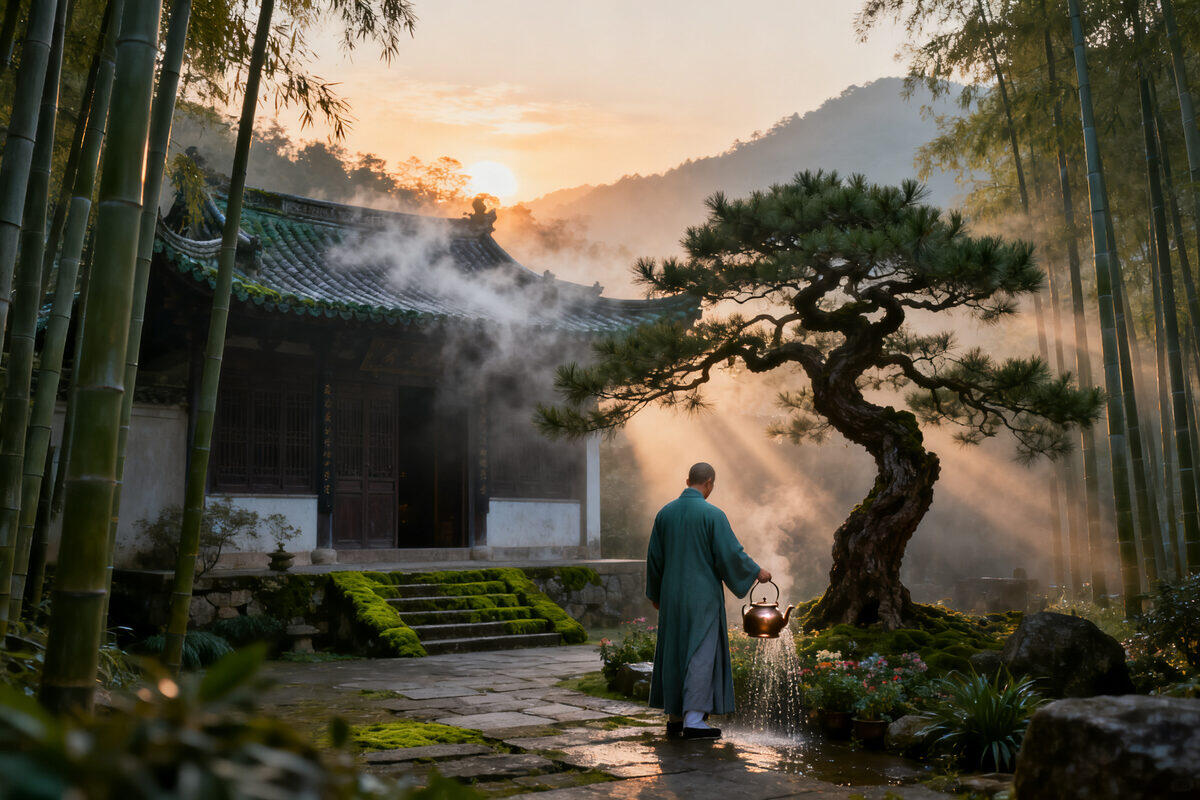
There's a small Taoist temple near my place. I've walked past it many times, never once gone in. That afternoon I was out walking, ended up there, and saw the door open. A middle-aged man in a grey-blue robe was in the courtyard, watering flowers.
I don't know what came over me. I walked in.
He glanced at me, said nothing, and went on watering. I stood there watching for a while, not sure how to start. Finally I pointed at the copper kettle in his hand and asked, "Is that a magic tool?"
He laughed.
"It's for watering the flowers."
I Asked Him If Cultivation Was Real
And just like that, we started talking. His name was Chen. He'd lived in this small temple for over ten years. Not one of those "masters." He spoke like a normal person, like a neighbor.
I showed him the cultivation novel on my phone. Asked him: In your Taoism, do you actually believe people can ascend and become immortals?
He thought for a moment.
"What do you think?" he asked me back.
I said I didn't know. That's why I was asking.
He set down the copper kettle, sat on the stone bench in the courtyard, and told me to sit too.
"Those things in the novels," he said, "most of it is made up. Riding swords through the sky, grabbing objects from across a room, living forever without aging — those are all things the writers dreamed up."
I was a little disappointed. Honestly.
"But," he went on, "cultivation itself. That part is real."
What Does "Real" Mean
He explained it to me. Taoism does have the idea of "cultivating immortality." But it's nothing like the novels.
The word xian — immortal — in ancient times had two ways of writing it. One was written as a person climbing up onto a mountain, living up high. The other was a person next to a mountain.
The meaning is simple — a person who goes to live in the mountains.
Not to fly through the sky or dive through the earth. To get away from the things that suffocate you, find a quiet place, and sort yourself out.
Master Chen said the most central thing in Taoist cultivation really comes down to two words: nourish the qi.
Not the wild version from the novels — "suck the spiritual energy of heaven and earth into your dantian." No. The real thing: slow your breathing down, make it even, let your body and your mind both grow quiet.
He told me to try it. Breathe in, slowly, like smelling a flower. Then hold for a moment. Then breathe out, even slower.
I tried it a few times.
I couldn't really describe the feeling. But it did seem like my mind got a little quieter.
What About Living Forever
When I asked him this one, he laughed for a long time.
"How long do you want to live?"
"…A hundred years?"
"And after a hundred years?"
"…"
He said that yes, in Taoist history there were quite a few practitioners who lived a long time. But "long life" in Taoism was never about the flesh living forever. That's impossible. Even Peng Zu, who lived eight hundred years — if that legend is even true — in the end, he left too.
"Long life," he said, "is letting your heart settle first, and stay."
When the heart is steady, you stop panicking. When you stop panicking, your body naturally does a little better. This isn't mysticism. It's common sense.
I looked into it later. And it's true — modern research has found that long-term meditation and breathing practice have positive effects on the heart, the immune system, even the length of your telomeres. Not about living ten thousand years. About living better while you're alive.
What About the Heavenly Tribulation
The most exciting part of any cultivation novel is the heavenly tribulation — you reach a certain level, and lightning comes down from the sky to strike you. Survive it and you level up. Fail and you're erased from existence.
I asked Master Chen, does Taoism have this?
He said yes. But not the way you think.
"The heavenly tribulation isn't lightning from the sky," he said. "It's the checkpoints inside your heart."
When you reach a certain point in cultivation — or really, when you reach a certain point in life — you run into things that break you. A loved one leaves. Your body fails you. Your faith shakes. Those moments, those are the jie. The tribulations.
"A lot of people don't make it through," he said calmly. "Not because of the lightning. Because the heart collapses first."
I went very quiet.
Because it was too true. You don't need cultivation. You don't need to sit in meditation. Every person, once they live long enough, runs into these things. Those tribulations aren't lightning. They're losses you weren't ready for.
Is Alchemy Real
I asked about this too.
He said yes, Taoist alchemy did truly exist. There were two kinds: outer alchemy and inner alchemy.
Outer alchemy meant taking minerals — lead, mercury, sulfur — and refining them in a furnace to make pills you could swallow. This one, he said plainly — "killed quite a few people." Several emperors in history died from eating outer alchemy pills.
"So we don't do that anymore," he said. His tone was flat, like he was talking about something perfectly ordinary.
Inner alchemy is what Taoist cultivation mainly is now. Simply put: your body is the furnace, your breath is the fire, your essence and spirit are the ingredients, and you "refine" them inside.
It still sounds a bit mystical. But translate it into modern terms and it's roughly this: through breathing, meditation, and guiding exercises, you keep your body and mind in their best possible state.
It's a lot like yoga. A lot like mindfulness. A lot like baduanjin.
Not flying through the sky. Just living well.
When I Walked Out of the Temple
The sun was almost down.
The flowers in the courtyard were all watered. Master Chen was putting the copper kettle away. I thanked him. He nodded and said, "Take it slow on the road."
Four plain words.
Walking home, I thought about a lot of things.
Cultivation novels are fun to read because they give us a way out — an escape from reality. In that world, everything has rules. Hard work pays off. The weakest can become the strongest. That wish itself is a good thing.
But real cultivation moved me more than the novels did.
Because it doesn't lie to you. It doesn't tell you that you can fly. It says: you can't fly. But you can stand firmly on the ground. Your heart can be quiet. Your breath can be even. And when you face those tribulations you can't dodge, you don't have to fall apart.
That's harder than riding a sword through the sky.
And a lot more real.
Back Home
I made a cup of tea and sat by the window.
No golden core. No inner spirit. No heavenly tribulation. Just the sky outside going dark, little by little.
I closed the cultivation novel on my phone. Not because I didn't like it anymore. Because I didn't need it anymore.
That afternoon in the temple, the last thing Master Chen said to me — I've kept it.
He said: "When you cultivate to the very end, you just come back to the ordinary. When you eat, eat. When you walk, walk. When you sleep, sleep."
Exactly what the Zen masters say.
I took a sip of tea. Mm. Today's tea did seem to taste a little better than usual.
Maybe just because, this time, I paid attention.
A few questions for you:
- Have you ever really noticed your own breathing? You can try it right now — breathe in a little slower, then breathe out a little slower.
- What's the "tribulation" you've been running into lately? Is it really coming from outside — or from your own heart?
- If cultivation isn't about flying, but about standing firmly on the ground — right now, are you standing steady?