Zhaozhou's Dog: One Question, A Thousand Years of Silence
Someone asked Zhaozhou: Does a dog have Buddha-nature? Zhaozhou said: Mu. Just one word that countless people have failed to penetrate for a thousand years. Maybe it's not an answer but a wall — making you crash into it and find all your prepared responses useless.
Zhaozhou's Dog: One Question, A Thousand Years of Silence
This story is so famous that I hesitated to write about it. Everyone who writes about Zen mentions it. They all talk about the word "Mu." They all talk about "huatou."
But today I came across this koan again, and I still wanted to say a few words. Not to explain anything. Just to hold it in my heart a little longer.
Someone asked Zhaozhou: "Does a dog have Buddha-nature?"
Zhaozhou said: "Mu."
That's it. One word.
The first time I read this story, it felt strange. Doesn't Buddhism teach that all beings have Buddha-nature? Of course a dog has Buddha-nature. Zhaozhou was an awakened master — he couldn't not know this. So why did he say "Mu"?
I thought about this for a long time. And I came to a possibility: he wasn't answering the question "Does a dog have Buddha-nature?" He was answering the person who asked.
The person who asked was probably coming with a need for confirmation. He wanted an answer — a clear one he could take home, put on his shelf. "Yes" or "No," just give me one.
But Zhaozhou didn't give an answer. He gave a wall.
You ask "Does it have Buddha-nature?" I say "Mu." This wall stands before you. You crash into it, and "yes" can't hold up anymore, "no" can't hold up either. Nothing to grab onto. That feeling of nothing to grab — maybe that's what he wanted you to touch.
I remember sitting in a temple once, drinking tea with an old teacher. I asked him, "When I meditate, my mind is full of distracting thoughts. What should I do?"
He looked at me and said, "Who is meditating?"
I was caught off guard. I said, "I am."
He asked again, "Which you?"
I opened my mouth but nothing came out.
That moment felt a lot like Zhaozhou's "Mu." Not that there's no answer, but every answer you had prepared becomes useless. All your cards are dead.
It's a kind of emptiness. Not the emptiness of nothingness — it's more like… you suddenly don't know who you are. Not scary, not exciting. Just… stunned.
In that moment of being stunned, the mind stopped for a second. No story, no judgment, no narrative of "I am meditating." Just breathing. Just the steam rising from the teacup.
Then the thoughts came back: "The teacher is impressive." "I didn't have an answer." "Next time I should say…"
When the thoughts returned, that emptiness was gone.
But you knew it had been there.
The word "Mu" that Zhaozhou spoke was later collected by Master Wumen Huikai in The Gateless Gate, as the first case. Wumen wrote a commentary, saying roughly: do not understand "Mu" as the "mu" of "existence and non-existence." Do not understand it as the "mu" of "nihilism." It is not knowledge, not philosophy, not logic.
Then what is it?
Wumen said: treat it as an iron broom, sweeping away all your thoughts. Sweep until the inside is empty, the outside is empty, and "emptiness" itself is empty. At that point, the word "Mu" will suddenly come alive.
He gave a verse:
The dog, Buddha-nature — the full command is given. The moment you step into "is" or "isn't," you lose your life.
"The moment you step into 'is' or 'isn't,' you lose your life." — As soon as you start thinking "yes" or "no," you've already lost.
When I read this line, I was sitting at my desk, holding a half-finished cup of cold tea. Outside the window, someone was walking a dog. The little dog was excitedly sniffing the ground, tail wagging hard.
I thought — does that dog know what "Buddha-nature" is? Of course not. But in that moment of sniffing the ground, it is wholehearted. Not a second thought. It doesn't wonder "Am I sniffing correctly?" or "What does this smell mean?"
It is just sniffing.
And us? We do everything while thinking "Is this right?" "Is this good?" "Does this have meaning?" We think so much that we forget the thing we're doing itself.
Zhaozhou said "Mu" — maybe he was saying: stop thinking.
But "stop thinking" is itself another thought.
So what do we do?
I don't know.
That's the honest answer. I don't know what "Mu" means. I've tried using "Mu" as a huatou — focusing on this single word, not letting other thoughts in. I did this for a few days. Nothing special happened. But one day I was walking and kicked a stone by accident. A sharp pain shot through my toe. In that instant, there was nothing in my mind.
Not the word "Mu." Truly nothing. Just pain.
Then I started thinking: "That hurts." "Bad luck." "Why is there a stone in the middle of the road?" — The thoughts came back.
Maybe Zhaozhou's "Mu" is that stone.
Not something to understand, but something to trip over. Trip, fall, and all those carefully constructed frameworks in your mind shatter. In the moment of shattering, what you see isn't "emptiness" or "Buddha-nature." You just see — oh, I've been building frameworks this whole time.
I've been finding meaning in everything, labeling every experience, positioning every relationship, drawing road maps for every day.
"Does a dog have Buddha-nature?" — This is itself a label. An act of trying to stuff a living being into a concept.
Zhaozhou said "Mu" — maybe he was saying: stop stuffing.
Sometimes I think the hardest part of practice isn't meditation, isn't reading sutras, isn't keeping precepts. The hardest part is — letting yourself off the hook.
Letting yourself not need an answer for everything. Letting yourself be okay with not knowing. Letting yourself remain, on some questions, a person without conclusions.
"Does a dog have Buddha-nature?"
"Mu."
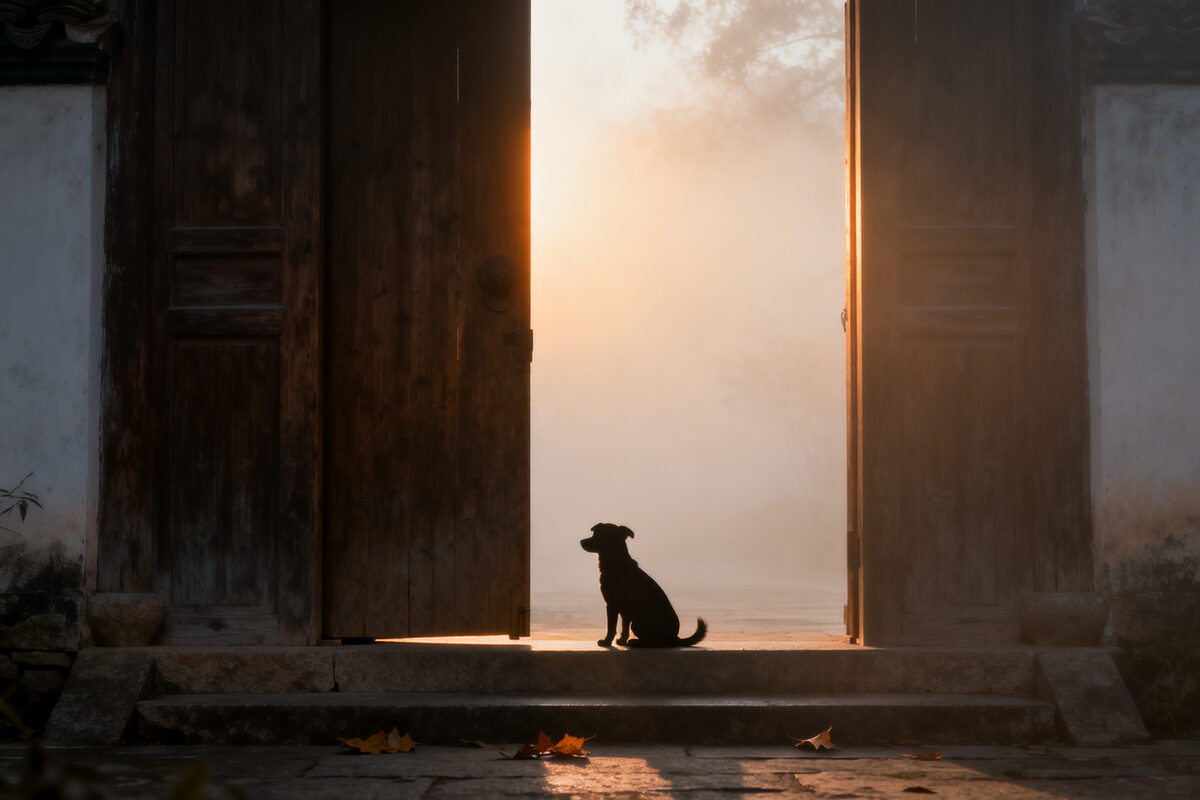
This "Mu" is not negation, not affirmation, not philosophy, not religion. It is a door. But don't try to push it open — because the act of pushing is itself the obstacle.
Just stand before the door. Don't push, don't pull, don't analyze what material the door is made of, don't research its historical origins.
Just stand there.
Then maybe one day, the wind will blow it open by itself.
Maybe not.
But that moment of standing before the door — that moment of no longer trying to solve the problem — maybe that is it.
I've written to here, and the dog outside has walked far away. The tea has gone completely cold. I set the cup down and glance at the book spread open on my desk — the first page of The Gateless Gate, its edges curled from being flipped through so many times.
I close the book.
I'll stop thinking now.
Three questions for you:
- Have you ever had a moment where all explanations ran out, and only silence remained? What was in that silence?
- If someone asked you the simplest question — like "Who are you?" — could you answer without thinking? Try it.
- Today, is there one thing where you could let go of the urge to "find the answer" and just let it be?