They Call It 'Chinese Yoga.' My Grandfather Called It Baduanjin.
On TikTok, a woman wrote: 'Three weeks in, my shoulders finally let go.' She was doing Baduanjin — the slow routine I watched my grandfather do in the park and found unbearably boring as a kid. Nine hundred years old, it has traveled from a Song dynasty official's midnight to a New York balcony.
I was scrolling my phone this morning when a video stopped me.
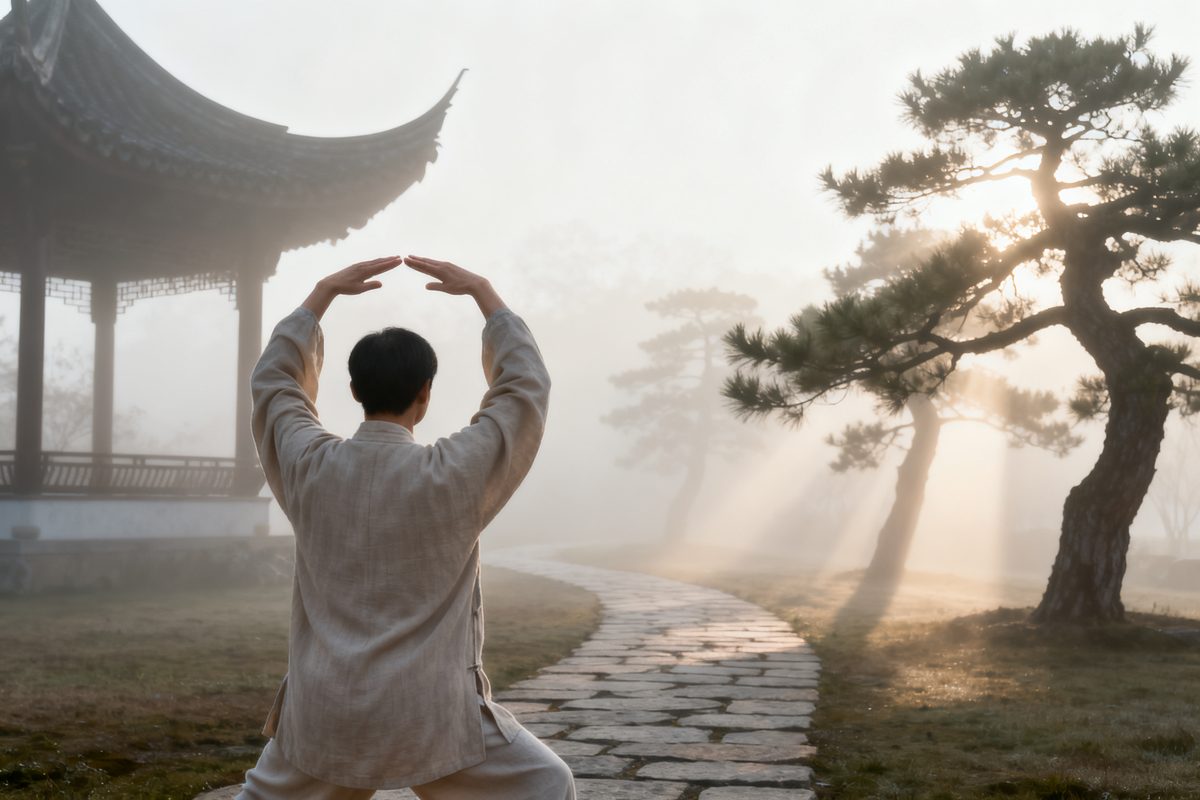
A woman in her twenties, standing barefoot on her balcony. English captions, quiet lo-fi music. Her arms rise slowly, up over her head, palms turning to the sky, as if holding something invisible. Then they sink back down.
The caption reads: Two Hands Hold Up The Sky.
The top comment, five thousand likes: "This is better than coffee. Been doing it for 3 weeks, my shoulders finally let go."
I stared at the screen for a few seconds and laughed out loud.
What she was doing is called Baduanjin. When I was a kid, I watched my grandfather do it in the park, probably a thousand times.
One
My grandfather used to go to the park at 5:30 every morning. One summer holiday, he dragged me along.
The sky was just turning gray, and a group of old people already stood in the small plaza. No music, no counting, completely quiet. Everyone followed an old man in a blue cotton shirt — slowly raising their arms, slowly turning, slowly bending.
I was eight or nine. Ten minutes in, I was bored out of my mind. Even radio calisthenics was more fun than this — at least it had a beat. I asked my grandfather: what is this, and why is it so slow?
He didn't even turn his head. "You'll understand when you're tired."
I didn't understand. I could run without getting winded. How would I ever be tired?
Two
Twenty-something years later.
My days now: sit down at the computer at eight, eat lunch facing a screen, stand up at night with a stiff neck. For a while my shoulders were so tight that reaching the top shelf hurt. I went to a massage place. The man pressed twice and said: this isn't an injury. This is rust. Machines rust when left alone too long. So do people.
I bought a gym membership. Went four times before it expired. I tried running, bought all the gear, lasted two weeks. It's not that I couldn't keep going — it's that every time I exercised, I couldn't stop checking the numbers. Kilometers today, calories burned, heart rate. Exercise had become another KPI. Work was exhausting enough; now I was grading myself a second time.
So I quietly gave up, and comfortably stayed rusted.
Three
I found Baduanjin again last winter, after a sleepless night.
I woke past four and couldn't get back to sleep. Lying there in the dark, I typed the word into my phone. An old twelve-minute tutorial came up — plain teaching video, an instructor in a red tracksuit standing against a white wall.
I got out of bed, stood barefoot on the floor, and followed along.
First movement: Two Hands Hold Up The Sky. Hands crossing at the belly, rising slowly, chin lifting, palms opening upward—
And in that one motion, I heard my shoulder blade click. Like a door that hadn't been opened in years.
Second movement: Drawing the Bow. Horse stance, pulling an invisible bowstring, fingers spread. After three rounds on each side, warmth spread slowly through my upper back.
I didn't sweat. My heart rate didn't spike. No burn. But after those twelve minutes, sitting on the floor, I felt something like — my body letting out a long sigh.
It turns out the body sighs too. It just sighs so softly that normally you can't hear it.
Four
Later I read a little about where it comes from, and it kept getting more interesting.
Baduanjin is not new. A Southern Song book from the 1100s mentions an official named Li Siju who would get up at midnight to sit, breathe, and massage himself — practicing exactly this "Baduanjin." Counting back, these eight movements have been moving through China for at least nine hundred years.
Even the name is lovely. Jin means brocade — figured silk. The ancients compared this routine to eight lengths of precious silk: movements unfolding, unbroken, like fabric.
And the names of the movements:
Two hands hold up the sky — to clear the triple burner. Draw the bow left and right — as if shooting an eagle. Raise one hand alone — to settle the stomach and spleen. Look back over your shoulder — to undo the five strains and seven wounds. Sway the head, sweep the tail — to cool the fire of the heart. Reach down and hold your feet — to steady the kidneys and waist. Clench the fists, widen the eyes — to gather strength. Rise on the toes seven times — and a hundred illnesses fade away.
Read them out loud. The first half of each line is the movement. The second half is a promise. A whole map of the body, folded into eight sentences. The Chinese wrote poems even for exercise — and quietly slipped the body's logic inside.
I won't claim it cures a hundred illnesses. But I slowly understood its logic. The modern logic of exercise is burning — burn calories, tear muscle fibers, recover, get stronger. It does work on you.
Baduanjin doesn't work on you. It's closer to unblocking. In Chinese medicine they say: where there is flow, there is no pain; where there is pain, there is no flow. The question isn't how much you burned. The question is: does everything move the way it should. The breath, the shoulders, the qi.
Slow is not lazy. Slow is another way of using strength.
Five
Back to TikTok.
I browsed the #baduanjin tag. The videos count their views in the tens of millions. The people practicing are all over the place: apartments in New York, back gardens in England, Chinese-American kids learning from their grandfathers. Some call it Chinese yoga, some call it Daoist morning stretch. One creator keeps patiently correcting his followers: it's not yoga. It's Baduanjin. Eight pieces of brocade.
One of the most-liked comments came from a Chinese user: "This is what my grandma does every morning in the park. The whole world is finally catching up."
Dozens of replies underneath: Your grandma is a legend.
Reading these, I thought of what my grandfather said. You'll understand when you're tired.
He could never have imagined that decades later, young people across an ocean would follow a phone screen and practice the movements he did his whole life. The movements are still the same eight. The names have been translated into other languages. But the thing itself hasn't changed: one person, in the early morning, slowly waking their own body, inch by inch, out of a night of sleep.
Six
My mornings now: get up, don't touch the phone first (most days I manage), boil a kettle. While the water heats, I stand on the balcony and do Baduanjin.
No check-ins, no counting, no chasing perfect form. On good days, all twelve minutes. Some days just the first movement — Two Hands Hold Up the Sky, three times. Three is enough for that rusty door in my shoulder blade to creak open.
My grandfather has been gone for many years. In my hometown, they say the old people still gather in the park every morning, still just as slow, still without music.
Only now, on the other side of the screen, there are many more faces — young ones, speaking English, speaking Spanish.
They don't know who Li Siju was. They've never heard of the book that remembered him. That's fine. They know the one thing that countless people have known, over nine hundred years:
Wake up, open the body slowly, and the day becomes a different day.
If you want to try:
Buy nothing. Go nowhere. Find a twelve-minute tutorial, take off your shoes, stand on the floor. Doing it badly is fine — Baduanjin has no "wrong." There is only doing it and not doing it. The first three times you will probably be bored out of your mind. That's exactly right. I was eight, and I felt the same.
Three questions to leave with you:
- When was the last time your shoulders were honestly raised over your head?
- Your last workout — was it for how your body felt, or for a number?
- If there were a practice that didn't ask you to be faster or stronger, only smoother — would you give it twelve minutes?