She Called It a "Superfood" on TikTok. My Mom Laughed: I'd Been Drinking That Soup My Whole Life
A girl in California introduced her new discovery: goji berry, antioxidants, an "ancient Chinese secret." My mom has been putting them in soup for forty years. She never asks "what does it contain" — only "who is it for." The same little red fruit: one civilization uses it to mock you for aging, another to prove you're trendy. Tonight I made a cup too. Whether it cures anything, I'm not sure. But the cup is warm in my hands.
She called it a "superfood" on TikTok. My mom just laughed: I'd been drinking that soup my whole life
A few days ago I saw a video. A girl in California, very serious, introducing her newly discovered "superfood" to the camera: a small handful of little red dried fruits, dropped into hot water. She called them goji berries. Antioxidants. Good for the eyes. An "ancient Chinese secret."
The comments were excited. Someone said they'd add it to their smoothie. Someone said they bought the capsule version.
If my mom ever saw that video, she would laugh.
Because that thing is called gouqi. She's been putting it in soup for forty years.
A brief history of one bowl of soup
As a kid I didn't like soup. On a Cantonese dinner table there is always a pot of it, slow-cooked for two or three hours, with unnameable things inside: a few slices of ginger, a few red dates, a handful of goji berries, sometimes yuzhu, sometimes dried figs.
A child's tongue only tastes salty or bland. It can't taste reasons. And my mom never explained. She just dropped a few goji berries into my cup when I stayed up studying; simmered pear and fig when my throat hurt; quietly set the soup down when I said "whatever, anything is fine."
Her medicine cabinet was the kitchen.
Only later did I learn this whole system has a name: medicine and food share the same source. It traces back to the Huangdi Neijing, written over two thousand years ago — "eaten on an empty stomach, it is food; eaten by the sick, it is medicine." Same thing. When you're hungry, it's dinner. When you're ill, it's a remedy. The line isn't in the food. It's in the person.
Goji berries have a specific seat in this system: they enter the liver and kidney meridians, nourish and brighten the eyes. The Shennong Bencao Jing listed them as a top-grade herb, saying long-term use "strengthens the body, makes one light and unaging."
"Light and unaging" — people were saying that two thousand years ago. See, the hunger for a "superfood" is nothing new.
Two civilizations, one ocean apart, studying the same little red fruit
What's interesting is how differently each side asks its questions.
The Western lab asks: what do you contain? The answer is a string of chemical names — zeaxanthin, polysaccharides, carotene, vitamin C. So it gets put into capsules, labeled with dosages, lined up on the supplement shelf next to fish oil and CoQ10. Every bottle says how many milligrams.
My mom never asks "what does it contain." She asks "who is it for."
Is there internal heat? Is the throat dry? Are the eyes tired? In her head there's no ingredient list. There's an older chart — cold, cool, warm, hot. Goji is neutral, slightly warm: good in winter, skipped during a fever or a cold. Paired with chrysanthemum it clears the liver and eyes; paired with red dates it builds blood; brewed alone it gently restores.
The same person, right for it yesterday, maybe wrong for it today. The fruit didn't change. The person did.
I realized this is really two very different views of the world: one wants to take food apart into parts and find the "active ingredient." The other treats food as a relationship — how it gets along with this person, at this moment.
Which one is right? I honestly don't know. The zeaxanthin in the lab is real, and so is my mom's soup. Maybe both are real, just real at different levels.
Middle age in a thermos, youth in a smoothie
For a while, goji berries were a joke on the Chinese internet.
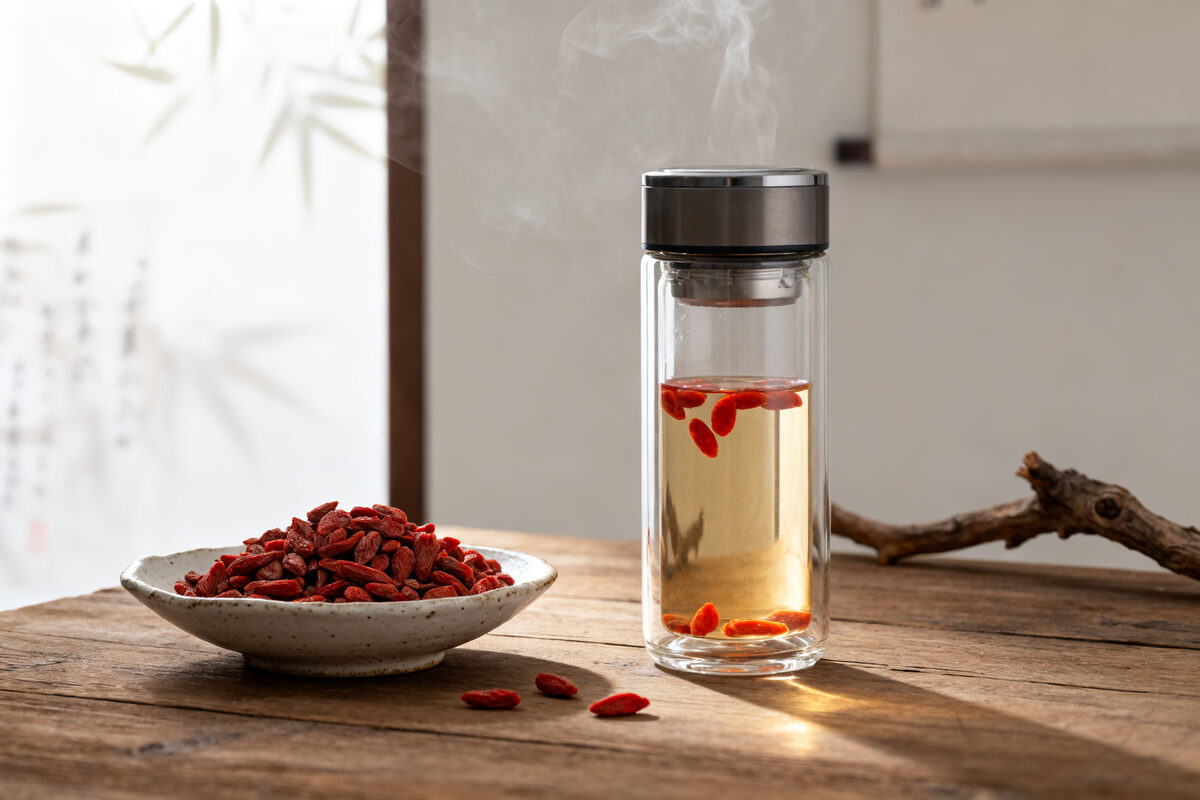
The uniform of the "midlife crisis": goji berries in a thermos. A middle-aged man who no longer drinks iced cola, carries a thermos, a few red fruits floating inside — that image was once used to mock a man for "getting old," for "giving up."
But have you noticed? The wind has changed.
Now it's young people in gyms dropping goji into their shaker bottles. Office workers deep in overtime, cups floating with goji and chrysanthemum. Nobody laughs anymore, because everyone has become that picture.
And on the other side of the ocean, the same picture is being translated into another language: goji berry, superfood, antioxidant, $12.99 a pack, in a nice kraft-paper bag with "ancient wellness" on the label.
The same fruit. In one civilization, it's the mockery of "you're old." In another, it's the badge of "you're trendy."
Sometimes I think both sides are actually drinking the same thing: faith that "it's not too late to fix it." The middle-aged believe starting now is still in time. The young believe early prevention spares them the same fate. The goji slowly unfurls in the hot water like a sentence of comfort: still time, still time.
My mom has never heard of antioxidants
Last year I went home and showed her that TikTok video.
She put on her reading glasses, watched for a long time, and asked: what is this?
I said, it's goji. Foreigners are brewing goji.
She went "oh," handed the phone back, and said: then they're doing it wrong. Just soaking in water is a waste. Goji should be cooked, or chewed. Soaking alone barely gets anything out.
I froze, and went to check. There really are studies saying the bioavailability of zeaxanthin in goji depends heavily on how it's processed.
My mom doesn't know what zeaxanthin is, or antioxidants, or superfood. She has simply cooked soup for forty years and watched a family's faces grow up and grow old. Her knowledge isn't written in papers. It's written in her hands — how much to add, when to add it, who shouldn't have it. More feel than theory.
The Dao De Jing says: "To know that you do not know is best. To not know and think you know is a disease."
My mom is the first kind. She doesn't think her soup is anything special. Ask her why she cooks it this way and she says, "that's just how it's done."
Honestly, those confident words in the video — detox, superfood, miracle berry — sound further from knowing than that.
Ending
Tonight I made a cup too. A few goji berries fell into hot water, sank first, then slowly rose, their wrinkles unfurling little by little, tinting the water a pale gold.
Someone did this a thousand years ago. Someone on the other side of an ocean is doing it right now. Tomorrow morning my mom will still drop a handful into the soup.
Whether it cures anything, I'm not sure. But the cup is warm in my hands. That much I'm sure of.
Three questions for you:
- Is there something you ate growing up that the outside world suddenly discovered as a treasure?
- If you could only ask one question — "what's in it" or "is it right for you" — which would you ask?
- When was the last time you finished a cup of hot water, slowly?