Americans Sculpt Their Faces With Gua Sha. My Mom Healed Me With It.
A thirty-dollar jade stone on TikTok and the fifteen-yuan buffalo horn board in my mom's drawer are the same thing. They call it lymphatic drainage. My mom calls it "bringing out the sha." One untranslatable word, two beliefs an ocean apart.
I saw it again on Instagram.
A beautiful blogger sitting in a bathroom full of morning light, holding a flat little board, slowly pushing it along her cheekbone. The caption said "my morning gua sha routine." Two million likes. People in the comments asking where to buy. The link led to a thirty-dollar jade stone, tax not included. You could chill it in the fridge first, "for extra de-puffing."
I stared at that board for a long time.
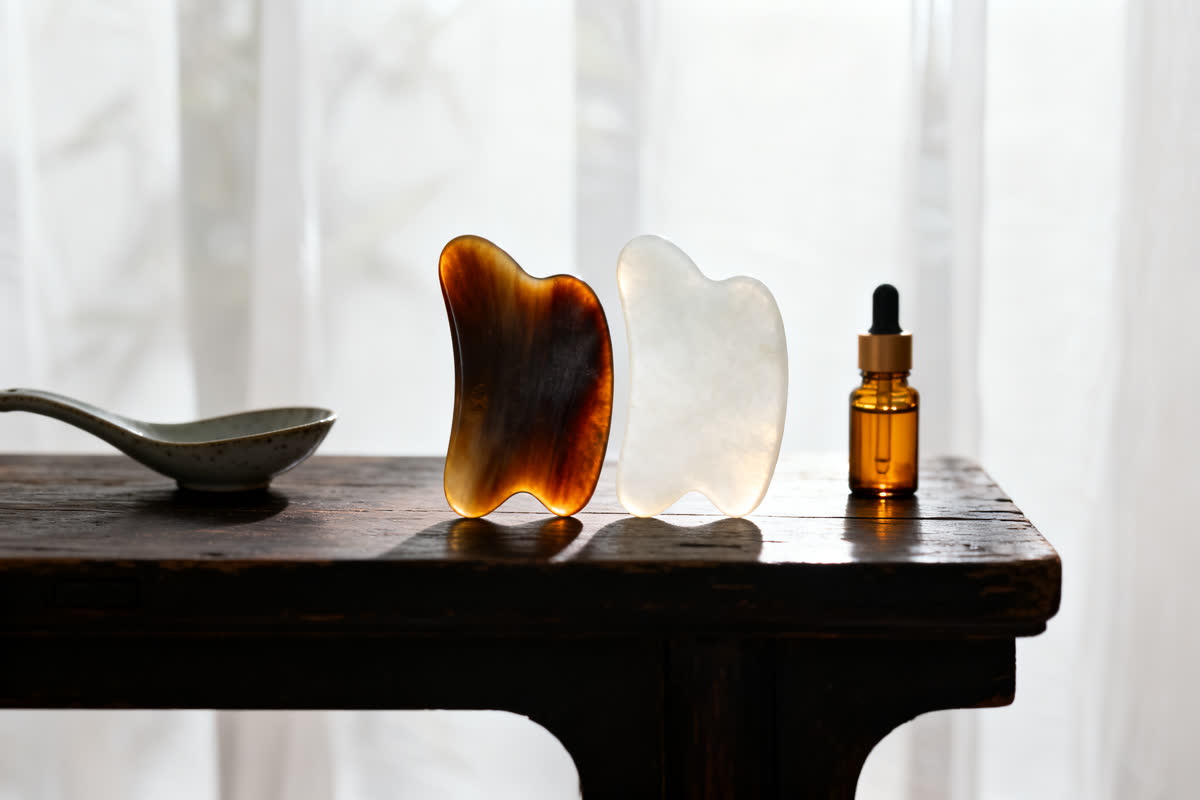
Because I know it. My mom has one in her drawer. Buffalo horn, edges worn round and smooth, the color of dark amber. Twenty years of use. I think it cost about fifteen yuan.
Same shape. Same motion. An ocean apart, living two completely different lives.
On TikTok, gua sha shows up like this:
Early morning. A chilled jade stone. A drop or two of facial oil. From jaw to ear, from brow to hairline. The blogger calls it lymphatic drainage — "de-puff," "sculpt your jawline." Sculpting. They love that word.
The comments are all "it works!!!" — my jawline is so much sharper now.
In their world, the board is a beauty tool. Cold, clean, pretty. Morning light, face oil, a small private ritual almost anyone can afford.
In my mom's world, the scraping board shows up like this:
When I was little, I once got "sha" in the summer — heatstroke, the folk kind. Dizzy, nauseous, my whole body tight. I couldn't say where it hurt. It just hurt everywhere. My mom didn't panic. She sat me backwards on a stool, told me to lift my shirt, took a little porcelain spoon, dipped it in cooking oil, and scraped my neck and back. Stroke by stroke.
It hurt. It really hurt. I cried every time.
Wherever she scraped, clouds of purple-red rose to the skin, one patch after another, like bruises shaped like thunderclouds. My mom would look at it and say: "The sha is out." And you could hear the relief in her voice — like the illness had been dragged out of me and pinned there on display.
The next day, I was fine. The dizziness was gone, that tight feeling had loosened. The purple clouds faded over the following days — yellow, then green, like a sunset inside a bruise.
Later I learned that in English, those purple marks are simply called "sha."
Doctors call them petechiae. Some American doctors have been genuinely alarmed — a patient walks in with a purple-red back, the first thought is abuse, and the patient says: oh no, that's my gua sha, I feel so much better now.
I have to be honest here: I'm no expert on medicine, and I can't hand down a verdict for either side.
Chinese medicine says the sha is illness being pushed out — evidence that something bad has been driven from deep inside to the surface. The sha is out, so the blockage is open. Once it flows, the pain stops.
Modern medicine says the redness is tiny capillaries leaking under pressure — a controlled, mild injury. Afterward the body rushes in to repair, local blood flow speeds up — and maybe that's where the "lighter, looser" feeling comes from.
Others would say: it's just placebo.
My own experience: that afternoon, I went from "too sick to talk" to "out playing." A nine-year-old doesn't know the word placebo. A nine-year-old only knows: mom's hands, that spoon, those purple clouds — it worked.
I still have no verdict. I just find it fascinating: two languages, thousands of years apart, an ocean apart, somehow describing the same bodily event. A board presses the skin, red clouds rise underneath, and the person feels better.
One side calls it illness leaving the body. The other calls it lymphatic drainage.
I can't translate it. Like "shanghuo" — "heatiness" — the word sha has no equivalent. It survives in English as pinyin, sha, borrowed whole. Like tofu. Like yin and yang. Some things one civilization uses for thousands of years, and the other can only lift the entire word, unchanged.
Actually, these two worlds have collided before — much louder than on TikTok.
In 2001 there was a Chinese movie called "The Gua Sha Treatment." A Chinese grandfather scrapes his grandson's back in America; the marks are taken as evidence of child abuse; the case goes to court; the family nearly falls apart. The hardest scene is the courtroom, where nobody can explain what gua sha actually is. One side is certain it's harm. The other side is certain it's love. Both desperate — and no word anywhere to break the wall between them.
That was twenty-five years ago. Watching it then, it felt like injustice, a cultural misunderstanding.
Watching it now is strange. The word nobody in that courtroom could understand hangs today on TikTok's hashtag shelf: gua sha, billions of views. Los Angeles bloggers sculpt their jawlines with it. New York spas print it on their menus. Thirty dollars a stone. The wall didn't fall. It just turned around — the same board that was once "evidence of abuse" became "a beauty tool."
I don't know whether to call that understanding, or another way of missing each other. They took the board in. But the part they took was the de-puffing and the sculpting. The part my mom actually believes — the sha coming out, the illness leaving, "once it flows, the pain stops" — is still outside the translation.
Maybe that's how cultures meet: first misunderstood, then fashionably adopted, then slowly, slowly understood. Or never understood at all. But at least the board stayed.
One more detail I keep thinking about.
TikTok bloggers wince a little while scraping, and say: a little tender. And someone in the comments will reply: that's the good pain.
The good pain.
My mom's version: "If it doesn't hurt, it isn't working."
Look at that. On the subject of pain, the two civilizations meet again. Both admit there is such a thing as a useful pain. Not the pain of injury — the pain of unclogging. The muffled sound the body makes when a blocked place is finally found and pushed open.
Their version is more refined: chilled stone, oil, morning light, a jawline — the pain carefully dosed at "a little tender," just right for one video.
My mom's version is rougher: porcelain spoon, cooking oil, scrape after scrape, crying, until the clouds cover your back.
But mute both scenes and watch only the motion — a board, dipped in oil, pressed against skin, pushed in one direction, over and over — and you are watching the same thing. You couldn't tell a Los Angeles morning from a county-town afternoon in my childhood.
I called my mom a few days ago and asked if she still has that buffalo horn board.
She said yes, and asked why I wanted to know.
I said Americans use it now. Jade ones. They chill them in the fridge and scrape their faces. Thirty dollars. Supposed to slim your face.
She laughed. "Thirty?" Then, after a pause: "Chilled won't do. The cold gets into you. It should be warm — rub it hot in your hands first."
An ocean apart, the same board, and they can't even agree on whether it should be cold or warm.
But before hanging up, she added: "Still. Scraping does feel good. It even brightens your eyes."
I think that's the floor beneath all the arguing. Whatever the explanations say, the body itself knows: scraping feels good.
This board has traveled from porcelain spoon to jade roller, from cooking oil to face oil, from "bringing out the sha" to "lymphatic drainage," from my back to a jawline in Los Angeles. So many names. So many prices.
And what it does has stayed the same for thousands of years: where a person is blocked, give a push.
Three questions, for you:
- Have you ever been scraped? Do you remember that feeling — pain first, then the loosening? If you remember it: compared to any "modern" relaxation you've tried, which felt more real?
- Is there a word like "sha" in your language — alive at home, impossible to translate?
- What did the older generation fix for us with "old-fashioned" methods when we were kids? We found them embarrassing back then. Do you miss them a little now?