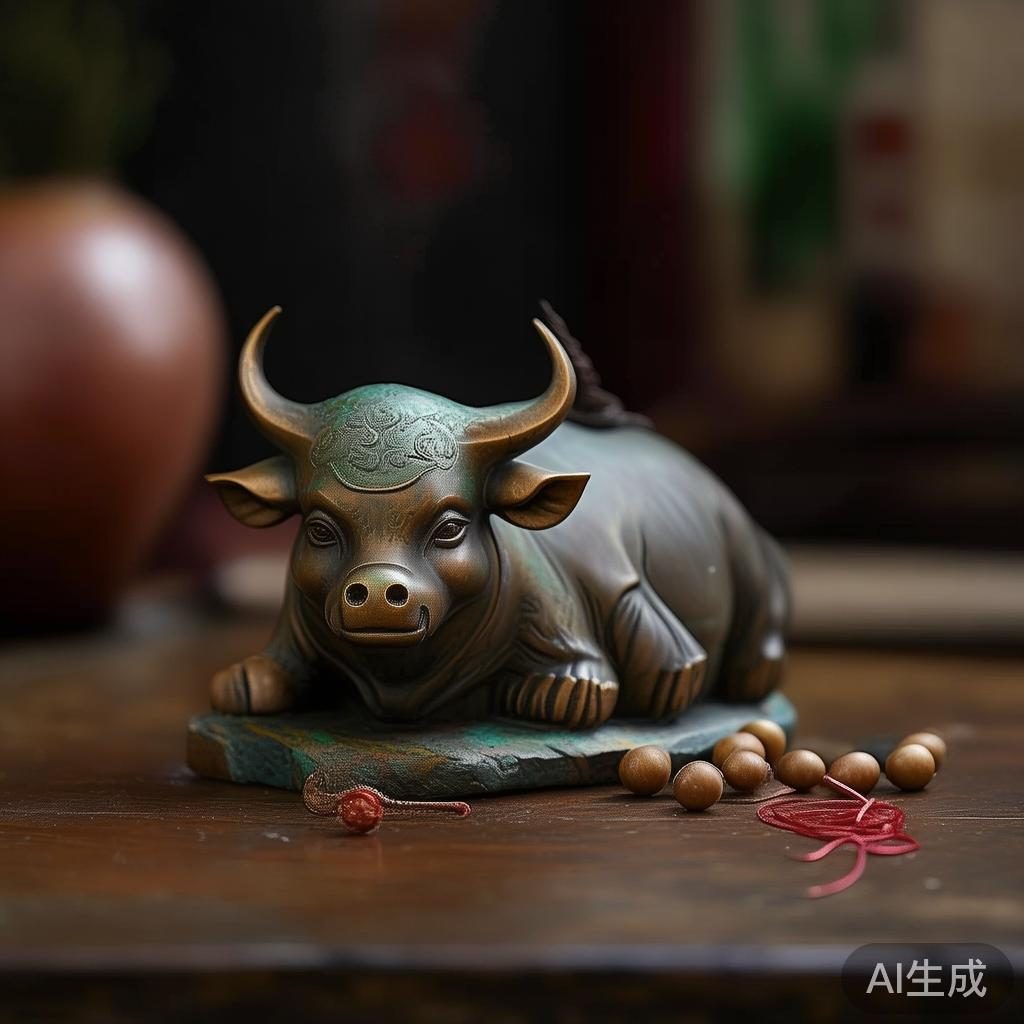
Her Zodiac Year Is Coming: One Red String, Two Civilizations, No Copying
A friend asked if the red string of her zodiac year actually works. Digging around, I found the Kabbalah red string, the matchmaker god's red thread, and the benmingnian bracelet — on opposite ends of Eurasia, humans invented the same red string more than once. It doesn't ward off evil. It just reminds you that someone is looking out for you this year.
A friend messaged me at eleven last night. Next year is her benmingnian — her zodiac year, the year her own animal sign comes back around. Her mom had already started on the topic of red underwear. She asked me: honestly, does this stuff work?
Honestly? I don't know.
But I told her about my cousin. Two years ago, in her zodiac year, she wore red from head to toe. Red socks, red belt, a red string bracelet — the kind her grandmother got for her at a temple. That year went pretty well for her. She got promoted, fell in love, and at her year-end checkup they found a tiny thyroid nodule. Benign. Just keep an eye on it. Was that a lucky year or not?
Her mom said: see, without all that red, it wouldn't have stopped at a nodule.
You can't argue with that. It doesn't stand on logic. It stands on caring.
Every twelve years, your year comes back
First, what benmingnian actually is. The animal sign of the year you were born comes around again every twelve years. The Earthly Branch of that year is exactly the same as the year you arrived. Folks call it "sitting with Tai Sui" — the Year God of your own year. Some regions call it the "threshold year." A threshold. Step over it and the road smooths out.
The old rules for a zodiac year are many. No weddings, no moving house, nothing drastic. Wear red, be careful, stay steady. When younger people hear this, the first reaction is usually "superstition." Mine was too, for years.
Then I started wondering about something. Why do cultures all over the world have some version of "this year, be extra careful"? The West has the Saturn return — around age twenty-nine, Saturn comes back to the spot it occupied when you were born. Astrology books call it "the threshold of fate." Sounds familiar, doesn't it? A Saturn return runs into a zodiac year. One speaks with planets, one speaks with animal signs, and both are saying the same thing:
At this mark — twelve years, or twenty-nine — a person tends to stop and ask: how am I actually doing?
A zodiac year may not really be unluckier. But it is a culturally marked "audit year." Think about it: by thirty-six, by forty-eight, the body starts sending warnings, parents start getting old, a career hits its plateau. These things bunching up at certain ages isn't random. The ancients didn't have statistics, but they had eyes. They saw the pattern, so they gave it a name and dressed it in red — so people would remember.
Why red, of all colors
China's trust in red is far older than the phrase benmingnian.
You know the Nian beast from childhood stories — the monster that feared noise, light, and the color red. That's why firecrackers are red, spring couplets are red, lanterns are red. You can file it as a tale for children, but underneath sits something harder. The Han dynasty honored red as its color; Liu Bang styled himself the "son of the Red Emperor." From very early on, red was tied to the fortunes of a state. Go back further and cinnabar was one of the first mineral pigments people mastered — painted on cliff walls, glazed onto vessels, dotted on foreheads — prized because its red looked like blood, like fire, like life at its fullest burn.
In China, red was never just a color. It was a signal: alive, thriving, warding.
And here's the part that stopped me cold when I first learned it.
Kabbalah — a mystical strand of Jewish tradition — has a red string too. Tie one around your left wrist and it blocks the "evil eye," the jealousy and ill will other people send your way. Madonna wore one. So did a string of Hollywood stars. The red string bracelet that trended in Western fashion a few years ago traces back to that lineage.
Two traditions, on opposite ends of the Eurasian landmass, who never once compared notes, picked the same red string.
I can't explain the coincidence. I can only tell you honestly: a red thread tied around a wrist, to keep out something unseen and unkind — humans invented that, separately, more than once.
Why a "string" and not a "charm"
This layer I only worked out recently.
In the Chinese pantheon there's an old man of the moon, the matchmaker god. How does he work? He takes a red thread and ties it around two people's ankles. Notice: he doesn't stamp a certificate. He doesn't issue a license. He ties.
Tying is a peculiar gesture. It isn't dramatic. No thunder. Just a soft loop or two, and a knot. From then on, even a thousand miles apart, those two people are "tied."
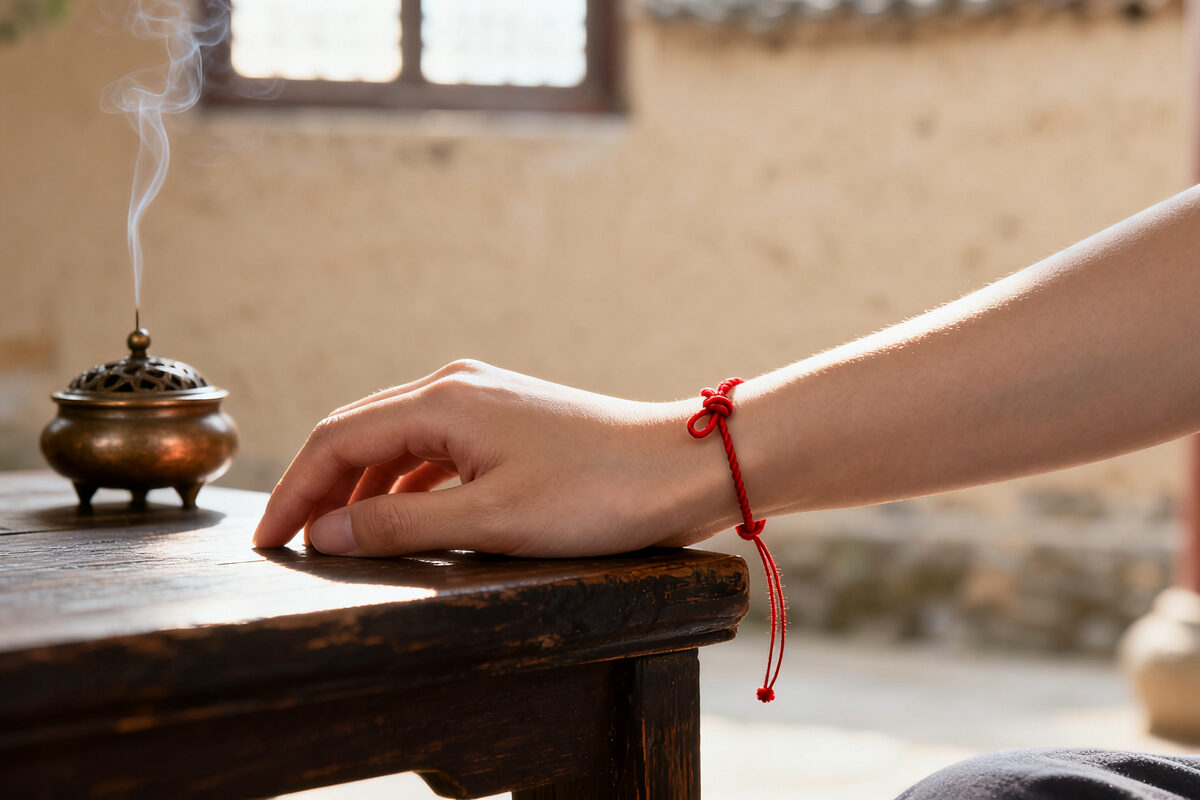
The red string runs on exactly that logic. It doesn't fight your battles. It doesn't step in front of the blade for you. It just sits there, wrapped around your wrist, resting against your skin — like a very light thing that never quite comes undone. The old rules say you mustn't cut it yourself, mustn't untie it casually; when it wears out, you take it off carefully and keep it, or burn it. All those rules boil down to one sentence:
A blessing is something you keep.
The string on your wrist doesn't ward off evil. But someone, before your zodiac year began, tied it on you with their own hands. The sentence they were thinking as they tied it — "let this year pass safely" — that is the entire contents of this object. The string is just that sentence, made physical.
Which brings me back to my cousin. Her bracelet came from a temple, tied by her grandmother. She wore it a whole year, and nothing bad happened. Did it work? All I can say is: it kept one old woman at peace for a year, and every time that girl glanced at her wrist, she remembered someone was looking out for her. That was always what this thing was for. Not the metaphysics.
Science has glanced at red too
One more thing, in passing. In 2005, two British researchers published a short paper in Nature noting that in Olympic combat sports, the athlete in red won slightly more often. The paper was brief, the finding contested, and later attempts to replicate it have gone both ways.
I'm not claiming this proves red wards off evil. I bring it up for another reason: color really does reach into a person's state of mind. A little, for the one wearing it and the one looking at it. In a boxing match that might be a few percentage points of win rate. In an anxious person's zodiac year, it might be the small thought: should I take it easier today?
The ancients didn't have the phrase "placebo," but they seem to have known early on that sometimes a person needs something visible to hold up a stretch of days that isn't.
The red string is that kind of thing. It doesn't solve anything. It just reminds you: this year, you've been marked. You've been thought of. So walk a little slower, keep your temper a little smaller, sleep a little more.
My own zodiac year
My last one, my mom bought me red socks. I never wore them — the day had already passed — so I tossed them in a drawer, where they sat for years.
Last year, digging through things, I found them. Still bright red. I sat on the floor looking at them for a long time. In the end I didn't throw them out. Back in the drawer they went.
I still don't wear them. I just can't throw them away either. What do you call that? I honestly don't know. To anyone else those socks are superstition. To me they're an image: my mother, one winter, standing at a market stall, remembering that her son's zodiac year was coming — and bending down to pick out socks.
Red doesn't ward off anything. But being thought of — I've come to believe that itself is a kind of protection.
Next year is my friend's zodiac year. I'll probably go with her to pick out a red string. Not one I tie on myself — by the old rules, it only counts if someone gives it to you.
While we're choosing, I'll tell her: this string won't bless you. Its only job is to remind you — someone hopes you get through this year well.
The rest is still yours to get through.
Three questions for you
- Do you own something you "don't believe in but can't throw away"? What is it, and who gave it to you?
- In your culture (or one you've encountered), is there anything like the red string — a small thing worn on the body to keep something out?
- If next year were your "threshold year," who would you want to tie that string for you?