She Thought She "Lacked Water" and Asked About a Humidifier. So I Showed Her My Kitchen.
A reader asked me, in earnest: she lacks the water element — should she buy a humidifier? Instead of answering, I showed her the old clay stove in my family kitchen. Wood, fire, ash, iron, steam — the five elements are not in a crystal shop. They are in a cycle. What was missing was never an element.
Last night, a reader sent me a message. She said she'd been getting into Eastern stuff lately, read an article saying she "lacks the water element" — fire sign, quick temper, dry skin. Then she asked me, in all seriousness:
"Should I buy a humidifier?"
I stared at that message for a long time, not knowing how to reply.
I wasn't laughing at her. Quite the opposite — I thought it was an honest question. She treated "lacking water" as something real, something you could fix, the way you fix low calcium with supplements. This way of thinking is everywhere in Western wellness circles now. I went and searched, and there really are people discussing how to "balance your elements": small fountains by the bed, blue crystals, fish tanks in the living room.
A humidifier does no harm, of course. But sitting there, I suddenly really wanted to tell her about my family's kitchen.
My Kitchen Holds the Whole Five Elements
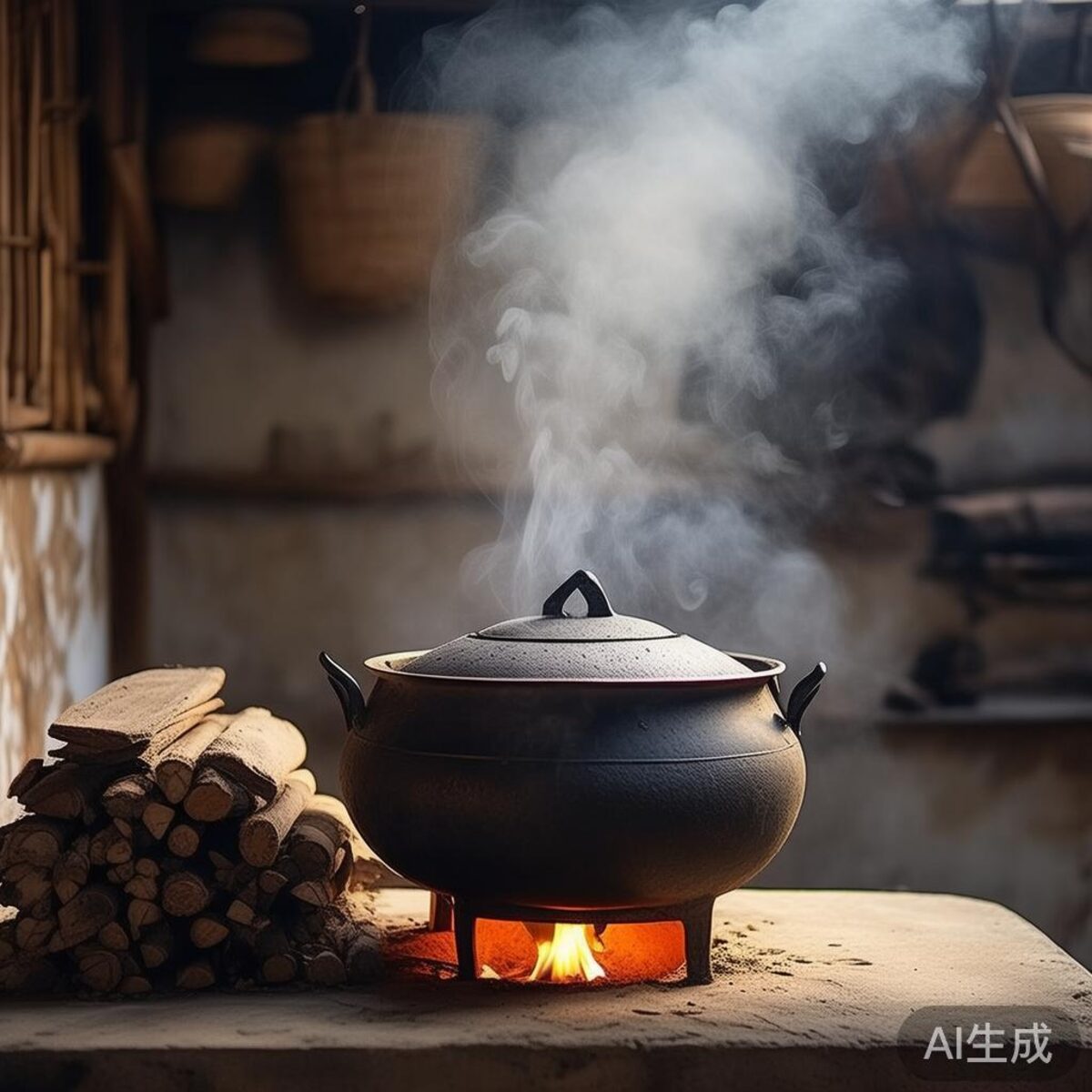
The stove in my childhood home is the old kind, a clay stove my mother cooked on for thirty years. If you stand in front of that stove, you can see the five elements plainly —
You burn firewood. The wood was cut from trees. Wood. The wood catches, flames leap up, the bottom of the wok glows red. Fire. The wood burns down to ash. The ash mixes into the earth beside the stove, and after years, that patch of ground turns rich. Earth. On the stove sits an iron wok, and the spatula is iron too. Where does iron come from? From ore in the mountains, buried in the earth. Metal. Inside the wok, congee is simmering. Water rings the lid, hissing when you add more. Water.
Wood feeds fire, fire becomes earth, earth bears metal, metal collects water, water grows wood — the log turns to flame, the flame falls to ash, the ash turns to earth, the earth holds ore, the ore is smelted to iron, the iron wok boils water, and the water goes back to feed the trees.
These are not five things. They are five movements, one cycle, one flowing road.
I later read that the ancients called this system "wuxing." The character "xing" originally means to walk, to run, to move. It is not "five elements" — five static elements sitting there waiting for you to spot the missing one and replace it. It is five movements. Five processes in motion.
The translation lost the most important word.
The Controlling Cycle Is the Clever Part
Generating isn't the whole story. Wuxing has another web, the controlling cycle: water controls fire, fire controls metal, metal controls wood, wood controls earth, earth controls water.
I used to think "control" was a bad word, one thing suppressing another. Then I worked it out in the kitchen — control means "keeping watch over."
Think about simmering congee. Water controls fire, so there must be water in the pot; however big the flame, it cannot burn the congee — the water keeps the fire in check. But too much water under too small a fire, and the congee never boils. Metal controls wood: you cut vegetables with an iron knife, and the hardest firewood splits under the cleaver. Wood controls earth: tree roots grip the soil, so the rain cannot wash it away — wherever there are trees on a hillside, the earth stays.
One web holding another web. No one gets to dominate alone.
Chinese medicine carried this web into the body: liver is wood, heart is fire, spleen is earth, lungs are metal, kidneys are water. Your anger is liver fire. If nothing restrains that fire, it burns upward — dizziness, insomnia, a bitter taste in your mouth. What does it need? Water. Kidney water rises to hold it down. Why do old doctors always say "nourish water to enrich wood"? It means watering a burning tree.
In this medicine, a temper is not a "personality problem." It is an imbalance of the five. I come from computers, and when I finally understood this, the phrase that jumped into my head was: this is a relational database, not an attribute table.
So How Do You Tell What You "Lack"?
That is her real question. Everyone's real question.
Let me say something that may disappoint you first: wuxing is not used that way. It is not a birth chart. You cannot type in a birthday and have the screen say "You lack water, humidifier recommended." When an old Chinese doctor actually reads you, he looks at your tongue, asks about your sleep, feels your pulse — he is reading an overall tilt. Too dry or too damp, too hot or too cold, too restless or too stagnant.
But if you want a rough feel for yourself, here is a clumsy method. Don't ask "which element am I missing." Ask "which movement is running too hard":
- Are you always burning? Quick temper, fast talk, poor sleep, dry mouth, red eyes. Too much fire.
- Are you always moving? Cannot stop, scrolling until your hand cramps, panicking after five quiet minutes. Wood is overgrowing, pushing up with no restraint.
- Are you stuck? Overthinking, no appetite, bloating, a sallow face. Earth is too weak to transport and transform.
- Are you too dry? Dry skin, dry throat, miserable every autumn. The lungs' rhythm of descent is off.
- Are you running on empty? Late nights, overdraft, sore lower back, cold intolerance, fading memory. Water is depleted — the kidneys' reserves are burning low.
See? Asked this way, the answer has nothing to do with buying a humidifier.
And "Supplementing" Is Not Stuffing Things In
All right — say you really have seen it: you run dry, you run empty, your water is low. How do you supplement?
The ancients' way was never "shove in whatever is missing." It was "lend the cycle a hand, go with its grain."
Through color. The five colors enter the five organs: black to kidneys, white to lungs, red to heart, yellow to spleen, green to liver. That's why my mother always grabs a handful of black beans and black sesame for winter congee — not because black foods contain some mystic molecule, but because for centuries people used color as a reminder to themselves: it is winter, draw inward, tend the root. Today that sentence travels on TikTok as "eat for your kidneys," and the comments are all wow. My grandmother's grandmother ate this way.
Through flavor. Salty enters the kidneys, sour the liver, bitter the heart, sweet the spleen, pungent the lungs. But hear the whole sentence: these flavors assist, they do not license binges. Too much salt injures the kidneys — my grandmother knew that without a textbook.
Through rhythm. In winter, sleep early, rise late, follow the sun. Water governs winter, storage, stillness. You think you lack water — what you lack is storage. You spend every day, you never once withdraw into the vault. Sleep is the cheapest kidney tonic there is.
Through conduct. This one I know from my own body. There was a stretch when my fire ran high; everything and everyone annoyed me. I didn't buy a blue crystal. I just turned off my phone for twenty minutes each afternoon, brewed a pot of tea, and watched the leaves settle. Within a week, the fire was half gone. Why? The water didn't come from the teapot. It came from the act of slowing down. Stillness itself is water.
Do you see? In the end, what you supplement is your way of living. A humidifier raises the humidity of a room. It cannot raise the humidity of a life.
What I Finally Wrote Back to Her
I thought about it all night, and the next day I sent her this, more or less: buy the humidifier if you like — autumn is dry anyway, your skin will thank you. But if the "lacking water" you mean is that dry, rushed, burning feeling inside, then what you need to supplement is not the water element. It's slowness.
After work, don't reach for the phone. Boil a kettle of water and wait for it, slowly. Watch the steam leave the spout and dissolve. That is water replenishing you — in a way you can see.
She replied "ohh, got it," then said: I'll buy the humidifier first, and try your way too.
I laughed. Good. A humidifier by the stove, breathing out white mist — seen through the lens of the five elements, that's one small ladle of water added to this dry autumn.
Wood burns in the stove, ash settles into earth, the pot is iron, the congee is nearly ready.
Nothing is missing. What's missing was only the slowness.
Three questions to leave with you:
- In your day, how many hours go to fire and wood — burning and moving? How many go to water — stillness and storage?
- Tonight while cooking, try to find all five elements in your kitchen. How many can you spot?
- If you were to supplement something in yourself, do you truly lack that "element"? Or do you lack the way of living it stands for?