The Blind Turtle and the Floating Log: How Rare It Is to Have This Human Life
The Buddha told a story about a blind turtle at the bottom of a vast ocean, surfacing once every hundred years, trying to put its head through a hole in a randomly drifting piece of wood. That probability, he said, is how rare it is to obtain a human life. This story has stayed with me — about cherishing, about possibility, about still surfacing when you can't see the way.
The Blind Turtle and the Floating Log: How Rare It Is to Have This Human Life
I was sweeping the yard this morning when a leaf drifted down and landed right on top of a small stone. Not too big, not too small — it just covered it perfectly. I stopped for a moment. I felt like I'd seen that image somewhere before.
Then I remembered — it was from a metaphor the Buddha once told.
A Turtle That Cannot See
The Buddha said: imagine an ocean. Not the kind of ocean you see at the beach, but a body of water so vast it has no north, south, east, or west — so enormous that even a seabird couldn't fly across it.
At the bottom of this ocean lives a turtle.
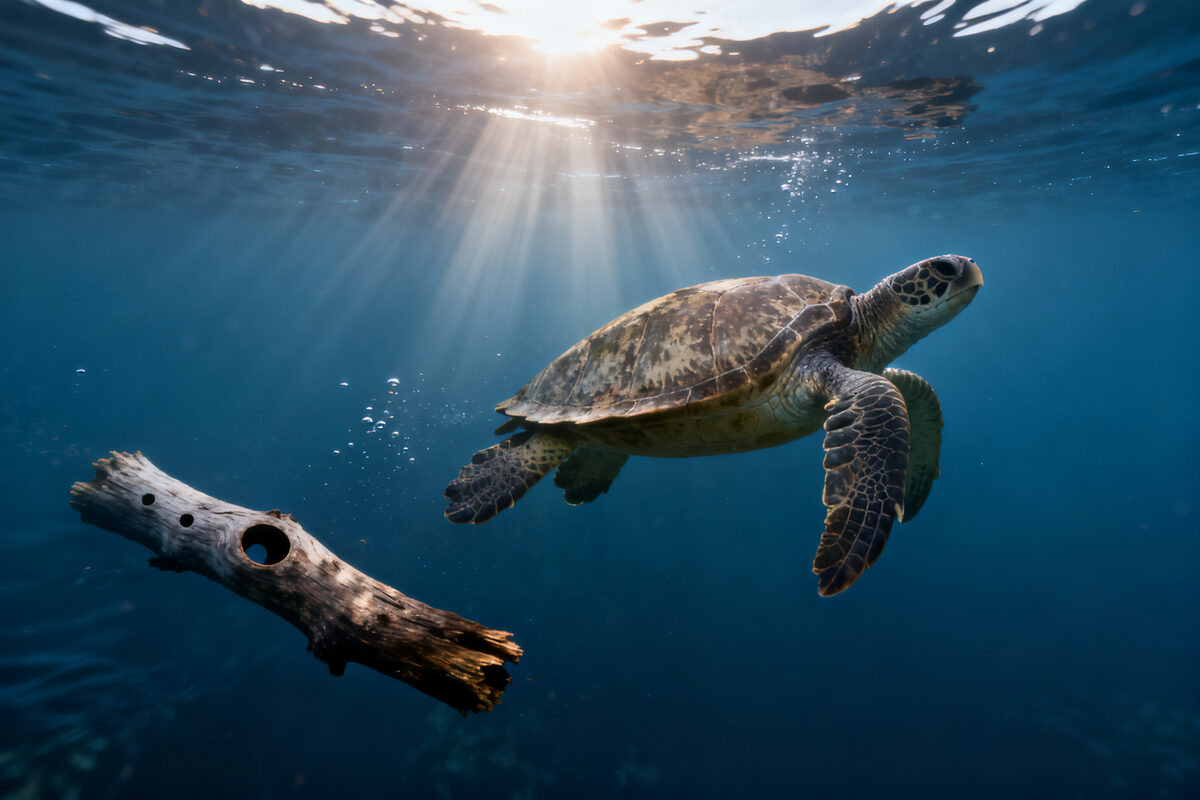
Not an ordinary turtle. This turtle is completely blind. It has lived for an incredibly long time — not decades, but the length of an entire kalpa. Once every hundred years, it rises from the ocean floor to the surface, takes one breath, and then sinks back down.
Once every hundred years.
On the surface of the water, there's a piece of wood. Not a big log — just a small piece of driftwood with a single hole in it, tossed about by the waves, drifting aimlessly across this boundless ocean.
The wind blows east, and the wood drifts east. The waves push west, and the wood goes west. No anchor, no direction — completely random.
The Buddha said: This blind turtle rises once every hundred years, and it has to put its head exactly through the hole in that floating piece of wood. That probability — that is how rare it is to obtain a human life.
The First Time I Heard This Story
I heard this story a few years ago at a temple. I had just started learning about Buddhism, and honestly, a lot of things still went over my head. After the dharma gathering ended, an older lay practitioner was chatting with me in the tea room, and he told me this metaphor.
To be honest, my first reaction was disbelief.
"Isn't this a bit much?" I thought. "No matter how rare human life is, it can't be that extreme."
The older man seemed to read my mind. He smiled, didn't argue, and just said, "Think about it yourself."
That night, I got home and lay in bed, unable to sleep. All I could think about was that turtle.
A turtle that can't see, in an ocean without edges, surfacing once every hundred years. A piece of wood drifting randomly on the surface. And — it has to put its head right through the hole.
I started doing the math.
If the turtle surfaces and the wood is a hundred miles to the east — missed it. If the wood is right above but tilted half a body-length off — missed it. If the wind suddenly picks up and moves the wood too fast — missed it. If a wave pushes the turtle just slightly off angle — missed again.
Every time, it misses.
Thousands of times, tens of thousands of times, billions of times — it misses.
Then, one day — maybe the trillionth time, maybe the ten-trillionth — the turtle rises, and the wood happens to be there, and the hole happens to line up, and its head goes right through.
This Isn't a Math Problem
I later told this to a friend who studies math. He said, "Let's calculate it. This kind of probability can be modeled geometrically — we just need the area of the ocean, the size of the hole..."
I said, "Go ahead."
He calculated for a while, then looked up at me and didn't say anything.
I said, "Yeah."
The point of this metaphor was never an exact number. The Buddha wasn't giving us a probability problem to solve to the nth decimal place. He was describing a feeling — that sense of "somehow, impossibly, it worked out."
Have you ever had a moment like that?
Running for the train, the doors are about to close, but you just barely squeeze in. Knocking over a cup, water spills everywhere, but your phone was a centimeter away from the splash. Forgetting your umbrella, and it starts raining halfway down the block, but there happens to be an awning right beside you.
That "close call" feeling — magnified ten thousand times — that's probably what "obtaining a human life" is like.
Sometimes I Wonder — What's So Great About Being Human?
To be honest, being a person is exhausting.
There's work, mortgages, relationships to navigate. Sometimes I look at the stray cat downstairs, sunbathing all day, dozing, waiting for food, and I feel envious. It doesn't have to think about tomorrow. It doesn't regret the past. It doesn't worry about saying the wrong thing.
So why is human life considered so rare and precious?
The Buddha taught that among the six realms, the heavenly realm is too pleasant. So pleasant that the thought of practice never arises. It's like a child who has had everything since birth — they never feel the need for change. The animal realm is too harsh. Every day spent finding food, avoiding danger — no bandwidth left to wonder "what is the meaning of life?"
Only the human realm — suffering and joy, mixed together.
Just enough suffering to make you think, "I can't keep going like this." And just enough joy to give you the strength to do something about it.
This middle ground is where practice begins.
There's Another Layer to the Turtle Story
I thought about it more, and I realized this story isn't just about "human life is rare." It's saying something else too.
The turtle is blind.
It can't see where the wood is. It doesn't know which direction the hole faces. It has absolutely no way to "aim" — it can only surface, and let things be as they are.
That's us, isn't it?
We don't know why we were born in this era, into this family. We don't know why some people are born into abundance while others struggle their whole lives just to get by. We don't know what will happen tomorrow, or where this life is heading.
We are all that blind turtle.
But the story says — even without seeing, surfacing means there's a possibility.
Not a certainty. A possibility.
Is that "possibility" enough? I don't know. Maybe it's not about whether it's enough. Maybe "surfacing" itself is the meaning.
Once at the Temple
There was a rainy day when I sat alone under the eaves of a temple. I wasn't there to pray for anything. I was just sitting.
Rain hit the roof tiles and dripped from the eaves onto the stone pavement below. The stones had water stains worn deep over the years — ring after ring, like a record of every rainstorm that had ever passed.
I thought, how many years did it take for those stains to form on this stone? Drop by drop, storm by storm. Each drop unremarkable on its own, but given enough time, it leaves a mark.
The turtle is like that too. Rising again and again, missing again and again. But it doesn't stop. Every hundred years, it still comes up. Not because it knows this time will be the one — just because that's the only thing it can do.
I'm not sure if that counts as practice. Probably does.
I Talked to the Older Lay Practitioner Again
He said something once that I still remember.
He said: "Knowing that human life is rare isn't meant to make you anxious. It's meant to help you cherish it."
I didn't fully understand at first. Later, slowly, I got it.
If human life really is as rare as the blind turtle and the floating log, then this human life I have right now is like winning the lottery. Not because I'm especially accomplished, or because I did something extraordinary. Just — it happened to work out.
This feeling of "it just happened to work out" shouldn't make you anxious, thinking "I need to do something quickly." It should make you quiet, thinking: "Oh. I'm already this lucky."
And then, carrying that sense of luck into each day.
Not every moment needs to be "I must cherish this." Rather — knowing this, you naturally become a little more tender toward everything around you.
When sweeping the floor, you think: I can sweep. How wonderful. When eating, you think: I can taste. How wonderful. When you see the trees swaying outside the window, you think: I can see green. How wonderful.
Here at the End
I'm sitting at my desk. It's dark outside now. There's a cup of tea on the desk that's gone cold, and beside it, my mala beads — sandalwood, worn smooth from use, like something that's been held for a very long time.
I think of that blind turtle.
It's still at the bottom of the ocean. Or maybe it's rising right now. Or maybe it just missed a piece of wood. Or — maybe, just maybe — it put its head right through.
If it's the last one, I hope it knows.
A few questions, for myself, and for you:
-
Have you ever had one of those "wow, I just barely made it" moments? What did that feel like?
-
If human life really is this rare, are the things you did today cherishing it — or wasting it?
-
That blind turtle, every hundred years, still rises — when you can't see the way forward, do you keep "surfacing"?