The Daoist Told Me He Hadn't Eaten Lunch in Seven Years
On a lost path behind Mount Qingcheng, I met a Daoist who had not eaten lunch in seven years. Bigu is not dieting, nor fasting — it is another kind of relationship between a person and food.

The Daoist Told Me He Hadn't Eaten Lunch in Seven Years
I first heard the word bigu — "avoiding grains" — on a small path behind Mount Qingcheng.
I had gone hiking alone that day and gotten lost. No phone signal, water almost gone. I sat on a rock, catching my breath. A middle-aged man in a grey Daoist robe came down the trail, carrying a cloth bag, walking fast but not even slightly out of breath.
I asked if there was water nearby. He pointed to a fork ahead and said ten minutes further there was a small temple, and behind it a mountain spring. I thanked him, then added: you walk so fast, not tired at all. He smiled. "Used to it." I asked whether he'd had lunch yet.
He said, "Seven years. Haven't."
I thought he was joking.
1. What Is Bigu
After I came down the mountain I looked through some books, and learned this really is an old Daoist tradition.
The two characters bi gu — bi means "to avoid," gu means "the five grains": rice, wheat, millet and so on. Simply put, no staple foods. But it isn't ordinary dieting, and it isn't the Chinese translation of Western "fasting" either. They sound alike but have different roots.
Daoism says "those who eat qi become clear-spirited and long-lived" — the belief that a person can sustain the body through breath, by absorbing the qi of heaven and earth, without depending on tangible food. That idea is of course very esoteric. But the more down-to-earth version I found goes like this: in ancient times, bigu happened in two situations — one, when a practitioner went deep into the mountains and grain really was hard to carry; two, when some practitioners noticed that eating less, eating cleanly, actually made the body lighter and more agile, that sitting in meditation, chanting, or walking the mountain trails didn't make you drowsy.
Ge Hong wrote in the Baopuzi: "If you wish for long life, keep the intestines always clear." Meaning, don't let the stomach get too full. Sun Simiao in the Qianjin Yaofang also said, "Eat often but little, not all at once and a lot." Today these lines sound remarkably like what modern nutrition calls "control total calories" and "avoid heavy meals."
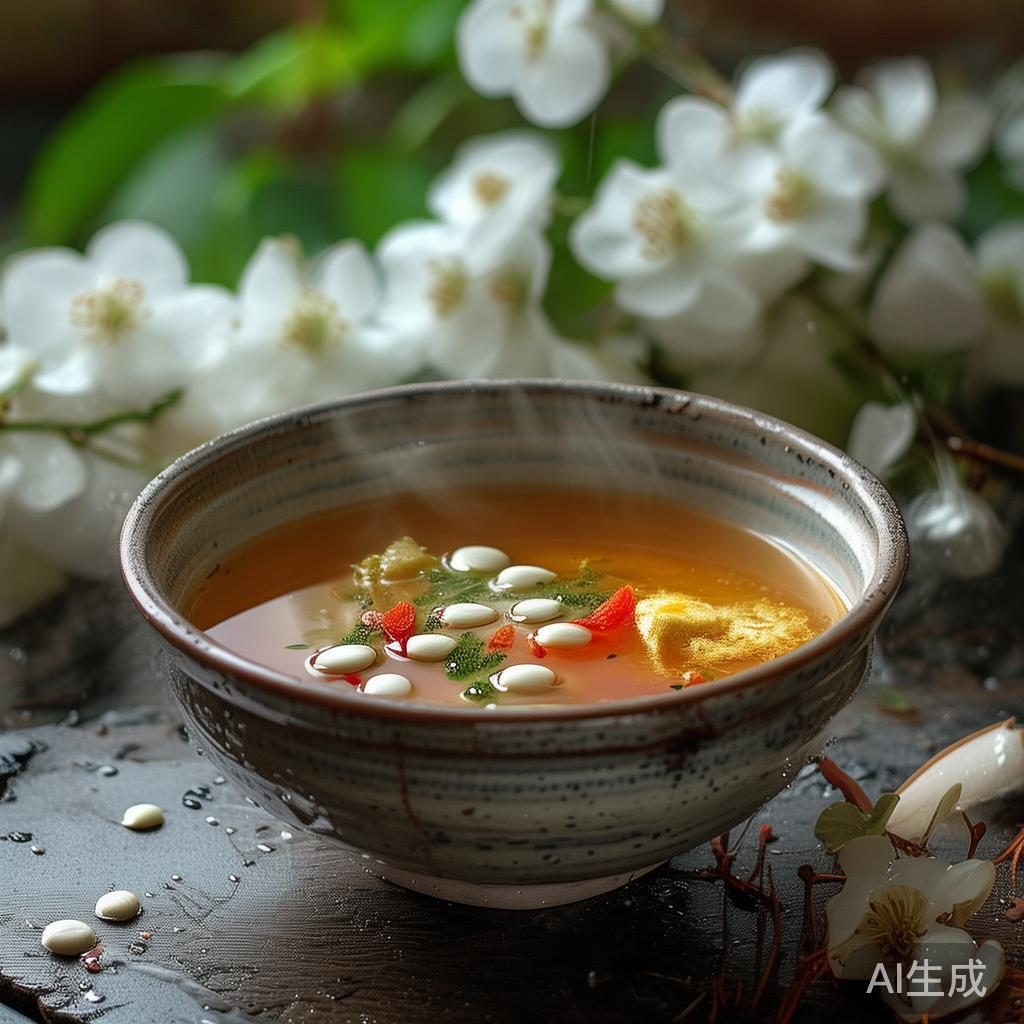
But bigu goes a step further. It isn't just "eat less." It's a methodical, staged adjustment of food, paired with breath and stillness. People who actually practice it don't start by eating nothing. They begin with "no food after noon," then move to "one meal a day," and only then to short periods of "water only" or fu'er — taking specific medicinal foods like pine nuts, Solomon's seal root, black sesame, and walnuts instead of grains.
That Daoist from Mount Qingcheng told me he now eats only one meal a day, in the evening, not much, but that food tastes extraordinarily good. He also said something I've kept for a long time: "Eating is for the body, not for the mouth. What the mouth wants isn't always what the body needs."
2. I Tried It for Three Days
After I got back, on some strange impulse, I wanted to try.
Not bigu — that's far away, and I didn't dare. I just wanted to try "no food after noon," drinking only water and light tea past twelve. I gave myself three days.
The first night, I was hungry. Really hungry.
Around eight in the evening my stomach started growling, and my mind started wandering. I opened the food-delivery app, stared at it for five minutes, closed it. I went to the kitchen, poured a cup of warm water, drank it slowly. I sat by the window and realized — when you're hungry, the world becomes very clear. The children arguing downstairs, the cooking-oil smell from the neighbor's kitchen, the distant thud of a car door closing — everything comes in.
That moment surprised me. So when we eat too full, the senses are actually blocked.
The second day, I wasn't hungry anymore.
More precisely, my body seemed to accept the new rhythm. The morning was energetic, the afternoon slightly tired — but not the heaviness that comes after a meal, a different, lighter kind of tired. In the evening I walked around the park. The wind blew against the back of my neck, and I felt as if I were walking a little lighter. Maybe an illusion.
But that day I noticed a small thing: my tongue was clean. Usually after meals my tongue coating is thick, and I wake up the next morning with a dull taste in my mouth. That evening I looked in the mirror and saw a pale pink tongue with a thin white coat. I looked it up in a Chinese-medicine book: "The tongue is the sprout of the heart, steamed by stomach qi." When the stomach is clean, the tongue cleans itself. That detail moved me.
The third day, I couldn't sleep.
Not from hunger — my mind was too clear. I lay in bed and heard my own breathing, slow and deep. I remembered what the Daoist had said: "Eat clean, and the spirit becomes clear." But a spirit too clear isn't always a good thing. That day I woke up at four in the morning, stared at the ceiling, and thought about a lot of things I usually don't.
For instance: how much of what I eat every day do I actually not need.
For instance: whether my definition of "full" has been spoiled by takeout and dinner parties.
For instance: that "seventy percent full" the ancients talked about — I may never have truly felt it in my life.
3. I Didn't Keep It Up
Three days ended, and I went back to eating dinner. The first meal was a bowl of beef noodles. I drank all the broth and was completely stuffed.
I didn't become a "no-food-after-noon" person. To be honest, coming home from work and skipping dinner is too hard for someone like me. Eating with friends, having guests over, grabbing a scallion pancake by the road after working late — too often, food is social, emotional, comfort, not just calories.
But from those three days I did take something with me.
First, I eat more slowly now. I used to finish a meal in ten minutes; now I chew, I pause. I noticed that when you chew slowly, you naturally eat less — the body has time to tell you "enough."
Second, once a week I give myself a "light day." No bigu, no skipping meals, just eating less that day, vegetarian, congee. Let the stomach catch its breath.
Third, I started asking myself, each time I want to eat: Is it the body that's hungry, or the heart that's empty?
It sounds precious, I know. But I found that at least half the time I go open the fridge, it isn't because I'm hungry — it's boredom, it's anxiety, it's wanting to move my mouth to distract myself. The ancients already saw through this. In Chinese medicine there's the idea of "stomach fire" and "heart fire" — often what we think is stomach hunger is the heart acting up.
4. A Warning
I have to be clear: bigu has risks. It isn't for everyone.
If you have stomach illness, low blood sugar, are pregnant or nursing, are a growing child, are elderly, or have a history of eating disorders — please don't try it lightly. Even healthy adults who really want to practice should find an experienced teacher and go step by step, not just follow some "tutorial" online and improvise.
I've read reports of bigu gone wrong. People who went a week with only water and fainted from low blood sugar; people who fasted long-term and perforated their stomachs; people who were already prone to depression and had a complete emotional collapse after bigu. None of that is bigu's fault — it's the fault of doing it recklessly. Just like you can't say running is wrong because someone got hurt running — but you do have to know how to run.
That Daoist told me real bigu is something that "happens when the conditions are ripe." First you train the breath, then you train stillness, then you adjust the diet. When the body's meridians open up, you naturally want less food. It isn't forcing it. Forcing it is just starving. That's not bigu.
5. The Daoist's Words
I'm not writing this to tell you to try it. I'm not recommending bigu. I'm just thinking about one thing.
Our generation is probably the most well-fed generation in human history. Our grandparents' generation went hungry, so they pushed us to eat. Our food-delivery apps, bubble-tea shops, snack advertisements all say "eat, eat, eat more." But the body doesn't really need that much. Daoism figured this out thousands of years ago: humans don't do better the more they eat.
That person I met on Mount Qingcheng hadn't eaten lunch in seven years. He wasn't doing penance. His complexion was good, his eyes were bright, he walked mountain trails faster than anyone. He told me:
"You don't have to learn from me. But sometime in this life, at least once, let yourself be truly hungry."
"You'll find that being hungry isn't as scary as you think."
"You'll also find that only when you're hungry do you really know how much you need."
A few questions to sit with
- When was the last time you were truly hungry?
- If you had to eat only one meal a day, would you be afraid? What exactly are you afraid of?
- Of all the things we eat every day, how much does the body need — and how much is just a lonely mouth, an anxious heart?
This isn't an article teaching you bigu. I just want to tell you that the Daoist's words stayed with me for a long time — eating is for the body, not for the mouth.