My Mom Pulled a Stone Out of Her Suitcase and Said: Your Face Is Swollen
I always thought gua sha was something old ladies did. Until my mom pulled out a jade scraper and told me my face was swollen. After a month, I realized the beauty benefits were secondary — those five quiet minutes every morning were everything.
My Mom Pulled a Stone Out of Her Suitcase and Said: Your Face Is Swollen
Honestly, I always thought gua sha was something old ladies did.
When I was little, every summer my grandmother would take out a buffalo horn scraper and drag it across her back until red and purple marks appeared. I'd stand there watching, half scared, half curious. She'd say, "Once it comes out, you'll feel better. That's the heat toxin."
I didn't know what a heat toxin was. I just thought those marks looked like something had bitten her.
Then I grew up, moved to the city, got an office job. Every day in front of a screen, my complexion turned dull, my face somehow looked wider and puffier. A colleague asked what was wrong. I said I wasn't sleeping enough. But it wasn't just sleep — I looked cloudy. Not fresh.
It started last month.
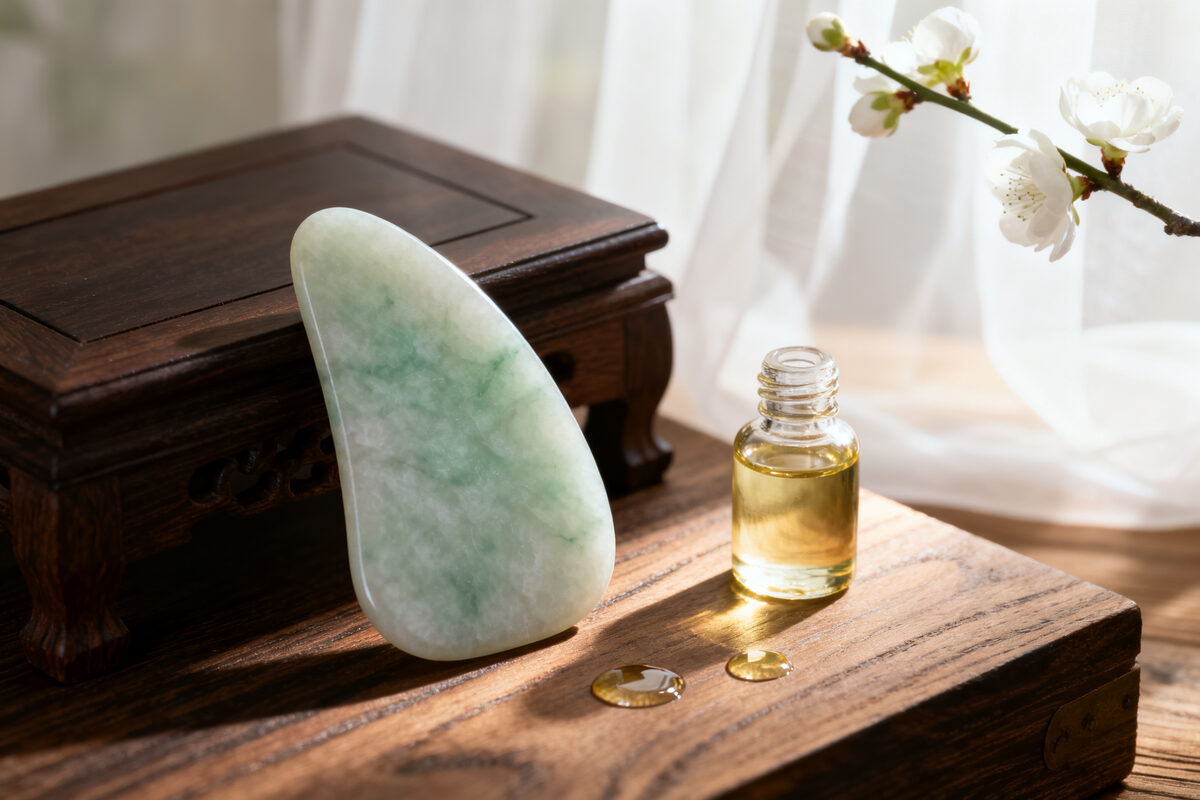
My mom came to stay with me for a few days. First thing she said walking through the door: "Your face looks terrible. It's swollen." Then she dug through her suitcase and pulled out a piece of white jade — flat, shaped like a little shovel, warm to the touch, with a faint green tint.
"This is a gua sha board," she said. "I used it on your back when you were little. Remember?"
I said I remembered, but I wasn't going to use that thing on my face.
She said, "You can scrape your face too."
About the Word "Sha"
I looked into it later. In Chinese medicine, "sha" refers to the external pathogenic factors — wind, cold, heat, dampness, dryness, fire — and the stagnation that builds up when qi and blood don't flow smoothly. Gua sha uses a smooth-edged tool to scrape the skin surface, causing micro-vessels to dilate and release this stagnation to the surface.
It sounds a little alarming — micro-vessels breaking? But it's not like an injury. It's a mild, controlled stimulation that increases local blood circulation and helps metabolic waste clear out.
I asked a friend who studies Chinese medicine. She said, "Think of your skin as a sheet of paper, and underneath are pipes. When the pipes get clogged, you scrape to get the flow moving again."
She put it crudely, but I understood. Gua sha isn't about scraping something out — it's about getting something unstuck.
What My Mom Taught Me About Facial Gua Sha
My mom isn't a professional Chinese medicine doctor. She's just someone who's been doing gua sha for over twenty years. What she taught me was simple.
Apply oil first. Don't skip this step. I was lazy at first and scraped dry — my skin immediately went red and stung. She said, "Do you think your face is made of iron?" After that, I dutifully used facial oil.
Direction matters: outward and upward. This is crucial. The meridians on your face follow specific pathways. Scraping along them works. Scraping against them makes things worse. I later understood why some people post gua sha videos online and their faces get puffier — they're going the wrong direction.
Keep it light. More pressure isn't better. My mom said, "Your face isn't a cutting board." Facial skin is thin. Gentle strokes — just enough to feel a slight warmth. You don't need those dark purple marks on your face like you might on your back.
You don't need to do it every day. Five to ten minutes is enough. I do it every morning after washing my face, before applying serum, standing in front of the mirror.
What Changed After a Month
I won't tell you "my face shrank after three days" — that would be a lie.
But I can tell you that after a month, some changes were real.
First, morning puffiness went down. I used to wake up, look in the mirror, and feel like my face had expanded overnight — especially around the eyes and jawline. After scraping, the drainage was noticeable, and my facial contour became a bit more defined. I looked into why: gua sha promotes lymphatic circulation, helping drain excess fluid from tissues. A lot of that morning puffiness is slow lymphatic return.
Second, my complexion wasn't as dull. Before, by noon I'd look in the mirror and feel like I hadn't washed my face properly. After a few weeks of scraping, my skin did look brighter. A friend explained that gua sha improves facial microcirculation — better blood supply means a healthier glow. I believe it.
The most surprising change: my smile lines seemed slightly shallower. I say "seemed" because it could be my imagination. But logically it makes sense — if facial muscles are tense and stiff, they don't support the skin well, and wrinkles look deeper. Gua sha relaxes muscles, improves tension, and lines naturally soften. Of course, this takes consistent practice, not one or two sessions.
A Few Things I Want to Say
First: an expensive gua sha board isn't necessarily better.
Online, you'll find jade boards for hundreds or thousands — Hetian jade, Xiuyan jade, crystal, tourmaline... Honestly, for practical results, the material difference isn't what the ads claim. Mine is a buffalo horn board my mom bought at a pharmacy for the equivalent of five dollars.
If you must choose, I'd suggest something with smooth, rounded edges, a bit of weight, that doesn't feel ice-cold in your hand. Jade is nice because it's easy to clean and doesn't harbor bacteria, but claims about "far infrared release" — I'd take those with a grain of salt.
Second: gua sha isn't for everyone.
If you have sensitive skin, inflammation, severe acne — don't do it. Pregnant women should avoid certain areas. People with low platelet counts or on blood thinners shouldn't either. This isn't fear-mongering — gua sha creates micro-stimulation on the skin. If your skin barrier is already compromised, adding more stimulation can cause problems.
Third: darker "sha" marks don't mean better results.
Some people post photos of their deep red marks like badges of honor. This is a misconception. The color of the marks relates to your constitution, skin thickness, and vascular permeability. Dark marks don't mean you have "more toxins" — that concept itself isn't quite accurate. I prefer to think of it as: a normal response of micro-vessels to stimulation.
Why You Need Oil
I didn't understand this at first, but then it clicked.
When the gua sha board glides across skin without a lubricating layer, friction directly damages the stratum corneum. Facial oil isn't some mystical thing — it reduces friction and protects the skin barrier. At the same time, the oil itself moisturizes. The two work together.
I use plain jojoba oil, cheap. Sometimes camellia oil my mom brought. What oil you use doesn't matter. What matters is: don't scrape dry.
Five Minutes of Ritual
I've come to realize that the biggest gain from facial gua sha isn't whether my face got smaller — though there have been some changes — but those five minutes every morning.
Apply oil, pick up the board, stand in front of the mirror. No phone, no messages, no emails. Just quietly, stroke by stroke, scraping.
It feels a lot like brewing tea. You put your attention on your hands, on your face, on that subtle warmth. Time slows down.
When my mom left, she gave me the white jade board. She said, "You don't have to do it every day. Just when you think of it."
I do it almost every day now. Not because it gives results that I keep going, but because those five minutes feel good.
Wake up, wash my face, apply oil, pick up that stone that holds a little warmth, and gently glide it across my face.
The world outside is loud.
But these five minutes are mine.
Three questions for you:
- Do you have one small thing that takes only five minutes a day but brings you quiet?
- Do you think "becoming beautiful" starts from the outside, or from the inside?
- If gua sha had no beauty effects at all, would you still do it?