My Mom's Gua Sha Board Went Viral on TikTok
A blonde woman on TikTok was scraping her jaw with a small white stone. The comments were all "adding to cart." I stared at that stone for a long time — it's a gua sha board. My mom keeps one in her bedside drawer, buffalo horn. In my home it treats heatstroke. Across the ocean, it's a $35 beauty tool. Same board, two destinies.
A few days ago I was scrolling TikTok and came across a blonde woman holding a small white stone, scraping it slowly up along her jaw. Her movements were slow and careful, like she was carving something. The caption read: morning routine, depuff, jawline.
The comments were all "just ordered" and "adding to cart."
I stared at that stone for a long time. Not because I'd never seen one. Because I knew it too well.
It was a gua sha board.
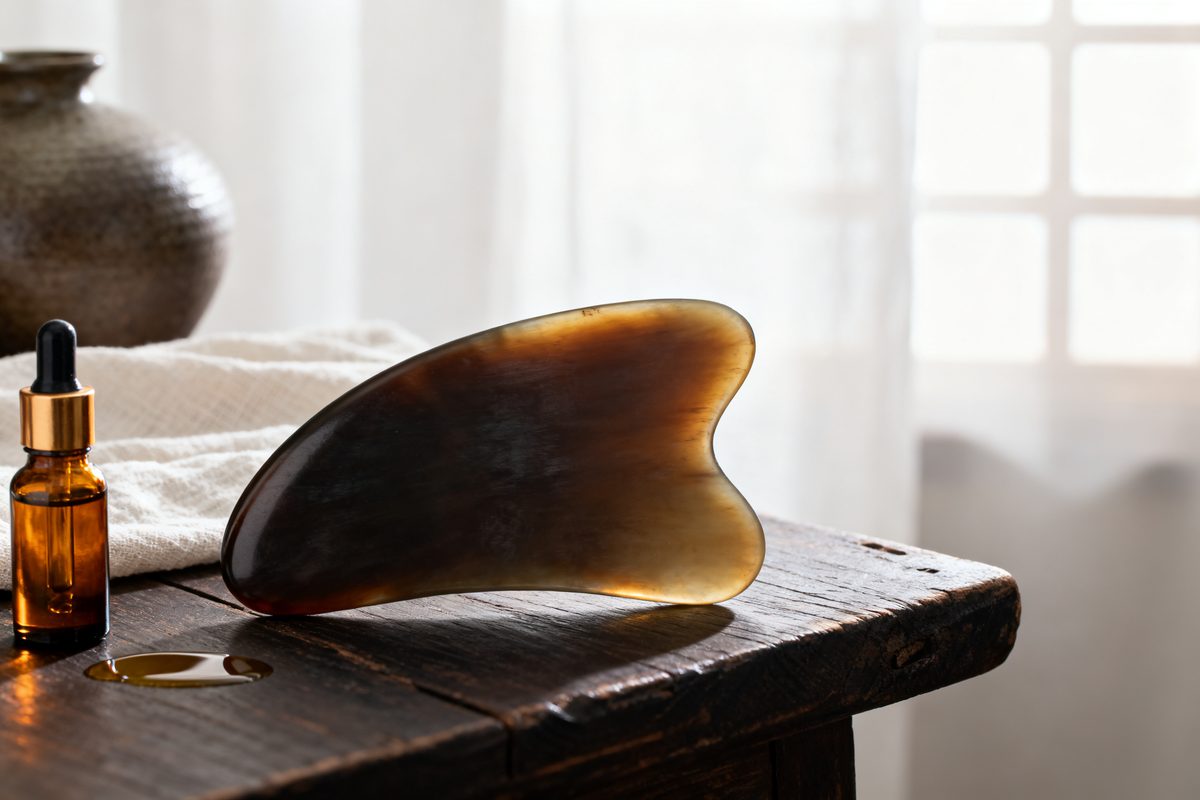
My mom has one. Buffalo horn, dark brown, about the length of a hand, its edges worn round and smooth. It lives in her bedside drawer, next to a bottle of medicated oil, half a roll of gauze, and a few old photographs. It has been in that exact spot since before I can remember.
Every summer when I was a kid, there would be a day or two when I "got sha" — dizzy, nauseous, no strength, wilted like a vegetable left out in the sun. My mom would take one look at me. No lectures. She'd pull the horn board from the drawer and send my dad to the kitchen for a porcelain spoon and a little sesame oil.
Yes — actually, she used the spoon more often. The horn board came later, a gift from a coworker, who said horn is cooling and good for scraping.
I still remember the routine. A layer of oil on the neck and back. Then the back of the spoon, or the horn, stroke after stroke, always in one direction. Not gentle, not brutal. The skin turns red first, then the sha comes up — patches of purple-red, like bruises but neater, in lines.
As a kid, I was afraid of it. It hurt, in a deep, sour way I couldn't describe. And it looked frightening — perfectly fine skin, a few strokes, and it "bruises." My cousin thought so too. He was held down crying every single time.
But here is the strange part: it worked. Once the sha came out, that heavy, foggy feeling mostly lifted. My mom would say: "The sha is out. Now you can loosen up."
I never knew how to say that in the language of science.
When I grew up, I looked it up. In Chinese medicine, sha is stagnation — something blocked near the surface; you scrape it out, the qi and blood move, and the person loosens. Some modern research says the scraping dilates the capillaries and speeds up local circulation, waking up the body's own repair. Two languages, maybe not describing the exact same thing, but not necessarily enemies of each other. I'm not a doctor. I can't settle it. I only know my body remembers: after scraping, it was looser.
What made me want to write this, though, is what happened to that stone on the other side of the world.
People in the West call it gua sha. The Chinese pronunciation, unchanged. They don't scrape backs, though. They scrape faces. Jade, rose quartz, polished like a piece of jewelry, sold with face oil and a silk pouch on Sephora shelves for thirty-five dollars. The tutorials teach you to scrape from chin to ear, from brow to hairline — "lymphatic drainage," "depuffing," "sculpting a jawline."
The first time I saw it in a Western beauty video, I froze. It was like seeing your family's old bowl at a stranger's wedding.
I wanted to laugh, and I felt something I couldn't quite name.
The same board. In my home it treats heatstroke — it comes out only when someone has wilted, when someone can't hold on anymore. Across the Pacific, it is a morning beauty ritual, with candles and a playlist. My mom uses it against sickness. The blonde woman uses it against puffiness.
It's hard to say which use is more "authentic." If you go by tradition, gua sha was medicine for sha syndrome — my dizziness and nausea. But scraping the face is old too; my aunt did facial gua sha her whole life, for the glow. One tool, holding both ends of a river.
When something crosses an ocean, it changes shape. Tai chi became Tai Chi fitness. Dumplings became dumplings, then gyoza. Changing shape is not a disgrace. Changing shape means it's still alive. The ones that die are the ones locked behind glass, untouched.
The night before I wrote this, I tried it myself.
Not on my face — I didn't dare. The tutorials disagree with each other and I was afraid of scraping my face swollen. I later asked a friend who studied Chinese medicine. She said facial gua sha should be light, always in one direction, always with oil — never dry, never chasing the sha. If sha comes out on your face, you've gone too far. So I scraped my shoulders instead. Anyone who works at a desk knows those two muscles — permanently wrung like wet towels.
I dug out the horn board my mom had slipped into my bag — yes, she did that once, along with the medicated oil. I'd found it too bulky and left it in a drawer. I put on some body lotion, and scraped along my shoulder, from neck toward arm, stroke after stroke.
The first stroke was sour. Deep, like pressing a place you normally don't dare touch. After a dozen strokes the skin grew warm and red, but no sha came out — my friend says chronically tense muscles often don't bruise much, and I wasn't chasing it anyway. Ten minutes in total. I put the board down. My shoulder felt warm, like it had been in a little sun.
The next morning, it was looser. Not completely. The kind of loose where the wrung towel turns back half a turn.
For that half turn, I decided to move the board from the drawer to my bedside.
A few honest words, because I don't want to mythologize it:
- Always scrape in one direction. Don't saw back and forth.
- Use something between the board and your skin — oil or lotion. Never dry. And never on broken skin.
- Darker sha is not better. The color depends on many things. Don't compete.
- If you are pregnant, have a skin condition, take blood thinners, or are very weak — ask a doctor first.
- The face is delicate. Go light. Then lighter.
None of this is my invention. Half came from my mom, half from my friend. My mom's version is shorter: "It's not a frying pan. Why are you pressing so hard?"
Writing this, I think of that horn board again. Thirty-some years, sitting in a drawer, making no sound. That smooth ring along its edge wasn't polished in a factory. It was polished by palms and skin, one year at a time.
A tool is quieter than a person. It doesn't rush to prove it's useful. It just waits — for the next heatstroke summer, or the next morning someone wants to feel beautiful.
Three questions, for you, and for me:
- Is there something in your home that your elders used for decades — and one day you saw it again, in a video from another country?
- When culture crosses the ocean and comes back changed, does it feel stolen to you, or caught?
- When was the last time someone took care of your body with their own hands — a scrape, a shoulder press, a thumb on your temple?