Hariti: The Mother Who Ate Other People's Children
A demon named Joy who ate other people's children to feed her own. The Buddha didn't fight her - he just let her feel that pain herself. A story about how wide our love can be.
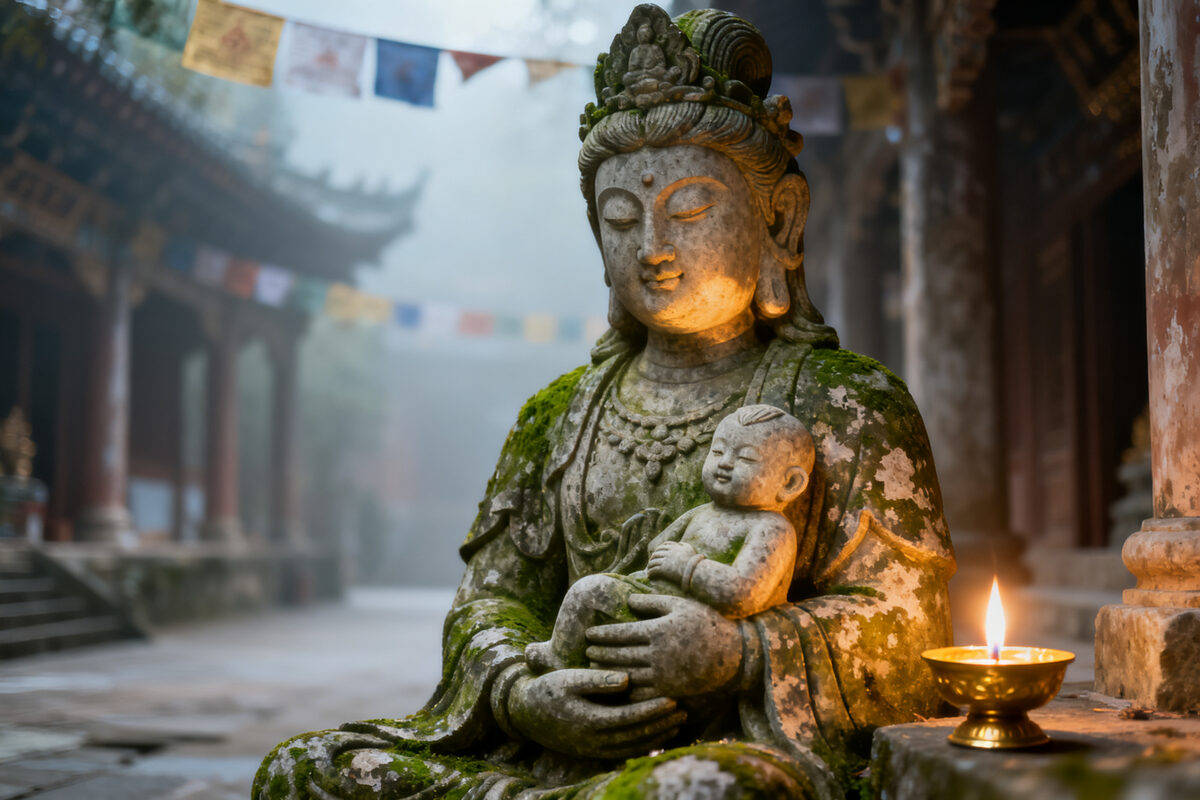
I was flipping through an old book of Buddhist stories when I came across a name—Hariti.
To be honest, the first time I heard it, I thought it was a horror story. A demon mother who ate children. Parents in the village trembled just hearing her name.
But after I finished reading the whole story, I sat there for a long time without moving.
Not because I was scared. Because—I felt like I had seen her somewhere before.
Hariti's original name was Joy. Funny, isn't it? A person named "Joy" who later became the source of everyone's fear.
The sutras say she was a yaksha. She married another yaksha and had many, many children. How many? Some texts say five hundred, some say ten thousand. Whatever the number, it was a lot. She loved her children deeply—the kind of love that maybe only a mother can truly understand.
But her love had a fatal flaw: to feed her own children, she ate other people's children.
Yes, you heard that right. She figured, as long as my children are fine, other people's children... that's not my concern.
She started appearing in the city of Rajagaha. At first one child went missing, then two, then more and more. Parents searched frantically. The whole city was filled with crying. Someone once caught a glimpse of her shadow—a massive figure, a mother in wild ecstasy, clutching someone else's child, disappearing into the night.
The people of the city went to the Buddha for help.
So what did the Buddha do?
He didn't slay the demon. He didn't use his powers to drive Hariti away.
He hid her youngest child—the one she loved the most.
Hariti searched the entire world and couldn't find her. She looked everywhere, frantic. From the heavens to the earth, from the cities to the wilderness. Her five hundred—or ten thousand—other children, she didn't care about any of them. She only wanted to find that one, the youngest.
She searched for seven days and seven nights. The demon mother who had once made all mothers tremble—now she was the most desperate mother of all.
Finally, she came before the Buddha.
The Buddha looked at her and said, very quietly:
"Hariti, you have ten thousand children, and losing just one brings you this much pain. Those mothers whose children you devoured—they only had one or two. Some had only one. Do you know how much pain they felt?"
When I read this part, I froze.
The Buddha didn't lecture her. He didn't say "you shouldn't do that." He simply let her feel that pain herself.
You have ten thousand children. Losing one and your world collapses. Someone else has only one or two, and you ate them. Think about what that feels like.
"Empathy" is such an easy word to say. But truly feeling it—maybe that only comes after you've been hurt yourself.
Hariti knelt on the ground and cried. Not the crying of fear, but the crying of someone who finally understood. She finally grasped the pain of those mothers—because she had just lived through it herself.
From that day on, Hariti took refuge with the Buddha. She vowed never to harm another child. And more than that—she became a protector of children. In some Buddhist temples, you can still see her statue: a gentle woman holding a child, nothing like the terrifying demon she once was.
Later, in Chinese folk belief, Hariti gradually became merged with the "Child-Giving Guanyin." Sometimes in temples, I see devout women kneeling before the Child-Giving Guanyin, praying for a child. And I wonder—do they know this statue's origin is a mother who once ate children?
This story stayed with me for a long time.
Not because of karma or reward and punishment—those things are too big for me to talk about.
It's about this thing called "love."
Hariti was not a bad person. Or rather, she wasn't someone without feelings. It was quite the opposite—she had too much feeling. So much that she could only hold her own children in her heart, and had no room for anyone else's.
Her love was too narrow. Narrow enough that she could eat other people's children for the sake of her own.
Sometimes I wonder—does each of us carry a little Hariti inside?
We love our own children, our own family, the people we've claimed as ours. This love is real. But sometimes this love becomes very narrow—my child needs to get into a good school, my family needs to be comfortable, my... my... my.
As for other people's children, other people's families—that's their business.
I'm not preaching here, not saying we should "love all humanity." I can't do that myself.
It's just that the Buddha's method strikes me as interesting. He didn't tell Hariti she was wrong. He let her feel the pain for herself.
Maybe true compassion isn't something you can be taught. Maybe it only grows after you've been broken open by pain.
A few days ago on the subway, a young mother sat next to me, holding a child maybe one or two years old. The child was asleep, little face pressed against the mother's shoulder, mouth slightly open.
The mother looked exhausted, dark circles under her eyes. But her hand never stopped gently resting on the child's back.
In that moment it hit me—every single child is being guarded with everything someone has. Every single one.
Hariti later protected all children. Maybe it was because she finally understood this.
I don't have any answers. It's just an old story, and the back of that mother on the subway, layered together in my mind.
If you've read this story too, maybe take a moment to think:
How wide is the "love" in your heart?
Have you ever, in loving someone, accidentally overlooked another person's pain?
If one day you could truly feel another person's pain, what would your life become?