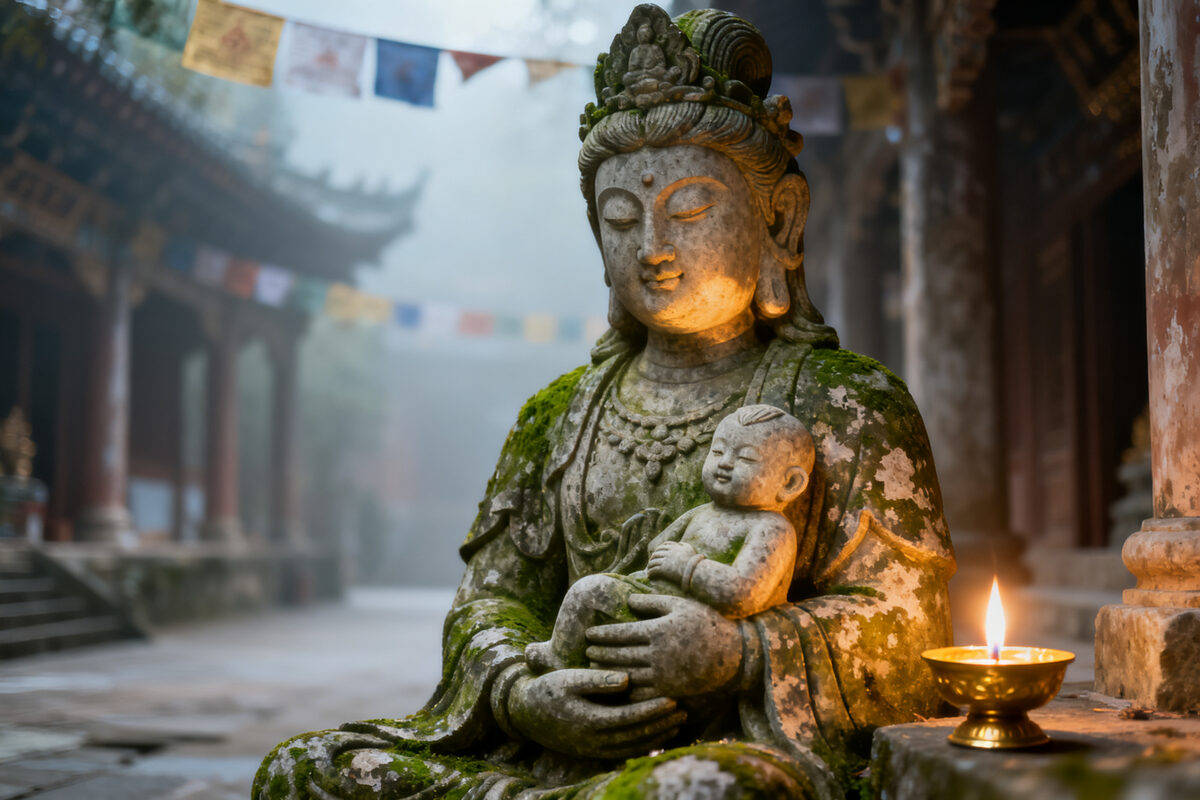
The Man on the Snow Mountain Who Gave Everything for Half a Verse
A man searched his whole life on a snow mountain for one true sentence. He finally heard half of it. The price for the other half was his life. He didn't hesitate.

The Man in the Snow Mountains Who Gave Himself Away for Half a Verse
Last night I couldn't sleep. I scrolled through my phone until two in the morning.
Nothing big happened. Just the usual mess in my head — things from work, my kid's tutoring classes, my mom's knee acting up again. One thing after another, like a pot boiling over, bubbling and bubbling.
Then somehow I remembered a story.
I heard it from an old monk at the temple a while back. I didn't pay much attention at the time, but last night it just surfaced. He said that a long, long time ago, there was a man who lived in the snow mountains.
The Boy on the Snow Mountain
At that time the Buddha had not yet become Buddha. He was just a practitioner, living up in the Himalayas.
They called it the Snow Mountain back then. Several thousand meters up. Wind so strong it could blow a person away. Air so thin every breath felt like swallowing ice chips.
And he was there. Alone.
No heating, no phone, no one to talk to. Every day he just sat, thought, practiced. His clothes were thin. He ate very little. Other people thought it was suffering. He didn't seem to notice.
He was looking for something.
What? A single sentence. One sentence that could truly explain life and death.
He had studied for a long time in the world. Visited many teachers. Read many texts. But something always felt off. The teachings were all fine, but they felt like looking at the moon through a window — you can see it, but you can't touch it.
That Voice
One day, sitting in meditation on the snow mountain, he suddenly heard a voice.
Not a human voice. More like a verse echoing between heaven and earth. It said:
"All conditioned things are impermanent, they arise and pass away."
When he heard this, his whole body trembled.
Not because the words were especially profound, but because they felt — true. He had lived so long, studied so much, and for the first time he heard something that felt completely real. Not a theory, not an argument. Something that landed directly on his chest.
Like suddenly understanding something you always knew but never dared to admit.
But there was a problem. The verse was only half finished.
"All conditioned things are impermanent, they arise and pass away" — and then? There should be a second half, but the voice stopped.
The Price of Half a Verse
He stood up and searched through the snow.
He shouted, "Who is speaking the Dharma? Where is the rest?"
No answer. The mountain wind scattered his voice.
Then he saw it. A rakshasa — a fierce spirit — standing on a rock not far away. Hideous face, terrifying features, just watching him.
He asked, "Were you the one who spoke that half-verse?"
The rakshasa said, "Yes."
"And the second half?"
The rakshasa smiled. "I've been starving for a long time. Speaking even this much has used all my strength. If you want to hear the rest, I have a condition."
"What condition?"
"Give me your body to eat."
I have to admit, when I read this part, I paused.
If it were me, what would I do? Trade my life for the second half of a poem? Isn't that crazy?
But that man didn't hesitate.
He said, "Fine. But say it first. After you speak it, I'll keep my promise."
Having Ended Arising and Passing, Stillness Is Joy
The rakshasa spoke the second half:
"Having ended arising and passing, stillness is joy."
The complete verse:
All conditioned things are impermanent, they arise and pass away. Having ended arising and passing, stillness is joy.
The meaning: Everything changes, everything arises and passes away — but when even that arising and passing ceases, that stillness is true peace.
He heard this and was silent.
Then he smiled.
He said, "I have heard it. This Dharma is worth more than my life."
He found a tall tree in the snow. Climbed it. He was going to throw himself down, offering his body to the rakshasa.
When he reached the top, he said something. Not to the rakshasa. More like to everyone who would come after:
"So that these words might remain in the world, so that people in the future might still hear them — I am willing."
Then he let go.
But
Here the story turns.
He didn't fall to his death. The rakshasa revealed its true form — it was Lord Indra, a god of the heavens, who had come specifically to test him.
Indra caught him in mid-air.
But I know this: even if Indra had not been there, he still would have jumped. This wasn't a calculated decision with a safety net. He genuinely meant it.
That's the part I keep thinking about.
Just Half a Verse
I'm sitting on the balcony today, holding a cup of tea that's gone cold, still thinking about this.
In the end, what he paid and what he received were completely out of proportion. A whole life, for half a poem. Just half a verse.
But was it worth it?
"All conditioned things are impermanent, they arise and pass away. Having ended arising and passing, stillness is joy."
More than two thousand years later, on a sleepless night, I remembered these words by chance. They crossed so much time, so many lives and deaths, and arrived in my mind on an ordinary night, and made me quiet.
At that moment, I think he wouldn't have felt it was a loss.
My Confusion
I'm writing this not because I understand something.
Honestly, I'm not sure I could do what he did. Forget sacrificing my body — if someone insults me online, I can barely resist firing back. I can't even manage my own temper. What business do I have talking about giving up everything for the Dharma?
But I love this story. Not because it contains some great teaching, but because it's honest.
A person, for something he truly believed in, was willing to give everything.
That kind of certainty — I don't have it. But I want it.
Maybe on this path of practice, walking and walking, it comes slowly. Maybe it never comes in a whole lifetime. I don't know.
The incense smoke in the burner has dispersed. I went to check — the ashes are still warm.
Three questions for you:
1. Have you ever heard a sentence that hit you like that — where you just knew, "This is true"?
2. If half a verse was worth a life, then how much is every page of scripture we casually flip through actually worth?
3. How far does a person have to go for a true sentence before they can say they truly believe it?