Master Hongyi: From Dashing Scholar to Vinaya Master
Master Hongyi transformed from a celebrated artist into a Vinaya master. He taught us: Life's turning points come not from external circumstances but from inner awakening; true letting go means releasing even the concept of letting go.
Master Hongyi: From Dashing Scholar to Vinaya Master
Editor's Note
Master Hongyi (1880-1942), born Li Shutong, was a renowned musician, art educator, calligrapher, and theater pioneer—one of the founders of modern Chinese drama. At thirty-nine, he ordained as a monk and dedicated himself to the Vinaya school, becoming a preeminent master. His life transitioned from brilliance to simplicity, from artist to practitioner—a true legend. His representative works include the song "Farewell" and his autobiography "Half a Life of Vegetarianism." This article is compiled from Master Hongyi's writings and life story.
I. From Li Shutong to Hongyi
Q: Master, why did you ordain?
Hongyi: Many people ask me this.
The Glory of My First Half of Life
My first half of life was quite splendid.
When young, I studied abroad in Japan, learning Western painting, piano, and drama.
After returning, I taught art and music at Zhejiang First Normal School in Hangzhou.
Students loved me, and I had many friends.
I painted, wrote calligraphy, composed music, acted in plays—I did everything, and did it well.
People called me a "talented scholar."
Inner Emptiness
But beneath this bustling surface, I felt very empty.
I often asked myself: Is this all there is to life?
Painting, calligraphy, composing—and then what? After death, will any of this remain?
I discovered that all art, all achievement, couldn't truly bring me peace.
The Causes for Ordination
In 1916, I did a fasting retreat at Hupao Temple in Hangzhou and experienced temple life.
That purity, simplicity, and focus touched me deeply.
In 1918, at thirty-nine, I decided to ordain.
Not escaping—finding the path I truly wanted to walk.
Q: What was different after ordination?
Hongyi: Completely different.
From Glamour to Simplicity
Before ordination, I was "Li Shutong," a famous artist.
After ordination, I was "Hongyi," an ordinary monk.
No fame, no applause, no flowers.
Just a monk's robe, a begging bowl, a few books.
From Being Served to Serving Others
Before ordination, I had servants attending to me.
After ordination, I washed my own clothes, cooked my own food, swept my own floors.
Others thought I wouldn't get used to it; I found it liberating.
From Many Arts to One Deep Practice
Before ordination, I learned everything.
After ordination, I did only one thing: research and propagate the precepts.
In life, sometimes subtraction is more important than addition.
II. Vinaya Practice
Q: Why did you choose the Vinaya school?
Hongyi: Because it's the most difficult and most important.
What Is the Vinaya School?
The Vinaya school specializes in studying and practicing Buddhist monastic discipline.
Buddhism has three collections: Sutras, Vinaya, and Abhidharma. The Vinaya contains the precepts.
Precepts are the foundation of Buddhism—without precepts, there is no Buddhism.
Why Choose the Vinaya School
At that time, many felt the precepts were too tedious and didn't want to study them.
I thought: Because no one wants to study them, I should.
The most difficult things have the most value.
Also, I had been too unrestrained before ordination and needed the precepts to discipline myself.
Vinaya Practice Method
Vinaya practice, simply put:
Act according to the precepts—live by the precepts.
It's not about knowing all the precepts, but:
- Knowing what should be done
- Knowing what shouldn't be done
- Actually doing according to this
Q: The precepts are strict. How do you maintain them?
Hongyi: The precepts aren't strict—your mind is too scattered.
Precepts Are Protection
Many think precepts are constraints.
Actually, precepts are protection.
Like traffic lights—seemingly restrictive, actually protecting your safety.
Insights from Keeping Precepts
I've kept precepts for decades. A few insights:
First: Start Small
Don't demand too much of yourself at once.
First keep the basic five precepts, then gradually add more.
Second: Don't Interrupt
Keeping precepts requires daily practice—you can't be sporadic.
Keep them today, break them tomorrow—that equals not keeping them.
Third: Don't Be Proud
Don't think that because you keep precepts, you're superior to others.
Keeping precepts is your duty, not a merit.
III. Calligraphy and Practice
Q: Your calligraphy is famous. What's the relationship between calligraphy and practice?
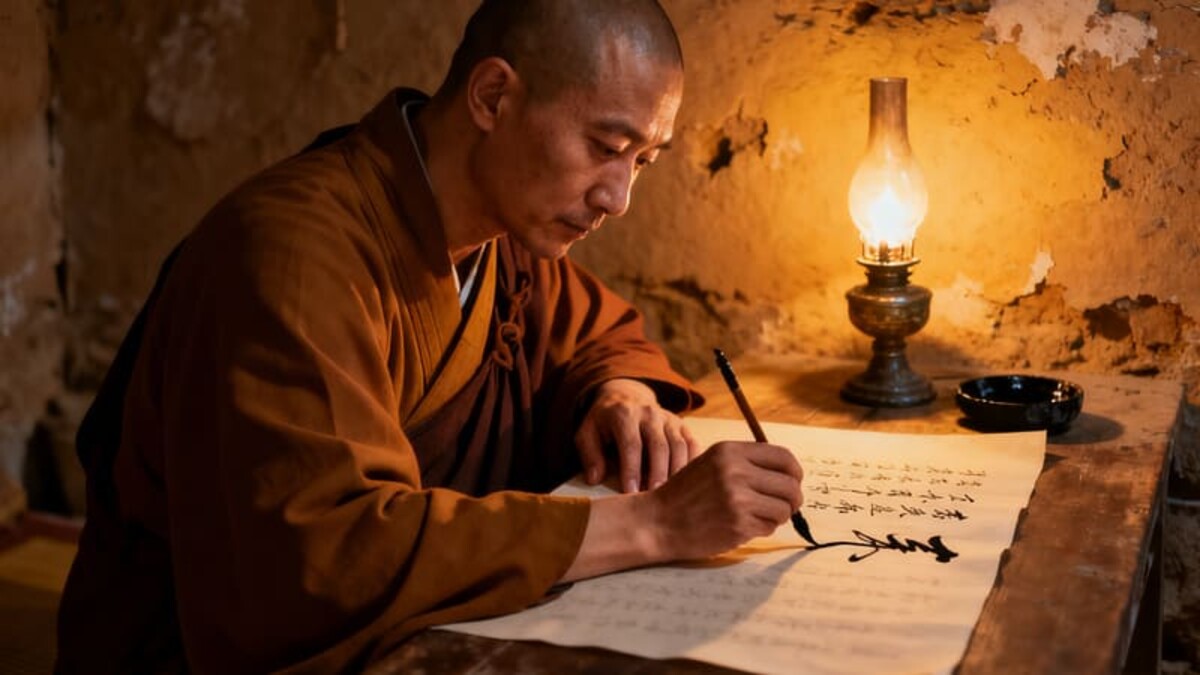
Hongyi: Calligraphy is the external manifestation of practice.
The Transformation of Calligraphy
My calligraphy before ordination was sharp and individualistic.
After ordination, it became calm and natural, without aggression.
This reflects the change in my mind.
Calligraphy As Practice
When writing, the mind must be calm, the breath smooth.
Every stroke is the expression of the mind.
What's in your heart appears in your characters.
So writing itself is practice.
Principles of Writing
I have several principles for writing:
First: Be Earnest
No matter who you're writing for, be earnest.
Don't be careless just because it's a small matter.
Second: Be Simple
Don't be ornate, don't show off technique.
Let it be what it is—natural is best.
Third: Be Beneficial
Most of what I write are Buddha's names, sutra passages, wise sayings.
Hoping those who see them might gain some inspiration.
Q: Do modern people still need to practice calligraphy?
Hongyi: Yes.
Writing Calms the Mind
Modern people are too restless; writing calligraphy can calm the mind.
Write a few characters, and your mind settles there.
This is a good form of rest.
Writing Cultivates Focus
Writing requires focus—every stroke must be right.
This focus can be applied to other things.
Writing Transmits Culture
Calligraphy is an important part of Chinese culture.
If you can't write, you've lost one form of cultural transmission.
IV. Art and Buddhism
Q: You were an artist. How do you view art after ordination?
Hongyi: Art and Buddhism are essentially the same.
Both Pursue Truth, Goodness, and Beauty
Art pursues truth, goodness, and beauty; so does Buddhism.
Art expresses through works; Buddhism expresses through life.
Art Can Be Practice
When painting, if you paint with full attention, that's practice.
When composing, if you compose with full attention, that's practice.
The key is your mind, not what you do.
After Ordination, I Let Go of Art
But I did let go of most artistic activities after ordination.
Not because I disliked art—my time was limited.
I needed to use my limited time for the most important thing: researching and propagating the precepts.
Occasionally writing calligraphy was also for making connections, not for art.
V. Life's Turning Point
Q: Your life had a huge turning point. What insights do you have?
Hongyi: Life's turning points are often the beginning of awakening.
Turning Points Aren't Bad
Many fear turning points, thinking they're bad.
Actually, turning points aren't bad—they're opportunities.
Walking the old path, you'll never reach a new place.
Only with turning points can you see new scenery.
Turning Points Require Courage
Turning points require courage.
Letting go of established achievements to walk an unknown path takes great courage.
But if you don't turn, you'll stay in the same place.
After Turning, Be Firm
After the turning point, walk firmly.
Don't be half-hearted, don't look back.
Choose a path and walk it to the end.
Q: How can we let go of what we have?
Hongyi: To let go, first see through.
See Through to Let Go
Why can't you let go? Because you haven't seen through.
You think fame and profit are real, you think achievements are important.
Actually, these are all passing clouds.
See through them, and naturally you let go.
Letting Go Isn't Loss
Many think letting go is losing.
No.
Letting go is gaining.
Let go of fame and profit, gain purity. Let go of attachment, gain freedom.
True gaining is letting go of what should be let go.
Methods of Letting Go
First: Contemplate Impermanence
Everything changes—nothing is permanent.
What you're attached to will eventually be lost.
Let go early, be free early.
Second: Contemplate Cause and Effect
What you gain is all causes and conditions coming together.
When causes and conditions disperse, it's naturally gone.
No need to be attached.
Third: Contemplate Birth and Death
When you die, what can you take?
Nothing.
So what's there to be attached to?
VI. Words for Students
Q: You taught many students. What do you want to say to them?
Hongyi: A few words:
First: Being a Person Is More Important Than Doing Things
Many only think about doing things, forgetting about being a person.
You may do things well, but if you don't know how to be a person, you've failed.
Being a person means being honest, kind, and responsible.
Second: Have a Specialization
Knowing a little about everything isn't as good as being expert in one thing.
Find what you truly like, go deep into it, become an expert.
Third: Maintain Curiosity
No matter your age, maintain curiosity.
Curiosity keeps you young, gives you motivation.
Fourth: Cherish Time
Time is the most precious resource.
Don't waste time on meaningless things.
Every day ask yourself: What did I learn today? What valuable thing did I do today?
VII. The Final Years
Q: How did you spend your later years?
Hongyi: Very simply.
Life in Later Years
My later years were in Quanzhou, Fujian, living in a small temple.
Every day was simple:
- Wake early and meditate
- Chant and recite sutras
- Research the precepts
- Occasionally write calligraphy
My health wasn't good, but my mind was at peace.
View on Life and Death
I knew I was close to leaving, but I wasn't afraid.
Life is like a stay at an inn—eventually it's time to go home.
I'd done what I should do, said what I should say—no regrets.
Final Verse
Before passing, I wrote a verse:
Sorrow and Joy Intertwined
Sorrow—for all beings not yet liberated. Joy—that I'm finally leaving.
VIII. Final Words
Q: Please give us your final teaching.
Hongyi: What I say is very ordinary:
First: Keep Precepts
Precepts are the foundation—don't ignore them.
Second: Chant Buddha's Name
The Pure Land method is most reliable—chant Buddha's name sincerely.
Third: Compassion
Have compassion for all sentient beings.
Fourth: Simplicity
The most beautiful thing in life is simplicity.
Don't pursue the dramatic—the plain and simple is what's real.
Postscript
Master Hongyi passed away in 1942 in Quanzhou, Fujian, at the age of 63.
His life was legendary.
From dashing scholar to ascetic master, from artistic genius to Vinaya authority.
His turning was clean and decisive, leaving no residue.
He often said: "Accomplishing nothing, I grow old; worthless, what is there to say."
This humility was precisely his greatness.
May all readers find in Master Hongyi's life the power to turn and the ability to let go.
This article is compiled from Master Hongyi's writings and life story, preserving his plain and natural speaking style to more authentically convey his spirit.
Carrying the Way through vessels · Transmitting the heart through things