Lin Qingxuan: Conveying Zen Through Words
Lin Qingxuan brought Zen into thousands of homes through his writing. He showed us: Zen is everywhere in life—the key is having a soft heart to discover it.
Lin Qingxuan: Conveying Zen Through Words
Editor's Note
Lin Qingxuan (1953-2019), renowned Taiwanese writer, hailed as one of the "Eight Great Contemporary Essayists." His Zen prose warmed generation after generation of readers. Representative works include the Bodhi Series, Body and Mind at Peace, and In This Dreamlike World. He wrote over one hundred works in his lifetime, conveying profound life wisdom through the simplest words. This article is compiled from Lin Qingxuan's writings and interviews.
I. Writing and Life
Q: Why do you write? What does writing mean to you?
Lin Qingxuan: Writing is my way of conversing with this world.
Childhood Loneliness
I was born into an ordinary farming family in Kaohsiung, Taiwan. There were eighteen siblings—I was twelfth.
Our family was poor, with so many children that my parents, busy with making a living, didn't have much time to pay attention to me.
I often sat alone on the ridge of the fields watching clouds, or hid in a corner reading.
That's when I discovered: words were my friends.
The world in books was bigger and more beautiful than the real world. I thought: if I could write words like this, how wonderful that would be.
The Original Intention of Writing
My original intention in writing was to make readers feel warmth.
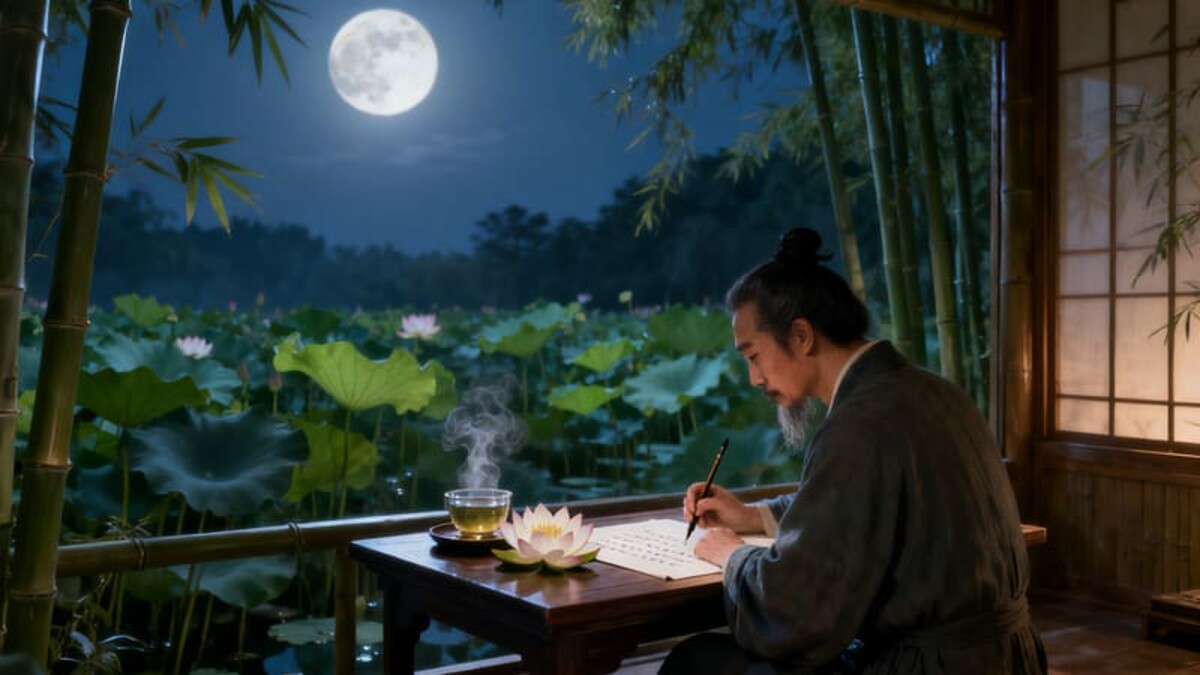
This world is sometimes very cold. I hope my words are like a cup of hot tea, letting people feel warmth when they're cold.
If even one sentence, one story, can give someone a little strength in their difficult moments, I'm satisfied.
Writing as Practice
For me, writing is also a form of practice.
Whenever I write, I must quiet my heart and enter a state of focus.
This state is very similar to meditation.
So I often say: Writing is my practice; my pen is my mala beads.
Q: Why do your words move people so much?
Lin Qingxuan: Perhaps because I write about real things.
Not Preaching
I never position myself as a "teacher"—I'm just a sharer.
What I write about are things I've personally experienced, felt, and thought about.
I'm not teaching readers—I'm sharing with them.
When you're sincere, readers can feel it.
Starting from Life
My material all comes from daily life.
A flower, a cup of tea, a person, an event—all can become an article.
Zen isn't far away—Zen is in life.
I use words to record these everyday moments of Zen and share them with readers.
Keeping a Child's Heart
I still maintain a child's heart.
Children look at the world, and everything is fresh, magical.
I hope I can be like this too—always keeping curiosity and wonder about the world.
A child's heart isn't immaturity—it's purity.
II. Zen Prose
Q: What is "Zen prose"?
Lin Qingxuan: Zen prose is integrating the spirit of Zen into essays.
What is Zen
Zen isn't anything mysterious.
Zen is:
- Eating when eating
- Sleeping when sleeping
- Doing when doing
Fully living in the present, not disturbed by stray thoughts—this is Zen.
Characteristics of Zen Prose
Zen prose doesn't preach, doesn't tell you what's right or wrong.
Zen prose is:
- Letting you see beauty overlooked in life
- Letting you feel the peace of this present moment
- Letting you think about questions you don't usually consider
I don't give you answers—I just give you a question to think about yourself.
Zen is in Life
Many people think Zen requires hiding in the mountains to practice. No.
Zen is in eating, Zen is in walking, Zen is in drinking tea, Zen is in chatting with friends.
Zen is everywhere in life—the key is whether you have the heart to discover it.
Q: How can we discover Zen in daily life?
Lin Qingxuan: Very simple—slow down and look with your heart.
Slow Down
Modern people are too fast. Eating fast, walking fast, talking fast—everything fast.
When you're fast, you miss things.
Slow down, and you can see:
- How sunlight passes through leaves
- How flowers slowly bloom
- How clouds flow across the sky
This beauty is always there—you're just too fast to see it.
Look with Your Heart
Looking at the same flower, some people only see "this is a flower."
Some people see color, shape, fragrance—they see the miracle of life.
What's the difference? Whether you're looking with your heart.
Look with your heart—everywhere is Zen.
Maintain Awareness
When eating, know you're eating. When walking, know you're walking.
This is awareness.
Awareness is the foundation of Zen, and also the whole of Zen.
III. Life Wisdom
Q: Where does your life wisdom come from?
Lin Qingxuan: From reading, from experience, from thinking, from suffering.
Reading
I loved reading from childhood.
My family was poor and couldn't afford books, so I'd stand in bookstores reading—reading for whole afternoons.
Reading let me know the world is big, and life has many possibilities.
Reading also let me know that ancient wisdom can solve today's problems.
Experience
I've experienced many things:
- Working too hard when young, my body collapsed
- First marriage failed, ending in divorce
- Being misunderstood, attacked by media
But these hardships all became my nourishment.
Much of what I write is the path I've walked myself.
Thinking
Experience itself doesn't produce wisdom—reflection on experience produces wisdom.
Every day I spend time thinking:
- What did this experience teach me?
- If I could do it again, how would I do it?
- What kind of person do I want to become?
An unexamined life is not worth living.
Suffering
Suffering is life's best teacher.
When I was young, I worked so hard my health suffered and was hospitalized for a long time.
During that time, I thought a lot.
I thought: If I die tomorrow, was this life worth it?
Since then, I learned to slow down, to cherish health, to find balance between work and life.
IV. Facing Setbacks
Q: Life always has setbacks. How do you face them?
Lin Qingxuan: Setbacks are part of life—no one can avoid them.
Accept
First, accept.
When setbacks come, don't escape, don't deny.
Admit you're facing difficulty, admit you're sad.
This is the first step.
See Clearly
Then, see clearly.
Why did this setback happen? What does it want to teach me?
Every setback carries a gift.
Only when you see it clearly can you receive the gift.
Transform
Finally, transform.
Turn setbacks into nourishment, into motivation for growth.
I often say: Wounds are where light enters your body.
Setbacks can hurt you, and they can also成就 you. The key is your attitude.
Q: What's the biggest setback you've experienced?
Lin Qingxuan: I've experienced many setbacks. One was the failure of my first marriage.
Marriage Failure
My first marriage lasted a few years before ending.
At that time I was in great pain, feeling life was gray.
But later I understood:
Marriage failing means we weren't suitable. Better to let go than continue in pain.
Divorce isn't failure—it's two people choosing different paths.
Learning from It
I started reflecting on myself:
- Was I too focused on work, ignoring family?
- Was I poor at communication, letting problems pile up?
- Did I take the other person's efforts for granted?
These questions, I paid attention to in my next marriage.
So now my marriage is happy.
Setbacks aren't endpoints—they're new beginnings.
V. Simple Living
Q: You advocate simple living. Can you explain more?
Lin Qingxuan: Simple living isn't asceticism—it's removing excess, keeping the essence.
Simplicity of Material Things
You don't need many things.
My home is very simple, without much clutter.
When you have too many things, you spend time organizing and maintaining them, and your mind gets cluttered too.
Keep what you truly need and truly like—let go of the rest.
Simplicity of Mind
Simplicity of mind is even more important.
Don't think too much, don't worry too much.
The past is past; the future hasn't happened.
All you can grasp is now.
Keep a simple heart, simply live in the present.
Simplicity of Relationships
You don't need many friends—a few sincere ones are enough.
Less socializing, more time for truly important people.
Life isn't about how many people you know—it's about how many people truly know you.
Q: What are the benefits of simple living?
Lin Qingxuan: Many benefits.
First: Freedom
When you have fewer things, you have fewer attachments.
You can set off anytime, change anytime, because you don't have many burdens.
Simplicity brings freedom.
Second: Focus
When you have fewer choices, you can focus more.
If you have a hundred things you want to do, you won't do any well.
If you focus on just one or two things, you can do them very well.
Simplicity brings focus.
Third: Joy
A simple heart is easily satisfied.
A good cup of tea, a good book, a good friend—that can make you happy.
A complicated heart is never satisfied—having this, it wants that.
Simplicity brings joy.
VI. On Life and Death
Q: How do you view life and death?
Lin Qingxuan: Life and death are natural—nothing to fear.
Death is Going Home
I often say death isn't an ending—it's going home.
We come into this world, walk a circle in it, then return.
Like going on a trip—played enough, time to go home.
Live Without Regrets
I've been writing for so many years. I've said what I wanted to say, done what I wanted to do.
If I left tomorrow, I'd have no regrets.
The key to not fearing death is living without regrets.
Cherish the Present
Death reminds us: life is limited.
Precisely because it's limited, it's precious.
So cherish the present, cherish those around you, cherish every day.
Q: If you had only one day left, what would you do?
Lin Qingxuan: I'd do very ordinary things.
Be with Family
Have a meal with family, chat.
Don't need to do anything special—just being together is enough.
Write One Last Article
If there's still time, I'd write one last article.
Tell everyone: This life was very worth it. Thank you for walking with me.
Look at the Sky
I'd find a place to sit and look at the sky.
I've looked at the sky many times in this life. The last time, I'll look well.
VII. Words for Young People
Q: What do you want to say to young people?
Lin Qingxuan: A few things.
First: Don't Rush
Young people's biggest problem is rushing.
Rushing to succeed, rushing to make money, rushing to prove themselves.
But good things take time.
A tree takes many years to grow. A person takes many years to mature.
Don't rush through the journey—walk each step well.
Second: Don't Fear
Young people fear failure, fear ridicule, fear taking the wrong path.
But how will you know if you don't try?
Failure isn't可怕—daring not to try is.
While young, try more, make more mistakes, learn more.
Youth is capital for making mistakes.
Third: Don't Lose Your Dreams
Many people have dreams when young, then get ground down by reality and forget.
I'm over sixty now, and I still have dreams.
I want to write better articles, I want to influence more people.
Dreams aren't the exclusive property of the young—they're a lifetime's fuel.
With dreams, there's motivation.
Fourth: Keep Reading
Reading is the cheapest investment.
A book costs a few dozen yuan, but might change your life.
I still read every day.
Books are my best teachers and my best friends.
Fifth: Be Kind
Finally, and most importantly: stay kind.
The world is sometimes cold, sometimes hard.
But don't let that make you cold and hard.
Kindness is your most precious quality—don't lose it.
VIII. Final Words
Q: Please give us your final teaching.
Lin Qingxuan: What I say is very simple, but it's all true.
Slow Down
Life doesn't need to be so fast.
Slow down, and you can see beauty.
Live with Heart
Every day is a gift.
Open this gift with care—don't rush through it.
Stay Kind
No matter how the world is, you stay kind.
Kindness is light—illuminating others, illuminating yourself.
Cherish the Present
The past is gone, the future hasn't arrived.
All you can have is this present moment.
Cherish it well.
Postscript
Lin Qingxuan passed away on January 23, 2019, in Taipei, at the age of 65.
In his life, he wrote over three hundred books, influencing several generations of Chinese readers.
His words are like warm water—not stimulating, but heart-warming.
He wasn't a master—just a sincere sharer.
He said: "If my articles can give someone a little warmth in their difficult moments, I'm satisfied."
He achieved that.
May all readers find life's Zen and life's warmth in Lin Qingxuan's words.
This article is compiled from Lin Qingxuan's writings and interviews, preserving his warm and accessible speaking style to more authentically convey the essence of his thought.
Carrying the Way through vessels · Transmitting the heart through things