An American Girl Wore It to Prom: This Chinese Skirt Is 400 Years Old
An American girl wore a mamian qun to prom. The comments asked what brand it was. She said: It's not a brand. It's 400 years old. This skirt has only been back on Chinese streets for twenty years. Where did it go? How did it come home?
An American Girl and a 400-Year-Old Skirt
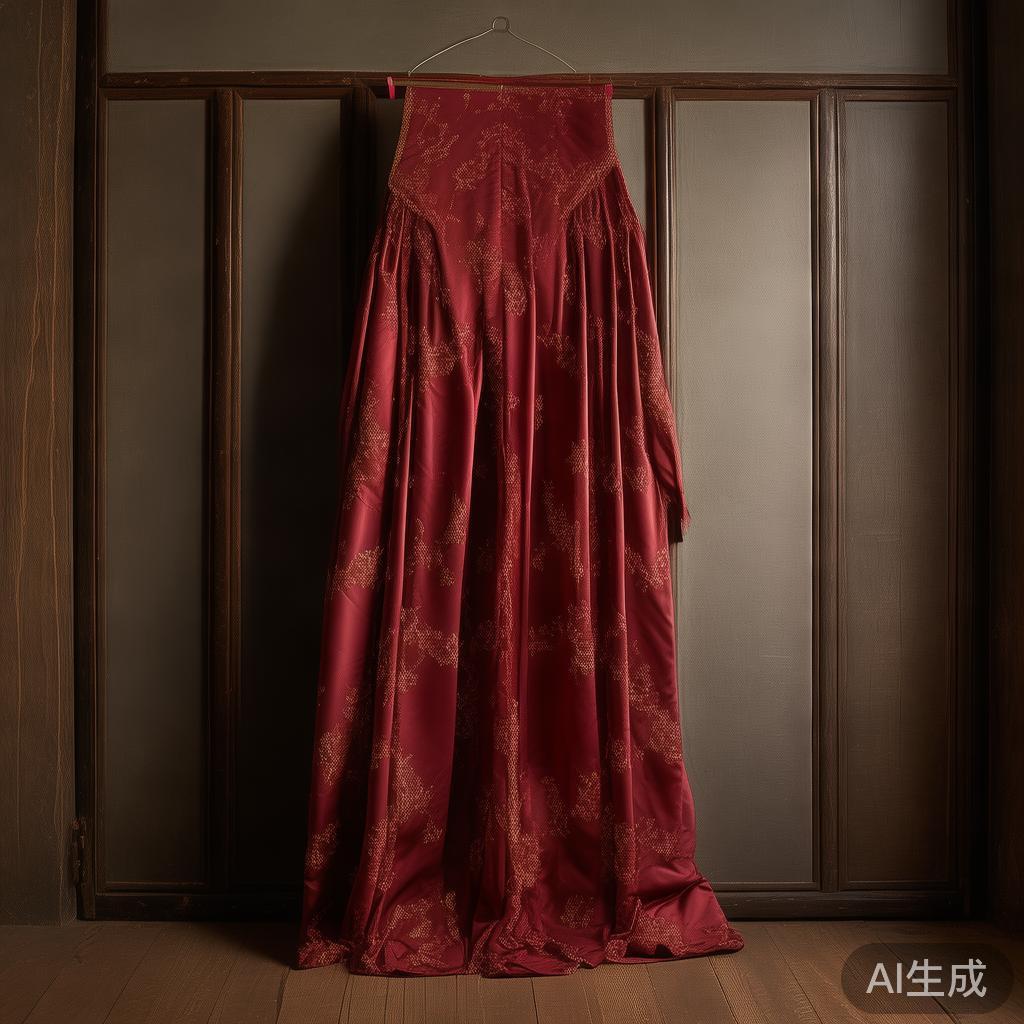
Last night I was scrolling TikTok and saw a video from an American girl. She wore a horse-face skirt to her prom. Deep red satin, gold threads woven into flowers that climbed and circled, spinning once under the gym's colored lights. The front panel faced the camera, opening and closing as she moved.
Someone in the comments asked: what brand is that skirt?
She replied: It's not a brand. It's 400 years old.
I stared at that skirt for a long time. Not because she looked good in it—though she did—but because I suddenly remembered something: this skirt has only been worn on Chinese streets again for about twenty years.
How does a piece of clothing need to "be worn on the streets again"?
It's Not a Costume
Many people think hanfu means "ancient costume," like the outfits in TV dramas. It doesn't.
Hanfu is the traditional clothing system of the Han people. Not one style, but a way of dressing that lasted three thousand years: crossed collar tied on the right, hidden ties instead of buttons, upper robe and lower skirt. Curved-hem robes, straight robes, short jackets over skirts, round-collar gowns, scholar's robes... The horse-face skirt is the lower half of that system—a smooth panel in front, a smooth panel in back, pleats on the sides. When you walk, the panels open slightly, like the tower-frames on an old city wall. That's where the name comes from.
The word "costume" is a subtle one. When Japanese people wear kimono on the street, nobody calls it a costume. When Scotsmen wear kilts, nobody calls it a costume. Only hanfu, for a long time, existed in two places: film sets, and photo studios.
How does a piece of clothing turn from "daily life" into "costume"?
Why It Disappeared
Long story, but it can be told short.
1645, the second year after the Qing army crossed the pass. An imperial decree: cut your hair and change your dress, or lose your head. Han men shaved their foreheads and grew queues, and put on Manchu-style clothes.
Not everyone accepted. In Jiangyin, a small city in Jiangsu, people held the walls for eighty-one days rather than cut their hair. When the city fell, almost no one survived. Dying a whole city for hair and clothes—unthinkable today. But to people back then, it wasn't hair and clothes. It was "the body, hair and skin, received from parents." It was "the cap and gown," the mark of who you were.
After that, hanfu disappeared from daily life. It retreated to the opera stage—what actors wear doesn't count. It retreated into portraits and ancestral paintings. It survived in Taoist priests' robes—religious dress was exempt. And one more place: burial clothes. In many parts of China, the clothes of the dead kept the Ming dynasty style. A person couldn't wear their people's clothing while alive, so they put it on to meet their ancestors.
That retreat lasted over three hundred years.
2003, Zhengzhou, One Man
November 22, 2003, Zhengzhou. Wang Letian, an electrical worker, walked out onto the street wearing a set of hanfu he had sewn himself.
He is the first person we can find who wore hanfu in public in the modern era. People surrounded him. People laughed. More people stopped him to ask: are you Japanese? Korean?
He said: I'm Han Chinese. This is the clothing of the Han people themselves.
There was no trending topic that day—no such word yet. But everything that followed began that day.
The Twenty Years Since
What came after happened fast, like a person suddenly remembering something.
2003 was one man. By 2007 there were hanfu forums. In 2018, the third day of the third lunar month was named Chinese Huafu Day. Cao County in Shandong—a county that used to make stage costumes—became the hanfu capital, selling billions a year. The horse-face skirt became the "New Year battle skirt": when you see a girl in one on the subway, nobody stares anymore. People just think—ah, the New Year is coming.
One more thing happened in between. In 2022, Dior released a skirt whose pleated structure was nearly a copy of the horse-face skirt. The official description called it "a hallmark Dior silhouette." Chinese students protested outside the Dior store in Paris, holding signs with one sentence: this is not a Dior skirt. This is a mamian qun.
I understand that protest. It wasn't about one skirt—imitation, if anything, is a kind of acknowledgment. What stung was that phrase, "a hallmark Dior silhouette." A piece of clothing had been silent for three hundred years, had only just walked back on its own, and turned around to hear itself introduced as someone else's.
Like a family heirloom that wandered far, and one day you recognize it at a flea market, and the seller tells you it has always been his.
Back to That American Girl
Beyond the brand question, another comment sat high in the thread. It said roughly: I spent the whole night reading about this. Why did I never know such a beautiful dress existed?
Someone replied: Because it was gone for three hundred years. It just came back.
The #hanfu tag on TikTok now counts views in the billions. Foreigners wear hanfu to the Great Wall, to comic conventions, to prom. Their outfits aren't always "formally correct"—buttons on the wrong side, waistbands crooked, paired with sneakers. Honestly, it doesn't bother me.
Because twenty years ago, the people on the streets of Zhengzhou asking Wang Letian "are you Japanese?" and the foreigners today asking "what brand is this?" are asking the same question: what is this clothing?
The difference is only this: one asked while assuming it belonged to someone else. The other asks, already willing to hear its name.
Not Fully Back Yet
The clothing is back. But sometimes I think, not entirely.
For the ancients, hanfu was daily life. Thoughtless. Like us throwing on a shirt before heading out. For us today, wearing hanfu is still, somewhat, "an occasion": you pick a day—a festival, a photo shoot, a date; you make a small mental preparation; you get ready to answer that question, "are you going to a film shoot?"
The clothing took twenty years to return. Perhaps that thoughtless ease will take longer.
The day a girl wears a horse-face skirt onto the morning rush subway, and nobody gives her a second look, and she herself doesn't feel she is "carrying on" anything—that day, the clothing has truly come home.
Three hundred years adrift, twenty years returning. No hurry. Clothing is more patient than people.
Three questions, for you, and for me:
- Do you own something you only dare to wear on "special occasions"? Why not on ordinary days?
- If starting tomorrow, everyone could simply wear their people's traditional clothing to work and school, how would the world be different?
- A piece of clothing vanished for three hundred years and still came back—what else do you think might be worth waiting for like that?