When This Incense Burns Out, an Hour Has Passed: The Song Dynasty's Pomodoro, Without the Bell
My phone told me I'd spent 7 hours 42 minutes a day staring at it last week. That night I dug out an incense seal mold that had sat in a drawer for two years; it took three tries to press a whole lotus. Once lit, there was no progress bar, no "25 minutes remaining" — just an ember walking slowly along the lines. Where it passed, the ash still stood. That stretch of ash was the time I'd just spent keeping it company. The pomodoro asks: are you focused yet? Incense doesn't ask.
One
A notification popped up on my phone — a weekly report I'd set myself: "Last week's screen time: 7 hours 42 minutes a day, on average."
Forty minutes more than the week before. I stared at the number for a while and felt nothing, the way you feel nothing reading someone else's check-up results. Numbers are abstract. What did I do inside those 7 hours 42 minutes? I couldn't remember. Everything I scrolled past was water flowing over stone — the stone didn't even get wet.
That night, while tidying a drawer, I found a wooden box. A gift from a friend two years ago: an incense seal mold, brass, with an openwork lotus pattern, and a small pouch of sandalwood powder. She'd said, "Try it when you can't sit still."
I'd tried once. Powder everywhere, and the moment I lifted the mold the pattern broke. I closed the box and put it back in the drawer. For two years.
This time I took it out. Not because of any sudden awakening — it was just that 7 hours 42 minutes rubbing me the wrong way.
Two
First, what an incense seal is, because a lot of younger friends may never have seen one.
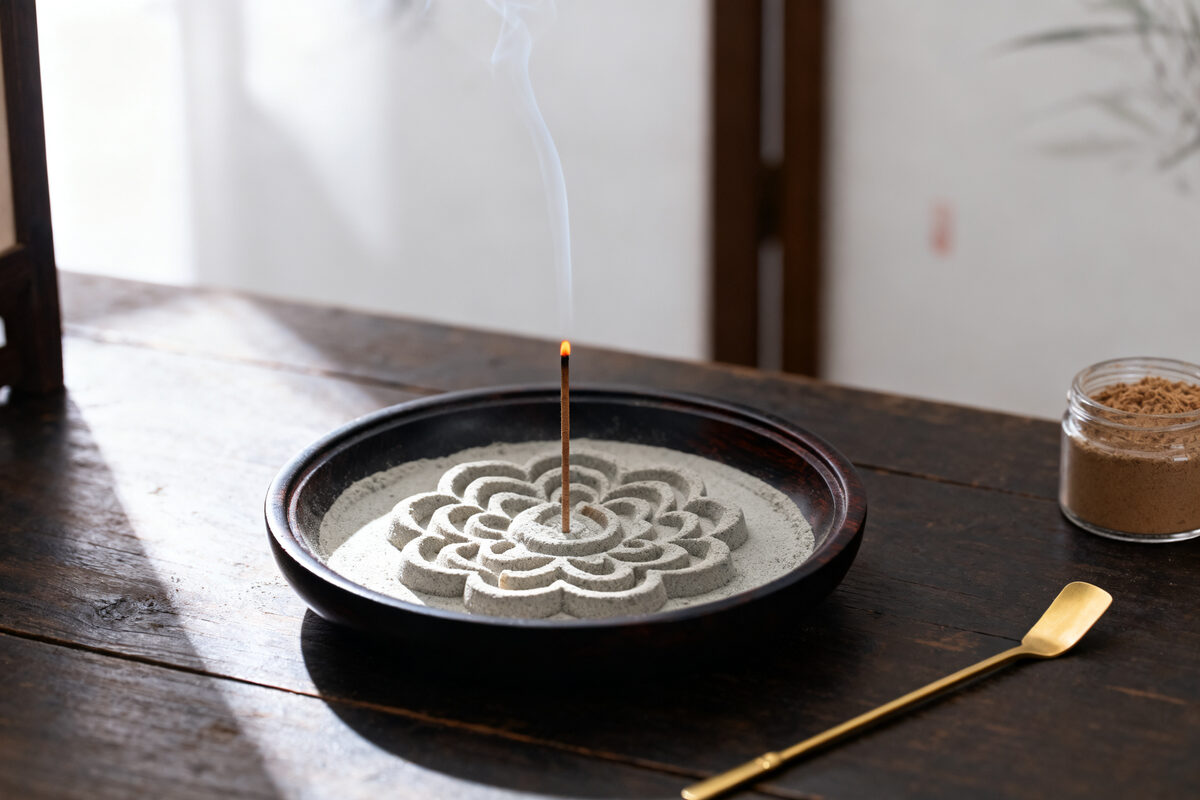
An incense seal — xiangzhuan, also called an incense stamp. You sift fine incense powder into an openwork mold, press it even, lift the mold away gently, and what's left in the ash tray is a connected seal-character pattern, or a cloud, or a lotus. You light one end. No flame — just an ember the size of a red bean, walking slowly, slowly along the lines.
A full seal takes an hour to burn; some take two.
So a long time ago, incense wasn't only for smelling. It was for use: it was a clock.
Temples still say "sitting a stick of incense." In the meditation hall, they don't say "let's meditate for forty minutes" — they say "one stick of incense." When it burns down, the chime sounds, and you rise. Monks walking briskly around the hall is "walking incense," and the board a monitor uses to tap a dozing monk on the shoulder is called an incense board. A whole day of practice is measured in incense.
The first time I realized this, I sat there for a moment. We talk about meditation and mindfulness as if they were some new technology imported from Silicon Valley. But "the time it takes one stick of incense to burn" — measuring your own quiet by the burning of incense — the Chinese have been doing it for over a thousand years.
The Song dynasty had a nicer phrase for it: the four idle arts — burning incense, whisking tea, hanging paintings, arranging flowers. Incense came first. In "Dongjing Meng Hua Lu," the old market streets of the Northern Song capital are full of incense shops next to tea shops; ordinary households burned incense as part of daily life. It was never something lofty. It was an everyday thing — a clock, and the air, and company.
Three
The second time I made a seal, I prepared. I put my phone in another room — the biggest show of sincerity I could manage.
The powder has to be worked into the mold's channels little by little with a small spoon. You can't rush. Rush, and it piles unevenly, and the burn will break. Press evenly; lift steadily — hold your breath and raise the mold straight up, bit by bit.
One petal of the lotus snapped off. I nearly closed the box again.
The third time, it held. A grey-white lotus lying in the black lacquer tray, strokes all connected, like a sentence not yet spoken.
Lighting it was the tensest moment. I carried a flame over on a stick of incense and touched it to one end. The glow dimmed — I thought it had died — I leaned in close: a point of orange-red, breathing slowly in the ash. Then a thread of smoke stood up.
No sound. No progress bar. No "25 minutes remaining."
Just an ember the size of a red bean, walking forward along the lines.
Four
I sat nearby and watched it burn.
It's a little embarrassing to say out loud — a grown man sitting at a table, watching incense. But that half hour or so (I didn't check the time afterwards; I'm guessing) really was the quietest stretch I'd had in a long while.
Where the ember has passed, the ash still stands. This is what fascinated me most: the fire moves on, the powder becomes ash, but the shape of the character is still there, the strokes still there — like snow melting while the shape stays in place. You have to lean in close to tell the burnt part from the unburnt.
Later I learned that people who work with incense call this "the ash that doesn't scatter," and consider it a good omen. The omen isn't what I care about. What I kept thinking was: that stretch of finished, ash-turned stroke — that was the time I just spent keeping it company. It didn't disappear. It changed form, and it's still standing in the tray.
And my 7 hours 42 minutes last week? They finished burning, and didn't even leave ash.
Five
I know what some people will say. Isn't this just the pomodoro technique? Twenty-five-minute blocks, invented abroad. Or those focus apps: grow a tree, and if you touch your phone the tree dies; paid subscriptions, white noise, notification blockers.
I've tried them all. They work — but they're not the same as an incense seal, at least not for me.
The pomodoro is an alarm clock. It stands outside your time, stopwatch in hand, shouting: Started! Five minutes left! Time's up! It's a supervisor. Those apps too — essentially all of them fight distraction: reminders against forgetting, a dead tree against guilt.
Incense doesn't shout. It burns its burn; you do your watching. Get up to pour water partway through — it isn't angry. Come back late — it has moved half an inch ahead, no criticism. It doesn't measure your focus. It just turns an hour into a visible thing, sets it on the table, and slowly makes it in front of you.
The pomodoro asks: are you focused yet? Incense doesn't ask. Incense just burns.
Later I thought, maybe that's the difference: one is managing time, the other is keeping time company for a while.
Six
That night, when the burn reached the lotus's last petal, I happened to be there.
The ember reached its end, dimmed once, and really went out. The smoke stood straight a while longer, then thinned. In the tray, a complete grey lotus, still standing.
I didn't reach for my phone. Not ashamed to admit it — I just sat a while longer, a few minutes maybe, doing nothing. The room was quiet enough to hear the refrigerator humming in the kitchen.
The next day I turned off the weekly screen-time notification. Not giving up — I'd just realized that number had nothing to give me. It can only count how much time I lost. It can't count it back.
The brass mold sits on the desk now. Some evenings, when there's too much to do and my head is noisy, I press a pattern, light it, and set it somewhere out of reach. Not to measure time, not as practice — just to keep something around that burns slowly.
It does its burning. I do my fretting. And somewhere along the burn, I'm not so fretful anymore.
Three questions for you
-
When was the last time you spent a full hour doing nothing else — and didn't feel cheated?
-
If you had to choose: an alarm that tells you time is up, or a thing that burns itself out slowly — which would you keep?
-
Is there something near you, slow enough that you'd be willing to keep it company for a while?