The Weight of a Mustard Seed: A Mother Searched the Whole City, Only to Find That Not a Single Family Had Been Spared from Loss
Today I came across an old book with a dried bodhi leaf tucked between the pages. It reminded me of a story from 2,500 years ago—a mother who lost her child, and the Buddha who asked her to find a mustard seed from a home untouched by death.
The Weight of a Mustard Seed: A Mother Searched the Whole City, Only to Find That Not a Single Family Had Been Spared from Loss
Today I came across an old book. Tucked between the pages was a dried bodhi leaf—I have no idea when I put it there. The leaf was brittle as paper, ready to crumble at a touch, but the veins were still clear, like a tiny map. I slipped it back in carefully and thought of a story from two thousand five hundred years ago.
One
The woman in the story is called Kisagotami. In some texts she's referred to by other names. She wasn't born into nobility. She married into a family that got by alright. Her life had been unremarkable—raising children, keeping house, no different from countless ordinary women of her time.
Then her only child died.
The boy was still very small, just barely walking. The texts don't say how he died. In those days, infants passing was common. A fever, a bout of diarrhea, and a life was gone. Today we don't really understand that kind of impermanence—we have antibiotics, emergency rooms, ICUs. But in Kisagotami's time, death came too fast, faster than anyone could react to.
She held onto her child's body and refused to let go.
I don't mean "refused to let go" as a figure of speech. She literally would not let go. She just held the body, walked out of her house, and wandered the streets of Shravasti, asking everyone she met: "Can you cure my child? Can you bring him back?"
People on the street looked at her. Some shook their heads. Some sighed. Some hurried away. A madwoman holding a dead child—nobody wanted to get involved.
I don't know how long she walked. A day? Two days? The texts don't say. But you can imagine the state: a mother who had just lost her child, her mind completely shattered, reason ground to dust by grief, nothing left but her body moving on its own. Walk up to someone, ask. Walk up to the next person, ask again.
Two
Eventually someone took pity on her and said: Go ask the Buddha. He's at Jetavana Monastery. Maybe he can help.
Kisagotami carried her child and went to find the Buddha.
She knelt down, placed the child's body on the ground, and said: Venerable sir, I beg you, bring my child back to life.
The Buddha looked at her. He didn't say "the dead cannot return." He didn't lecture her about impermanence, suffering, or emptiness. He just said one thing:
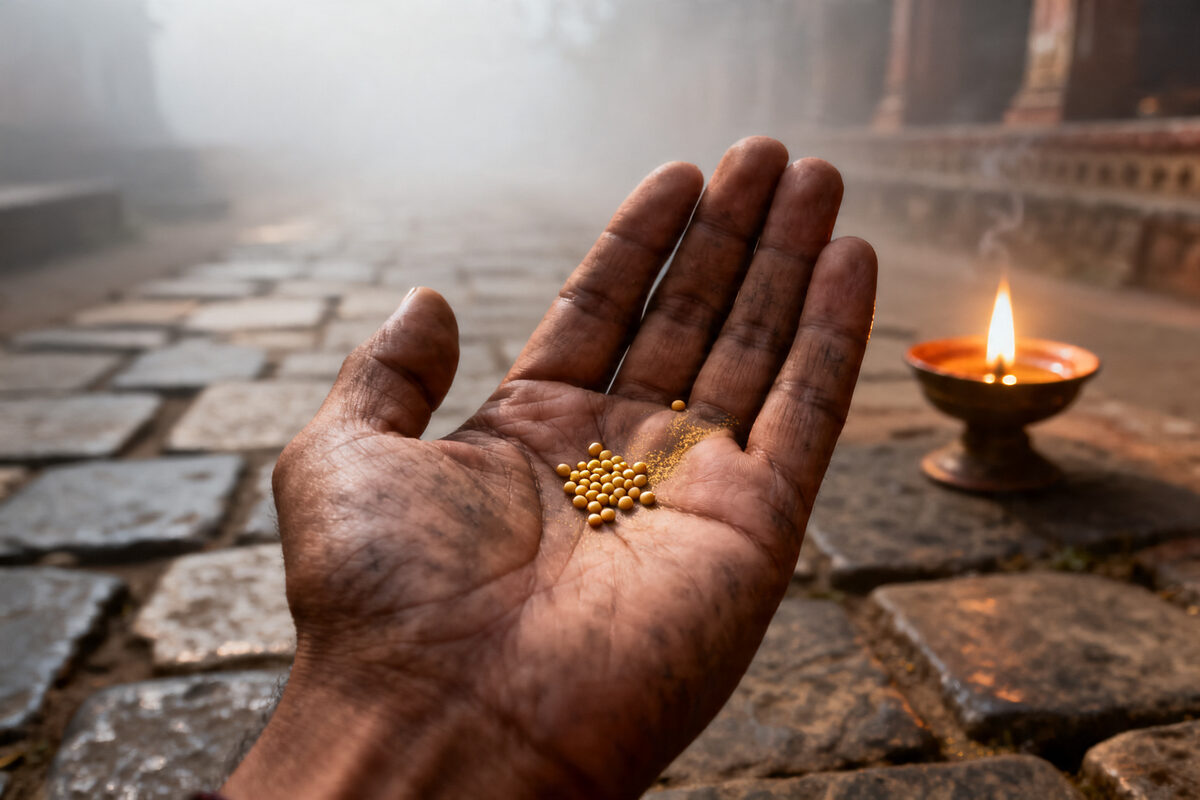
"Can you bring me a mustard seed?"
A mustard seed—tiny little thing, one of the most common spices in India at the time. Nearly every household had some in the kitchen.
Kisagotami said: Of course.
The Buddha said: But there is one condition. This mustard seed must come from a family that has never experienced a death.
Kisagotami thought, how hard can that be? She picked up her child, full of hope, and knocked on the first door.
"Excuse me, do you have mustard seeds?"
"Yes, how much do you need?"
"I just need one. But—has anyone in your family ever died?"
The woman who opened the door paused, then sighed. Yes. My husband passed away three years ago.
Kisagotami was quiet. She turned and walked away.
She knocked on a second door.
"Do you have mustard seeds? Yes. But has anyone in your family ever died?"
"My mother passed last year."
The third house. The fourth. The fifth.
Every house had mustard seeds. And every house had experienced death.
Some had lost parents. Some had lost spouses. Some had lost children. Some had elderly family members who passed peacefully. Others had loved ones killed in war. The reasons were all different. But "having experienced death"—not a single household was spared.
Kisagotami searched from dawn to dusk.
I don't know what she felt as the light faded. Maybe at first she still held on to hope—surely there's one family that's whole? Surely there's one home that death has never visited? But with every knock, every head shake, that hope slipped through her fingers like sand.
By evening, she suddenly understood.
The Buddha never needed a mustard seed. He had given her a mirror—a mirror that reflected the truth that everyone is carrying loss. Her suffering was real. But her suffering was not alone. In this whole city, there was not a single house that death had not knocked on.
That night, she buried her child.
Three
The first time I read this story, it was late at night. I was sitting alone at my desk. I hadn't yet experienced any great losses. I read it, thought it was a nice "parable," something with a lesson, and turned the page.
Then I grew older. I went through the passing of grandparents. The parting of friends. Those people you thought would always be there, suddenly gone. When I thought of this story again, it felt completely different.
It wasn't that I "understood the lesson now"—stories aren't meant for understanding lessons. It was that, all at once, the image of Kisagotami walking the streets holding her child became vivid. That refusal to let go, that desperate clinging, that "if only someone could help me" plea—no longer an abstract religious tale, but a state anyone could fall into.
We all hold on to things we won't put down. Maybe it's a person. Maybe it's a relationship. Maybe it's a "what if." Maybe it's the inability to accept how something turned out. It isn't always about life and death. Sometimes it's small things. But that feeling of holding on and not letting go—that's the same.
Four
The Buddha's method was gentle.
He didn't tell Kisagotami about "impermanence." He didn't tell her to "let go." He didn't recite the Four Noble Truths.
He simply let her find out for herself.
Go knock on doors. Go ask. Go see with your own eyes, hear with your own ears, measure this truth with your own footsteps: loss is not yours alone. Everyone is losing. Everyone is bearing it. Everyone is also continuing to live.
This is not consolation—"others suffer too so you don't have to" is not the point. Suffering is suffering. Nobody's pain gets lighter just because someone else hurts too.
But when you see this, you understand one thing: you are not being singled out for punishment. Loss is not because you did something wrong, not because you weren't good enough, not because fate has it in for you. It is simply part of being alive.
This realization cannot change what happened. The dead child will not come back. The people you lost will not reappear. But it can change your relationship with what happened.
Kisagotami later became a nun. She practiced and attained arhatship. This is what the texts record. The specifics of how, nobody knows. But I think the point isn't that she "attained" something. The point is that from a day of knocking on doors, she learned one thing: the only way to face loss is not to find a mustard seed you don't need, but to see the truth with your own eyes, and then come back, and let go.
Five
The tea beside me has gone cold.
I looked at the dried bodhi leaf one more time. It rests quietly between the pages, unhurried, as if to say: I lived, then I dried out, but the veins are still here.
Sometimes I feel that the whole work of practice comes down to one thing—knowing when to open your hand. Not being unfeeling. Not being indifferent. But having felt it, having cared, and then letting go.
If you don't let go, both your hands stay full, and you can't catch anything new.
Three questions, for myself, and for you who are reading:
- What are you holding onto right now that you can't bear to put down?
- If you knocked on every door in the city, how many families do you think could give you that mustard seed?
- What would you put in the space that opens up when you finally let go?