The Beast That Only Takes In: I Found a Pixiu in My Drawer
Cleaning out a drawer, I found a stone Pixiu I bought years ago for thirty yuan. The vendor said it has a mouth but no other end — nothing comes out. Now foreigners on TikTok call it the money beast. I finally understood: it isn't for asking wealth. It's for watching over what you have.
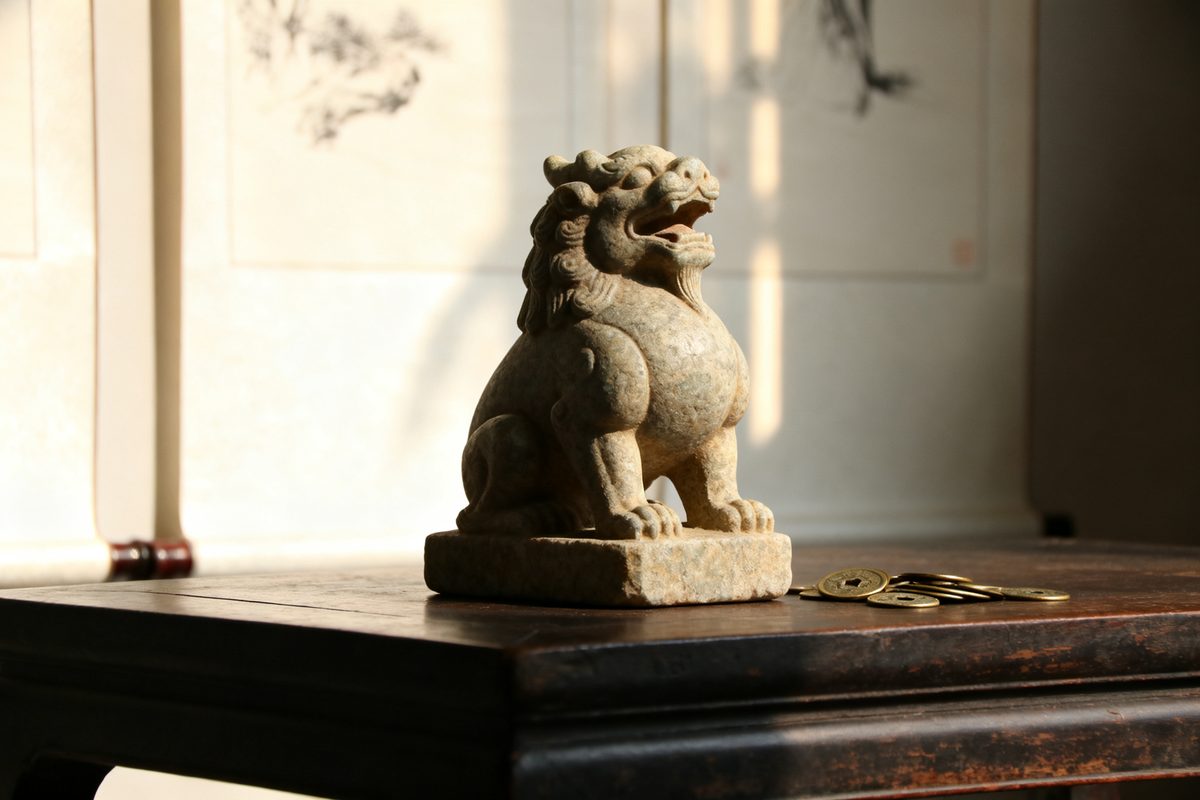
At the very back of my drawer, there is a small stone lion. Not quite a lion. A Pixiu.
I found it again while cleaning. A dusty little thing, crouching there, head slightly raised, mouth open — as if it had just swallowed something and hadn't finished.
I picked it up, wiped it, and remembered where it came from.
It was years ago, in the tightest year my hands had ever known. The pay was low, rent was due, and my family needed money for something. One day I passed a flea market — stalls selling prayer beads, copper coins, stones I couldn't name. I stopped at one. The vendor, an old man, saw me looking at the little stone beast and said: Pixiu. It brings wealth.
I asked: how?
He said: this creature has a mouth, but no other end. Things go in. Nothing comes out.
I didn't buy it. Truly. I wasn't the superstitious kind. I walked two steps, then turned back. Thirty yuan.
Not because I believed. It was that one sentence that paused in my head: things go in, nothing comes out.
For someone who spent every month wondering where the money went, those words stung a little.
What it actually is
Later I looked it up, and asked around.
The Pixiu, so the legend goes, is the ninth son of the dragon. The dragon had nine sons, none of them dragons — one carries stone tablets, another sits on temple bells. This ninth one looks like a lion, with wings at its ribs, fierce and mighty, and it swallows gold and silver.
What it swallows, it never spits back out.
There is a widely told story: the Pixiu once served in heaven and broke a rule — one version says it relieved itself in the wrong place (the telling is not elegant) — and the Jade Emperor slapped it on the backside and sealed it shut. From then on, everything it ate had to stay inside its body.
The first time I heard this story, I laughed for a long time. The punishment for a gluttonous beast is that it can never excrete again — funny at first, cruel on reflection: everything you swallow, you must carry yourself.
But the ancients didn't see it as punishment. They saw it as the greatest of virtues.
Think about it: a creature that only takes in and never lets out — what does that mean in a home? Wealth that doesn't leak away. Old merchants loved it. Money exchanges and trading houses often kept one on the counter. Some of the stone guardians at old banks' doors were not lions, but Pixiu.
Merchants, who dealt with money more than anyone, understood two things clearly: money is hard to earn, and money leaks easily.
So what they honored was not a god. It was a reminder.
Foreigners understood it before I did
Here's the interesting part: in the past two years, I've seen the Pixiu online more often than in the previous ten years combined.
Not on Chinese websites. On TikTok. On Etsy.
I scrolled past a video where an American creator held up a bracelet — obsidian beads with a little golden beast head — and told the camera, very seriously: This is Pixiu, the Chinese money beast. Then the instructions: wear it on the left hand, head facing outward, and never let anyone else touch it.
The comments were flooded with "where can I get one."
Search pixiu bracelet on Etsy and thousands of listings come up, none of them cheap. The descriptions say "attracts wealth energy," "Chinese Feng Shui tradition."
Honestly, the first time I saw that, I stared for a while.
The thing I bought for thirty yuan at a flea market, the thing that lay in my drawer for years — on the other side of the planet, people study it earnestly, wear it, follow its rules.
Then I saw another video, with comment after comment asking why they hadn't gotten rich after a month. One highly liked reply said: Maybe it's not about getting more, maybe it's about keeping what you have.
I read that line for a long time.
Someone I'll never meet, in English, in one sentence, had gotten to the root of the whole Pixiu thing.
The rules
Since I'm writing about it, I'll write down the customs too. Not so you follow them, but because each rule hides a wish about money.
Wear it on the left wrist. The folk saying is "in on the left, out on the right" — the left side lets wealth in, the right lets it out. So: left. You see, it always comes back to the same idea: let it in, don't let it out.
Head up, or facing outward. Up means swallowing the wealth of the world; outward means meeting fortune when you go out. Either way, the direction of the mouth matters. Wherever a beast opens its mouth, that's where you place your hope.
No one else may touch it. They say if someone touches it, they "borrow" the wealth away. I've thought about this rule — it sounds a lot like a plain truth in disguise: your money is not for others to handle freely.
Once on, don't take it off. Taking it off and leaving it around is like dismissing the guard. If you must set it down, face its head toward the door, so it "watches over."
Notice something? Every rule circles two words: in, and keep.
No rule teaches you how to earn. Not one says the Pixiu gets you a promotion. It governs a single matter: what comes in, keep it.
The ancients were clear-eyed about this: whether you earn depends on skill and luck — it can't be forced. But whether what comes in stays — that part is up to you.
What "in, never out" really says
Now I want to say something of my own. Nothing to do with feng shui.
For our generation, spending money is too easy.
Lift the phone, press a fingerprint, and the money is gone. No counting, no handing over, no felt sense of loss. The month's salary is like water poured into a bottomless bucket. At month's end the bucket is empty, and you can't even remember which hole it leaked from.
There was a season when money anxiety sat on me. Then I noticed: what I feared was probably not "not earning enough" — I earned enough to live. What I feared was the feeling of not being able to hold on to anything.
Money like sand. Grab a handful each day, leak a handful each day. You can't even say where it went.
The Pixiu has no other end.
It is a body that has been "sealed." Everything that comes in stays, is kept, stored inside its belly. Its belly is a storeroom with only a door in.
Suddenly I understood why the ancients made such a beast, and why it has been passed down for two thousand years.
It isn't for asking wealth. It is for watching over your wealth.
It crouches on the desk, mouth open, saying nothing. But every time you see it, you remember those words: in, never out. And then you think of your wallet, your bills, all those "just bought it casually" things.
This isn't superstition. It's a two-thousand-year-old piece of performance art, titled "Keeping."
The Tao Te Ching has a line: "A hall filled with gold and jade cannot be kept." Laozi saw it plainly — not being able to keep is the norm. Perhaps precisely because keeping is so hard, people needed an image that could keep, carved into stone and set before their eyes.
Coda
The little Pixiu — I didn't throw it away, and I didn't leave it in the drawer.
It sits on my desk now, right beside the computer. When I work, I only need to lift my eyes to see its open mouth.
Has it brought wealth? I can't say. These years haven't made me rich, but things have slowly loosened. If it has any use, it's this: every day when I see it, something clicks inside — today, did something that shouldn't have gone out, go out again?
Some days yes. Some days no.
Sometimes I pat its head and tell it: brother, you've worked hard.
Where does everything it swallows go? Nobody knows. Maybe its belly holds nothing at all. Maybe it holds ten or twenty years of a family's days. Maybe it is like you — just quietly putting each day away, into its body, without a sound.
Three questions, left for you:
- Do you have an object you can't quite call "belief," but have never thrown away?
- When was the last time you felt "this money shouldn't have been spent"?
- If things only came in, never out — time in, people in, money in — which one would you most want to keep?