Stick Out Your Tongue: A Chinese Doctor Can Tell What's Wrong
Last week I visited a Chinese medicine doctor. He asked no questions—just looked at my tongue for three seconds and knew everything. What can a tongue reveal?
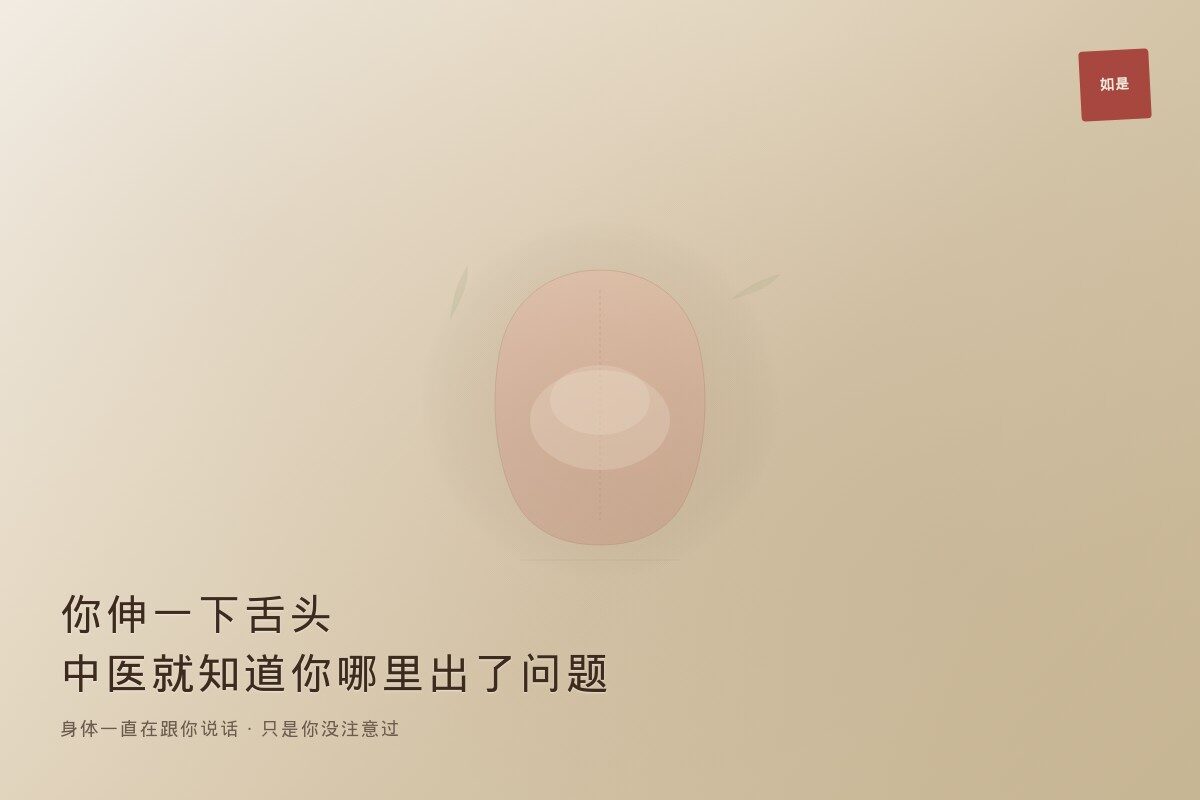
Stick Out Your Tongue: A Chinese Doctor Can Tell What's Wrong With You
Last week I went to see a Chinese medicine doctor. He didn't ask me a single question. He just said, "Stick out your tongue."
So I did. He looked at it for about three seconds and said, "You haven't been sleeping well lately, have you? You're irritable, and your urine is dark."
I was stunned.
Because he was completely right. I'd been lying awake for two weeks straight, and I'd recently snapped at a coworker over something I wouldn't normally care about. But he hadn't asked me anything. He'd only looked at my tongue.
On the way home, I couldn't stop thinking about it. What can a Chinese medicine doctor actually see in a tongue?
Your Tongue Is the Only Organ You Can See for Yourself
Here's something you may not have thought about: your internal organs are invisible. Your liver is inside. Your stomach is inside. Your heart is inside. You can't crack yourself open and check if your liver looks okay.
But your tongue is different.
In Chinese medicine, the tongue is called the "sprout of the heart" and the "outward sign of the spleen and stomach." What that means is there's a direct line between your tongue and your internal organs. Whatever's happening inside gets reflected on the tongue through the flow of qi and blood — the color of the tongue body, the thickness of the coating, whether it's puffy or thin, even the teeth marks along the edges. All signals.
Western medicine acknowledges this too. When you're low on vitamin B, your tongue gets smooth and sore. When you're anemic, it turns pale. But Chinese medicine reads the tongue in far more detail, and much earlier — often before you feel any symptoms at all.
I looked into it and found that tongue diagnosis has been practiced for over a thousand years. The earliest records go back to the Yuan Dynasty, when a man named Ao Jiweng wrote the Golden Mirror Record, entirely about how to read tongues to understand illness. Over centuries of refinement, it became the system taught in Chinese medicine schools today.
What Does a Healthy Tongue Look Like?
Before talking about what's wrong, we need to know what normal looks like.
Chinese medicine has a specific phrase for a healthy tongue: "pale red tongue, thin white coating." Simply put:
- Tongue body color: Pale red. Not too dark, not too light. Think of the pink of fresh pork, but slightly lighter.
- Tongue body: Moderate size — not puffy, not thin. Flexible and soft. It comes out flat and doesn't drift to one side.
- Coating: A thin, even layer of white. You can faintly see the tongue body underneath. Not thick, not greasy, not yellow, not black.
- Underside: Lift your tongue and look at the two veins underneath. They should be light purple or pale blue — not thick, not swollen, not coiled like earthworms.
If that's what you see, congratulations. Your qi and blood are flowing well.
But most people today don't have tongues like that.
I Looked in the Mirror and Startled Myself
After my visit, I started checking my tongue every morning while brushing my teeth.
Honestly, it made me a bit anxious — not from fear, but because I noticed things I'd never paid attention to before.
Here are the most common types of "problem tongues" in Chinese medicine, explained as plainly as I can:
1. Pale Tongue — You May Be Low on Qi and Blood
If your tongue is noticeably pale — washed-out, lacking color — and you also feel tired easily, get dizzy, or have cold hands and feet, Chinese medicine calls this "deficiency of both qi and blood."
This is especially common in women. Monthly blood loss, combined with dieting and skipping meat, can easily deplete you.
A friend of mine had a tongue that looked like it had been soaked in water until the color bled out. She said she'd get dizzy every time she stood up. After two months of eating red date and longan chicken soup, her tongue color slowly came back.
2. Red Tongue — You May Be "Running Hot"
This is the one I experienced most personally.
If your tongue is clearly redder than normal — even dark crimson, like an unhealed wound — Chinese medicine calls it a "red tongue" or "crimson tongue," meaning there's heat in the body.
Heat comes in two types: excess heat and deficiency heat.
Excess heat is what people usually call "shanghuo" — internal flare-up. You ate too much spicy or fried food, your gums are swollen, your throat hurts, your stool is dry as stone. The tongue is bright red with a yellow coating.
Deficiency heat is different. It's not that the fire is too strong — it's that the water is too low. Your yin fluids are depleted and can't keep the yang in check, so it appears relatively hot. This red is darker, and the tongue often has little to no coating — smooth and bare, like a wall with peeling paint. These people tend to have hot palms and soles, night sweats, and a dry mouth without wanting to drink.
Deficiency heat is rampant in modern life — staying up late, chronic stress, overthinking, too much coffee. All of it slowly burns through your yin fluids.
3. Puffy Tongue with Teeth Marks — Dampness
This one's very easy to spot.
When you stick out your tongue, if you notice it's thicker and larger than normal, with a row of indentations along the edges — like lace — that's basically "spleen deficiency with dampness."
Chinese medicine says the spleen is responsible for transforming food into qi and blood, and for draining excess fluid. If the spleen is weak, dampness accumulates in the body, and the tongue swells. A swollen tongue pressed against teeth over time leaves those marks.
People with heavy dampness usually share certain traits: they feel sluggish and foggy, their stool is sticky and hard to flush, their body feels heavy, like wearing wet clothes.
The tongue gives you a way to see this with your own eyes — no doctor needed, just a mirror.
4. Thick, Greasy Coating — Your Digestion Is Stuck
A normal coating is a thin white film. But if yours is thick, like a layer of tofu dregs, cream, or butter — it means there's stagnation in the spleen and stomach.
A thick white greasy coating usually indicates cold-dampness or phlegm-dampness. You ate too much raw, cold, or sweet food, and your spleen couldn't process it all, so it just sat there fermenting.
A thick yellow greasy coating usually signals damp-heat. Bad breath, foul sticky stool, oily skin and acne.
There's also "geographic tongue" — where patches of coating are missing, like a map. This often indicates stomach yin deficiency or an allergic constitution. It's more common in children.
5. Purple Tongue or Spots — Blood Stasis
Take this one seriously.
If your tongue is purple — a dull, dark purple — or has dark red spots and bruises on the surface, Chinese medicine considers this "blood stasis." Qi and blood aren't circulating well and have become stuck somewhere.
People with blood stasis may bruise easily, have fixed-location pain (not the wandering kind), dark purplish lips, and for women, menstrual clots with dark-colored blood.
If the veins under your tongue are thick, dark, and twisted, that's also a sign of stasis.
Something Fascinating: The Tongue Changes
After watching my tongue for two weeks straight, I noticed something remarkable: the tongue isn't fixed. It changes.
One evening after a long day — working until 11 PM — I got home and checked. My tongue was noticeably redder than usual, with a slightly yellow coating. I thought to myself, "Isn't that deficiency fire rising?"
On the weekend, I rested properly, drank some snow fungus and lotus seed soup, slept in, and checked again. The color had lightened. The coating was thinner.
Another time, I had hot pot for lunch. That evening, the coating at the back of my tongue was thicker. By the next morning, it was back to normal.
What makes tongue diagnosis most interesting isn't "diagnosis" — it's observing yourself. You don't need to be a Chinese medicine doctor, and you don't need to rush to the hospital every time something feels off. But you can spend three seconds looking at your tongue while brushing your teeth. It's more honest than you think.
Your annual physical report might take a year to arrive. But your tongue files a daily report.
Tongue Diagnosis Isn't Magic — But It's a Window
Having said all this, I want to be clear: tongue diagnosis isn't all-powerful.
Chinese medicine emphasizes "examination through all four methods" — looking, listening, asking, and feeling the pulse. Drawing conclusions from the tongue alone is unreliable. The tongue is one reference point, not a replacement for a complete diagnosis.
But its value is this: it gives ordinary people an entry point to understand their own bodies.
When you get a Western medical report, you see a bunch of numbers: elevated liver enzymes, high triglycerides. You know something's off, but it feels distant, because those numbers don't hurt.
The tongue is different. You watch it turn pale, turn purple, develop a yellow coating — and you feel something. "Ah, so my body has been trying to tell me something." That feeling matters, because it's what pushes you to change.
That's exactly what happened to me. After seeing my own tongue, I quietly moved my alarm from 7:30 AM to 11 PM — not to wake up, but to remind myself to go to sleep. I haven't fully succeeded yet, but at least now I know: my tongue is telling me to stop burning the midnight oil.
One Last Thing
I'm not writing this to teach you how to diagnose yourself. I don't have that ability, and even doctors who've studied Chinese medicine for decades wouldn't claim to understand everything from a single glance at a tongue.
I just want to share a feeling: your body has always been talking to you. You may have just never paid attention to what it's saying.
Sticking out your tongue might be the simplest way to start listening.
No tools needed. No money. No appointment. Just a mirror and an open mouth.
Three seconds is enough.
Three questions for you:
- Have you ever looked at your tongue while brushing your teeth? What color is it?
- Do you notice any connection between your tongue and how you've been feeling lately?
- If the tongue really does reflect your health, would you be willing to check it every day starting today?