Thich Nhat Hanh: The Art of Mindful Living
Thich Nhat Hanh brought Zen practice to the West, teaching mindfulness in the simplest ways. He showed us: every moment can be meditation, every step can lead to peace.
Thich Nhat Hanh: The Art of Mindful Living
Editor's Note
Thich Nhat Hanh (1926-2022) was a renowned Vietnamese Zen master, peace activist, and poet. He brought the Buddhist practice of mindfulness to the West and founded the "Engaged Buddhism" movement, influencing countless people's way of life. He established the Plum Village meditation center in France and authored over one hundred books, including The Miracle of Mindfulness and Peace Is Every Step. This article is compiled from Thich Nhat Hanh's writings and teachings.
I. What is Mindfulness?
Q: Thay, you often speak of "mindfulness." What exactly is mindfulness?
Thich Nhat Hanh: Mindfulness is simple—it is being fully present in the here and now.
Washing Dishes While Washing Dishes
Many people wash dishes while thinking about the tea they'll drink later. When drinking tea, they think about other things.
This way, you haven't really washed the dishes, nor have you really drunk the tea.
Mindfulness is: when washing dishes, fully focus on washing dishes. Feel the temperature of the water, the smoothness of the plate, every movement.
Washing dishes itself is a wonderful thing—why rush to finish it?
Eating an Orange While Eating an Orange
I often tell this story:
A person was eating an orange while thinking about future plans. He'd peel one segment and put it in his mouth, and before finishing it, he'd already be peeling the next.
I told him: "You should finish the orange in your mouth before peeling the next segment."
If you can't eat an orange properly, you can't do other things properly either.
Mindfulness is placing your full attention on this present moment.
Q: Why is mindfulness so important?
Thich Nhat Hanh: Because life exists only in the present moment.
The Past is Gone
The past has already passed—thinking about it won't help.
If you dwell on the past, you'll miss the present.
The Future Hasn't Arrived
The future hasn't happened yet—worrying about it won't help.
If you're always worrying about the future, you'll miss the present.
Only the Present is Real
The only thing you can touch is this present moment. The only thing you can feel is this present moment. The only thing you can live is this present moment.
So I say: Life exists only in the present.
If you miss the present, you miss life.
II. Mindful Breathing
Q: How do we practice mindfulness? Where do we start?
Thich Nhat Hanh: Start with breathing.
Simple Breathing Practice
Here's the simplest method:
Breathing in, I know I am breathing in. Breathing out, I know I am breathing out.
That's it. Very simple.
When you breathe in, place your full attention on breathing in. When you breathe out, place your full attention on breathing out.
Why Start with Breathing
Breathing is always with you.
No matter where you are, no matter what you're doing, you're breathing.
So breathing is the best anchor to bring your mind back to the present.
Whenever you notice your mind has wandered, return to breathing: "Breathing in, I know I am breathing in." "Breathing out, I know I am breathing out."
The Four Verses
At Plum Village, we teach students four verses, combined with breathing:
Breathing in, I calm my body. Breathing out, I smile. Dwelling in the present moment, I know this is a wonderful moment.
You can practice this daily—while walking, while waiting for the bus, during breaks at work.
It doesn't take long—a few minutes is enough. But practice often.
Q: What are the benefits of mindful breathing?
Thich Nhat Hanh: The benefits are many.
First: Relaxation of Body and Mind
When you focus on breathing, your body naturally relaxes, your mind naturally calms.
Many people don't realize how tense they are until they start paying attention to breathing, discovering their shoulders are tight, their brow is furrowed.
Second: Reduced Anxiety
Anxiety often comes from thinking too much—about the past, about the future.
When you return to breathing, you return to the present. The present has no problems; the present is safe.
Third: Increased Awareness
Regular practice of mindful breathing makes you more aware of your emotions and thoughts.
You'll know when you're angry that you're angry. You'll know when you're anxious that you're anxious.
This awareness itself has healing power.
III. Mindful Walking
Q: You often speak of "walking meditation." Can walking be meditation too?
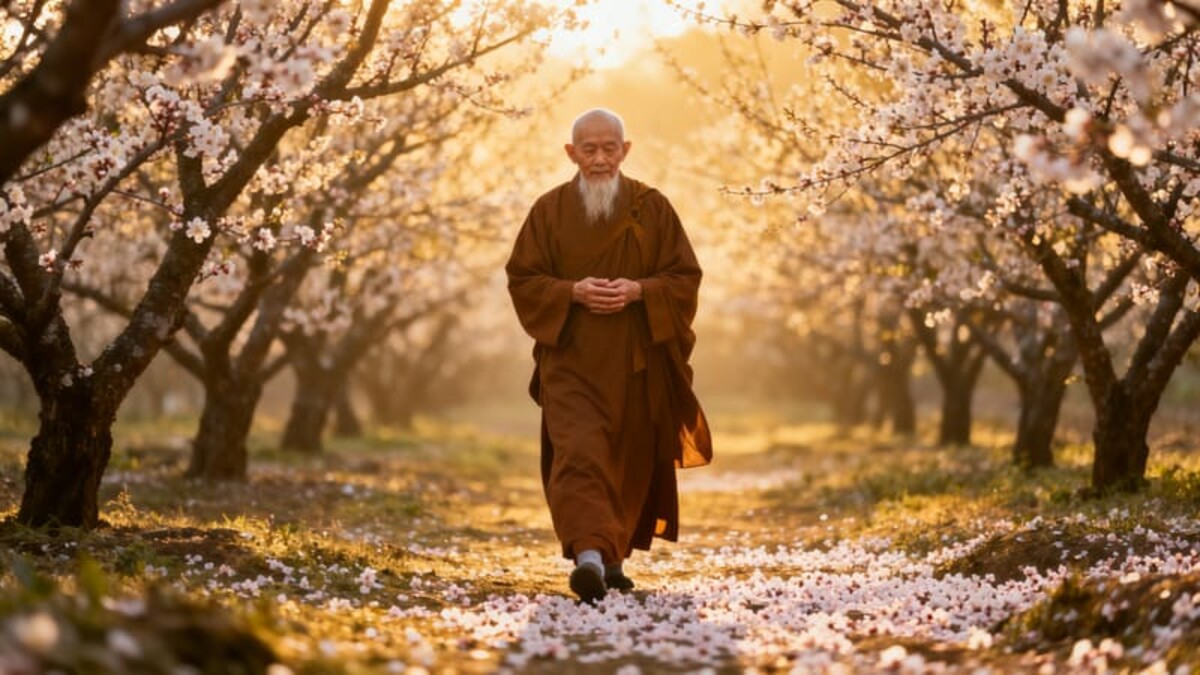
Thich Nhat Hanh: Of course. Walking itself is meditation.
How to Practice Mindful Walking
The method is simple:
Breathing in, I take a step. Breathing out, I take a step.
Every step, fully aware.
Feel the sensation of your foot contacting the ground, the sensation of your body moving, the sensation of the air around you.
Don't rush to reach the destination—walking itself is the purpose.
You Can Walk Anywhere
You don't need to go somewhere special.
Walking from bedroom to kitchen can be mindful walking. Walking from parking lot to office can be mindful walking.
You walk many steps every day—why not make them meditation?
The Meaning of Walking
When you walk mindfully, you're fully alive in this step.
You're not thinking about the past, not thinking about the future—you're just in this step.
This step is life.
When you walk this way, every step is peace, every step is joy.
I Walk in Peace
I often say: "I walk in peace."
When you walk mindfully, your footsteps carry the energy of peace.
The path you walk leaves a mark of peace.
This isn't an exaggeration—it's true.
Because your mind is peaceful, the world gains one more measure of peace.
IV. Mindfulness and Emotions
Q: How do we use mindfulness to handle difficult emotions like anger and anxiety?
Thich Nhat Hanh: Mindfulness is the best way to handle emotions.
Accepting Emotions
When you're angry, don't suppress it, and don't let it carry you away.
Just look at it and say: "Anger is here."
Like watching a cloud pass through the sky—you're not the cloud, you're the sky.
Anger comes, and anger goes. You're not the anger; you're the one who's aware of the anger.
Embracing Emotions
I often say to embrace your emotions.
Imagine anger is a crying child. You don't scold it—you hold it in your arms and say: "I know you're here. I care about you."
When you treat anger gently, it gradually settles.
Transforming Emotions
Emotions themselves aren't the problem—our relationship with them is.
Fear comes—you look at it, accept it, embrace it, and it transforms.
This is the power of mindfulness—not eliminating emotions, but transforming them.
Q: How exactly do we do this?
Thich Nhat Hanh: I'll teach you a method called RAIN:
R - Recognize
Recognize the emotion you're experiencing. "Anger is here." Or "Anxiety is here."
A - Accept
Don't judge yourself for being angry. Don't say "I shouldn't be angry."
Anger is anger; it's already here. Accept it.
I - Investigate
Investigate where this emotion is in your body.
Where is the anger? Chest? Stomach? Throat?
What does it feel like? Tight? Hot? Painful?
Don't think about why you're angry—just feel the sensation in your body.
N - Non-identification
You are not this emotion.
Anger is a cloud in your sky. You're not the cloud—you're the sky.
Clouds come and go. The sky is always there.
V. Mindfulness and Relationships
Q: How does mindfulness improve relationships?
Thich Nhat Hanh: Mindfulness makes relationships deeper and more authentic.
Deep Listening
Many people don't know how to listen.
When someone is speaking, you're thinking about how to respond, or judging whether what they say is right or wrong.
This isn't listening—this is preparing to speak.
Mindful listening is: fully focusing on what the other person is saying, not interrupting, not judging—just listening.
When you listen this way, the other person feels understood and respected.
Being heard is one of humanity's deepest needs.
Loving Speech
Mindfulness also makes us more careful with our words.
Before speaking, ask yourself:
- Is this true?
- Is this kind?
- Is this necessary?
If not, don't say it.
Loving speech isn't about saying pleasant things—it's about saying things that are true, kind, and helpful.
Understanding Brings Compassion
When you mindfully observe someone, you discover their suffering.
They're angry—perhaps because they've been hurt. They're cold—perhaps because they're afraid.
When you see their suffering, you won't blame them. Instead, compassion arises.
Understanding is the foundation of compassion.
Q: If someone has hurt me, how do I handle it mindfully?
Thich Nhat Hanh: This is an important question.
Don't React Immediately
When you've been hurt, don't react immediately.
Words and actions spoken in anger often lead to regret.
Give yourself time. Let the anger pass.
See the Other's Suffering
No one hurts others without reason.
The person who hurt you is also in pain.
Perhaps they weren't treated well growing up. Perhaps they're experiencing great stress.
When you see their suffering, your anger decreases and compassion increases.
Protect Yourself and Protect Them
Mindfulness isn't about letting others mistreat you.
You need to protect yourself, and also protect them.
Sometimes, refusing someone—not allowing them to continue hurting you—is also protecting them: preventing them from creating more negative karma.
VI. Mindfulness and Work
Q: How can busy people practice mindfulness?
Thich Nhat Hanh: Mindfulness can be practiced everywhere at work.
Morning Mindfulness
When waking up, take a few seconds to be aware: "I am awake. A new day has begun."
When brushing your teeth, focus on brushing—not on today's work.
When eating breakfast, focus on eating—not on looking at your phone.
These small moments of mindfulness set the tone for the day.
Mindfulness Between Tasks
Don't jump directly from one thing to the next.
Finish one task, pause, take three breaths, then do the next.
This small gap gives your mind a chance to breathe.
Mindfulness in Difficult Moments
When encountering something difficult, don't react immediately.
Stop. Breathe. Ask yourself: "What is most needed right now?"
Then act.
Mindfulness keeps you clear amid chaos.
Evening Mindfulness
When work ends, make a transition.
You might do a few steps of mindful walking on the way home, leaving work at work.
When you get home, you can truly be with your family.
Q: Does mindfulness affect work efficiency?
Thich Nhat Hanh: No—it actually increases it.
Focus on One Thing
Many people think multitasking is efficient. It's not.
Doing several things at once means doing none of them well.
Mindfulness is doing one thing at a time, fully focused.
This is actually faster and better.
Fewer Mistakes
Rushing leads to mistakes. Mistakes require redoing, which wastes more time.
Mindfulness makes you composed, reduces mistakes, and actually saves time.
More Creativity
Mindfulness quiets your mind, and creativity naturally emerges.
Answers to many problems aren't found through thinking—they appear naturally when you're quiet.
VII. Peace and Nonviolence
Q: You've dedicated your life to the peace movement. What does peace mean to you?
Thich Nhat Hanh: Peace isn't the absence of conflict—it's facing conflict with compassion and wisdom.
Peace Begins with Yourself
If you want world peace, start with your own peace.
If your mind is chaotic, how can you bring peace to the world?
So, peace begins with your own mind.
Practice mindfulness daily. Let your mind be calm, joyful, and compassionate.
Your peace will ripple outward, affecting those around you.
Nonviolent Communication
Language can be violent, or it can be peaceful.
The core of nonviolent communication is: speak your feelings and needs, rather than judging and blaming.
For example, don't say "You never listen to me." Say "When I'm speaking and you don't respond, I feel hurt. I need to be heard."
The former is blame, which triggers defensiveness. The latter expresses feelings, which triggers understanding.
Peace Isn't Escape
Some people think peace means avoiding conflict—tolerating everything.
No.
Peace is bravely facing conflict, but resolving it with compassion and wisdom.
Sometimes you must firmly say "no," but say it without anger.
VIII. The Life of Thich Nhat Hanh
Q: Can you tell us your life story?
Thich Nhat Hanh: My story is simple.
Childhood and Ordination
I was born in central Vietnam in 1926 and ordained at age sixteen.
The reason for ordaining was simple: I wanted to find the meaning of life and help sentient beings reduce their suffering.
War and Peace
When I was young, Vietnam experienced a long war.
I saw too much suffering, too many deaths.
I decided to do something. I founded "Engaged Buddhism"—Buddhists can't just practice for themselves; they must enter society and help those who suffer.
We started schools, built hospitals, helped refugees.
I also went to Europe and America to call for peace.
Exile
Because of my peace activities, I was disliked by both the South and North Vietnamese governments.
In 1966, I left Vietnam to call for peace in America, and was subsequently banned from returning.
That exile lasted thirty-nine years.
But I didn't resent. I established Plum Village in France, continuing to share mindfulness and peace.
Returning to Vietnam
In 2005, I could finally return to Vietnam.
The first time I returned, many people came to see me. They told me my books had spread widely in Vietnam, helping many people.
I was comforted.
The Belief of a Lifetime
My life has been practicing one belief: Peace is possible.
As long as each of us has a peaceful heart, peace is possible.
Not a distant dream—it can be realized here and now.
IX. Final Words
Q: Please give us your final teaching.
Thich Nhat Hanh: I have no special teaching—just a few simple words:
First: Breathe
You can return to breathing anytime.
Breathing is your anchor, bringing you back to the present.
Second: Smile
Smiling is a healing power.
When you smile, your body relaxes, your heart rejoices.
Even if you don't feel like smiling, try smiling—your heart will change too.
Third: Live in the Present
Life exists only in the present.
Don't sacrifice the present for the future. Live well in each moment—that's the best respect for life.
Fourth: Compassion
Be compassionate to yourself, compassionate to others.
Everyone is enduring suffering; everyone needs compassion.
Fifth: Live Simply
A simple life is a happy life.
Your needs aren't many. Reduce desire, increase joy.
Postscript
Thich Nhat Hanh passed away on January 22, 2022, at Tu Hieu Temple in Hue, Vietnam, at the age of ninety-five.
His life was a life of peace, a life of mindfulness.
He turned profound Buddhism into simple practices that anyone could benefit from.
What he taught was not a religion, but a way of life.
He often said: "We are here to live deeply in each moment, so that peace may be in our hearts, peace may be in our relationships, peace may be in the world."
May all readers learn mindful living from Thich Nhat Hanh's wisdom and find inner peace.
This article is compiled from Thich Nhat Hanh's writings and teachings, preserving his concise and poetic speaking style to more authentically convey the essence of his thought.
Carrying the Way through vessels · Transmitting the heart through things