Ten Thousand Hidden Clay Stupas: Does Something Only Count When No One Sees It?
A friend brought me a fingernail-sized clay stupa from Lhasa, called a tsa-tsa. The people who make them know their fate: dark cracks in great stupas, caves no one visits — zero audience. Meanwhile we count likes and refresh view counts, sprinting in exactly the opposite direction. An old man who made tsa-tsa his whole life said: when I make them, my mind is clean.
I. What Is a Tsa-Tsa
A friend came back from Lhasa, and a small thing rolled out of his suitcase.
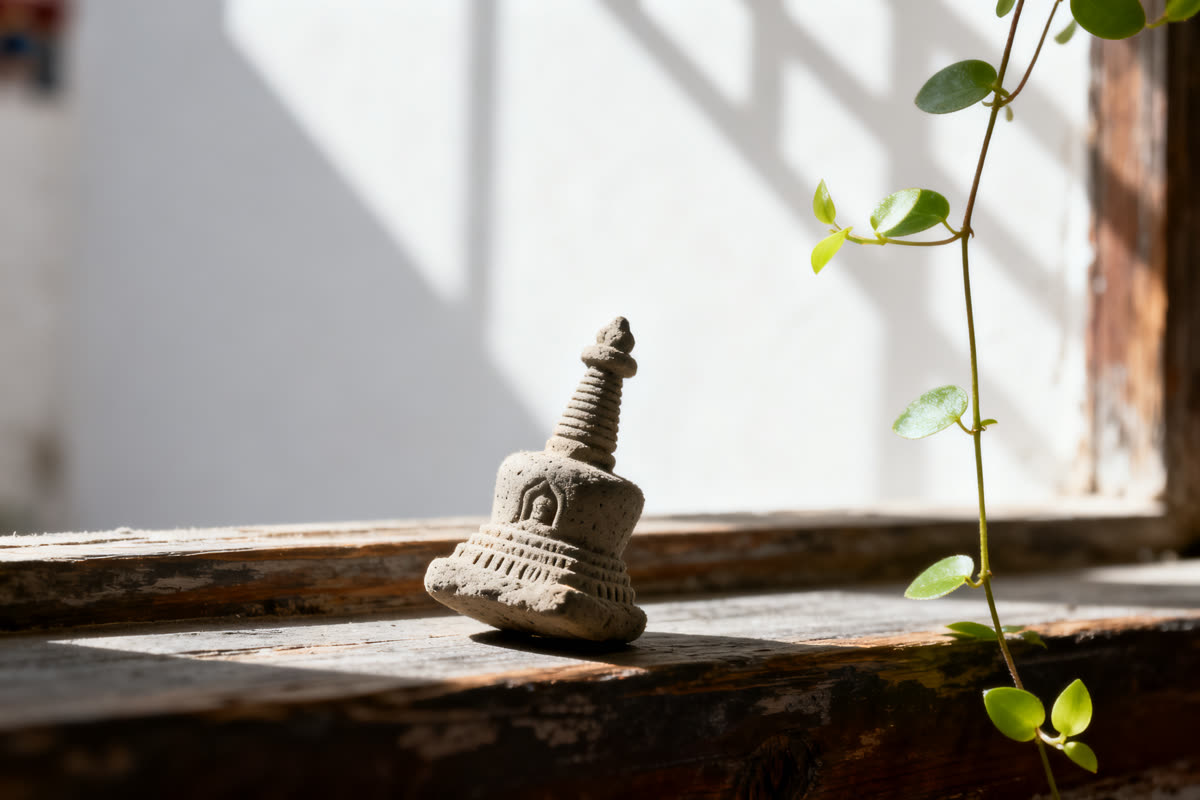
Fingernail-sized, mud-colored, a little stupa, pressed slightly crooked, with rough fingerprint marks along the edge. He said: this is called a tsa-tsa. It's a Tibetan word, meaning roughly "a copied stupa." You press damp clay into a bronze mold, tap it out, dry it in the shade — that's one. People in Tibet have been making these for over a thousand years.
Is it a craft item, I asked. Not really, he said. Tsa-tsa aren't sold. He had spent an afternoon making them with locals, and someone gave him this one.
I put it on my windowsill, next to a pothos plant that kept hovering between dying and not dying. Honestly, at first I didn't think much of it — it's just too plain. Dull gray, smaller than a mahjong tile, the workmanship no different from a lump of mud by a construction site. If it fell into the flowerpot's soil, I probably wouldn't notice for a week.
The change happened one morning. Slanting sunlight came in and landed right on the little stupa, and the clay surface had a fine, soft sheen. I stood there holding my tea and looked at it for a long time. Looked at what? I couldn't say. I just suddenly wondered: the person who made it — what were they thinking when they pressed the mold?
Later I read up on it and asked a few friends who knew the subject. The more I learned, the more interesting it seemed. The interesting part isn't the tsa-tsa itself. It's that the whole thing runs exactly opposite to how we live.
II. The Rules
Tsa-tsa come with rules, strict ones.
The clay has to be clean. You can't just dig it anywhere — ideally soil from high mountains no one has walked on, or earth from around a sacred site. It gets sifted, kneaded. Careful makers add things to the clay: saffron, highland barley, certain herbs ground into powder. The most careful add a bit of the crushed relics left after a great lama's cremation — just a pinch, like the small handful of salt you knead into dough.
The molds are mostly bronze, carved with a stupa, or a Buddha, or a mantra. Damp clay pressed in, pressed firm, tapped out, dried in the shade. No direct sun — it cracks.
And where do the finished tsa-tsa go? This is the part that surprised me most.
Most of them are not enshrined. They don't stay on a home altar or sit on a shelf. They are carried out to the wild, pressed into the cracks of great stupas, into their foundations; or placed in caves no ordinary person would ever visit; or tucked into the crevices of mani stone piles. The wind blows, dust settles, and after a few years they become one with the wall.
No one will ever see them.
The maker knows this. When they press that mold, they already know: this little stupa's fate for the rest of its existence is darkness, narrowness, silence. It will not be tipped, not shared, never discovered by someone who gasps "how beautiful."
In Tibet they say making tsa-tsa builds merit. Make many, and the merit is great. There are old people who have made tens of thousands in a lifetime, all carried into the mountains. From a "return on investment" angle, the math never balances: tens of thousands of "works," zero audience.
III. Over Here
After that day, I kept catching myself comparing it with my own life.
We post something and count the likes. If no one likes it, we think about deleting it. We write something and refresh the view count every ten minutes. Exercise needs a photo, reading needs the cover shot — even meditation apps jump a line at the end: You have practiced 47 days in a row, more than 98% of users.
I don't think this is wrong. Humans need response. I do too. Being seen feels good — that's the truth, no need to pretend otherwise.
But sometimes at night, after scrolling and scrolling and getting nothing, there's a hollowness. Like eating a lot of snacks and no actual meal. That hollowness reminds me: it's been a long time since I did something that no one would definitely never see.
Does keeping a journal count? Not quite — while writing it, somewhere in the back of my mind is the thought that maybe someday someone will read it. Does chanting count? Shaky too — midway through, a thought sneaks in: what a decent person I am.
A thing truly no one sees doesn't even anticipate the phrase "no one sees." While doing it, there is no audience seating in the mind.
IV. The Old Man in the Documentary
I once watched a documentary clip I've never forgotten.
An old man in Tibet who had made tsa-tsa his whole life. The molds in his hands were worn smooth and shiny. He made a few dozen a day; his children carried them into the mountains. The film crew followed him for many days, and at the end they asked him: what are you doing this for?
The old man thought for a moment, smiled, and said: when I make them, my mind is clean.
The translation may not be exact, but that's the gist. None of the big words — no merit, no blessings, no next life. Just one sentence: my mind is clean.
I've turned that sentence over and over. It doesn't deny merit — merit may well be real, and the old man may believe in it. But when he described himself, he didn't use those words. He described a state: hands pressing clay, nothing else in the mind.
"Flow," "focus," "living in the present" — the things we modern people chase so hard, a whole wall of books in the bookstore teaching them. And an old man who can barely read simply lives it, one clay stupa at a time, as everyday routine.
He doesn't need to know the concepts. He's doing it.
V. One on the Windowsill
My tsa-tsa is still on the windowsill. The pothos miraculously survived, and one of its trailing leaves is almost touching the little stupa now.
Some evenings, sitting by the window with tea, I glance at it. Crooked, rough, gray. By any standard of aesthetics, it fails. But strangely, the longer I look, the steadier it feels. It proves nothing, invites nothing, just sits there.
A while ago I read a line saying that practice isn't done for others to watch, just as a tsa-tsa needs no audience. I think each of us probably has a tsa-tsa inside — something you quietly do, expecting no return, your mind going quiet while you do it. Maybe it's properly cleaning your room on a night no one knows about. Maybe it's putting out a bowl of water for a stray cat. Maybe it's swallowing a cruel remark that had already reached your teeth.
These things leave no data, no records. By the next day even you can't remember them.
But they were done. Done is done.
Like those tens of thousands of little stupas in the mountain cracks. No one sees them, and still they stand neatly in the dark, one beside another.
Not remembering doesn't mean not there.
VI. Three Questions to Leave With
It's getting dark as I write this. The little stupa on the windowsill is just a gray outline now.
I'll leave three questions here. No rush to answer.
First: when was the last time you did something you were sure no one would see?
Second: if no one ever liked anything again, would you still do the things you do now? Which would remain, and which would disappear?
Third: is "being seen" and "actually existing" the same thing?
I haven't finished my own answers either. First, the tea.