White Dew: My Mom Called to Say, No More Cold Drinks
A cool gust on a late-summer night told me summer was truly over. White Dew — the most beautifully named of China's twenty-four solar terms. TCM says autumn is for the lungs. I ignored that for years. This year I finally cooked the soup.
One
A few nights ago, I went downstairs to take out the trash.
It's only a short walk. But when the wind came over, I suddenly shivered. Not the sticky wind of summer — a cool one. A clean kind of cool. I stood there for a few seconds, then checked my phone. Oh. White Dew is almost here.
White Dew — Bailu. Of all twenty-four solar terms in the Chinese year, I think it has the most beautiful name.
The Book of Songs, some two or three thousand years ago: "The reeds are gray and vast; the White Dew turns to frost." Someone stood by a river one autumn, saw the pale reeds, saw the dew on the leaves about to freeze, and wrote it down. All of us memorized it in school.
The next day my mother called. Her first sentence was not "have you eaten?" It was: "White Dew is coming. No more cold drinks."
I said okay.
After hanging up, I poured myself a cup of warm water. Thirty-four years old, and I still have to listen to my mom.
Two
So what exactly is White Dew?
It's simple, really. In summer the days are long and the ground stores up heat. By September, the days shorten and the nights lengthen; the heat slips away faster. When the night temperature drops far enough, the moisture in the air condenses on grass and stones into dew. Go out before dawn and look — every drop is white.
The ancients had no weather forecast. They read the dew and knew: the summer heat has truly withdrawn. Not that it gets cold at once, but the direction has turned. Heat retreating, coolness advancing. The yang half of the year is over; the yin half has begun.
There's another layer I like: dew is invisible by day. It forms while you sleep, drop by drop. By the time you step out in the morning, it is already there on the grass.
Many things happen this way. Quietly.
Three
On that phone call, my mother said one more thing: "In autumn, take care of your lungs."
I used to let words like that slide past me. Lungs are lungs. They breathe on their own. What is there to take care of?
Later I looked it up, and I think I finally understand what she meant.
In traditional Chinese medicine, the body maps onto the seasons: spring to the liver, summer to the heart, late summer to the spleen, autumn to the lungs, winter to the kidneys. Autumn air turns dry, and the lungs, TCM says, "like moisture and dislike dryness." They are also the inner organs closest to the outside world — they deal directly with the air. So when autumn turns dry, they are the first to feel it.
You may have noticed: as soon as autumn arrives, your throat gets dry, you cough a little in the morning, your skin suddenly feels tight, your shins start to itch, your lips crack — and no amount of water seems to help.
In TCM, all of this falls under "autumn dryness." Not an illness, exactly. But you spend the season subtly shriveled and uncomfortable.
There's even a phrase for the mood of it: "autumn sorrow." The days shorten, the leaves yellow, the light thins, and people go quietly low. It isn't just poetry — mood is part of how the body answers the season.
So "nourish the lungs in autumn," in plain words, means roughly this: when the sky turns dry, don't let your body turn dry with it.
Four
My mother's White Dew list — I could recite it with my eyes closed: pear, snow fungus, lotus seeds, lily bulbs, Chinese yam, honey.
I heard it all through childhood. I found it annoying. I thought it was old-lady folklore.
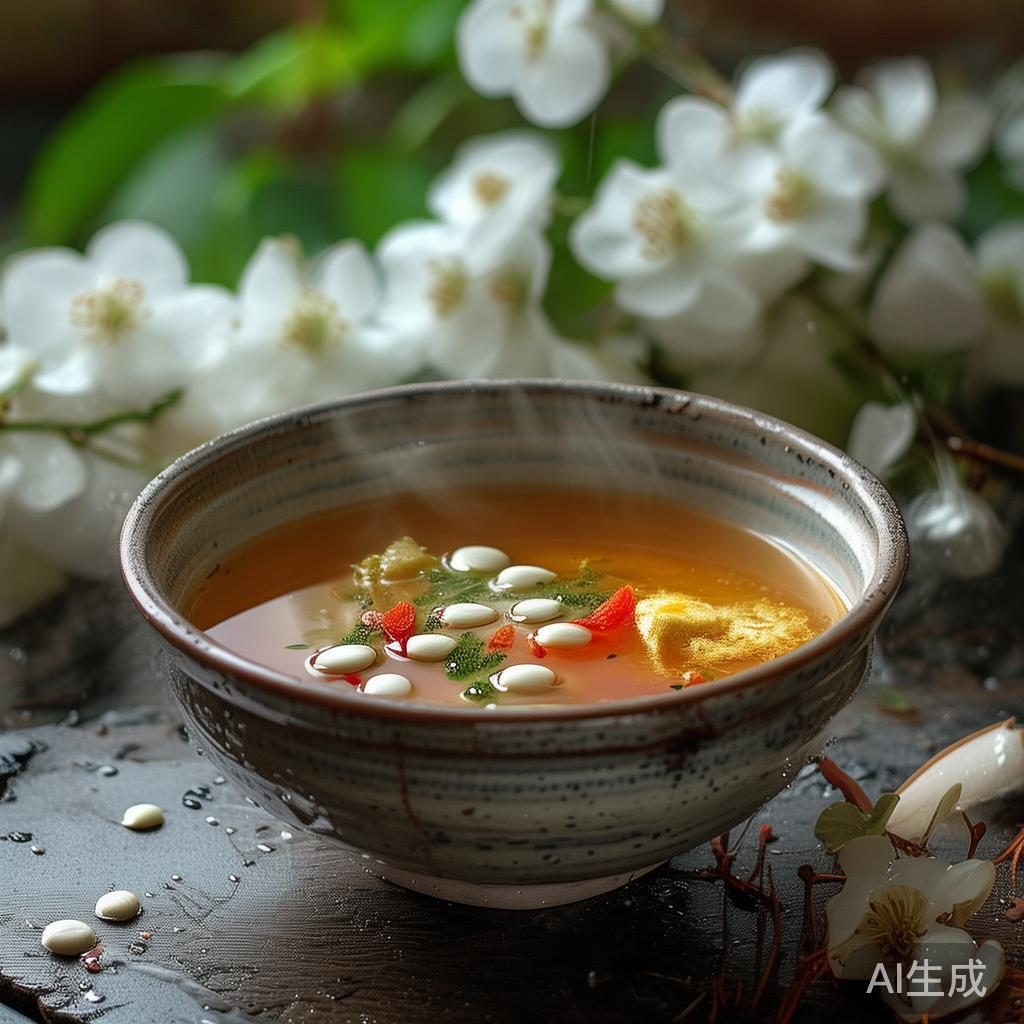
The other night, I cooked this list for the first time with my own hands. Soak the snow fungus ahead, tear it into small pieces, simmer it with lotus seeds over a low flame, add a few red dates and goji berries near the end, and a little rock sugar. An hour or so later you have a pot of soup with a warm, faintly sticky, amber glow.
I ladled out a bowl and drank it warm. Hard to explain — but from throat to stomach, it felt like something had been gently smoothed over.
Same with pears. My mother never let us eat pears raw in autumn. Always cut up, steamed with rock sugar, or boiled into water. Raw is "too cold," she said; steamed, it "moistens." I later learned this dish has a name — rock-sugar steamed pear — and families all over China make it for coughs. Does it truly work? I can't say for certain. But a warm bowl going down does soothe the throat — and comfort is not a small thing.
And yam. TCM calls yam "neutral" — neither cooling nor warming — and good for the spleen and stomach. My mother's autumn soups always had yam in them, "to lay a base," she said: if the digestion is well in autumn, winter goes easier.
Taken one by one, these things look unremarkable. Put together, they carry one idea: meet a dry sky with moistening food.
Not medicine. Not tonics. Just meals. Day after day, adjusting with the season.
Five
There are two more sayings that old folks repeat around White Dew.
One: "Past White Dew, bare no more." After this day, stop baring your arms and legs — especially your feet. "Cold enters from the feet." In the chill of early mornings and evenings, the cold slips in first through the soles. My mother's version is more direct: "Put the sandals away."
The other: "Cover in spring, endure in autumn." In spring, don't rush to shed layers; in autumn, don't rush to pile them on. Let the body adjust slowly. Don't wrap yourself into a dumpling at the first cool breeze.
The two sayings seem to contradict — cover, or don't cover?
My read: what you "endure" in autumn is the branches; what you keep covered is the root. Letting your limbs meet a little cool air trains the body — that's good. But the ankles, the belly, the back of the neck — TCM says cold sneaks in from these places. Those stay guarded.
In plain words: don't force yourself, and don't coddle yourself. Much like keeping a houseplant.
Six
One last thing: in autumn, sleep earlier.
The Yellow Emperor's Classic of Medicine says that in the three months of autumn one should "sleep early, rise early, keep time with the roosters." Sleep when the chickens sleep. It sounds funny today — telling us to be in bed before ten is harder than telling us to chant sutras.
But I tried it for two weeks, moving bedtime from past midnight to before eleven. The change isn't dramatic, but it's there: my throat is less dry in the morning, and the afternoon slump seems lighter.
Maybe it isn't early sleep that's magic. Maybe I'm just sleeping more. Staying up through summer nights was a slow leak all along.
Seven
As I write this, the wind is up again outside the window.
I keep thinking about that cool gust by the trash bins. The seasons change watch without saying goodbye. You just get the notice, some perfectly ordinary night.
Same with dew. No one sees it form. It just borrows the dark, drop by drop, and settles where it should.
Have you noticed, lately, that the wind has turned cool?
Three questions, for you and for me:
- Since autumn began, what signal did your body send first — throat, skin, or mood?
- Is there a piece of seasonal nagging you grew up with — annoyed by it, then slowly believing it?
- If you did only one small thing this autumn, which would it be: a warm bowl of soup, or lights out before eleven?