The Amitabha Sutra: The Pure Land Is Not About the Afterlife — It Is the Direction of Your Heart Right Now
The Amitabha Sutra is the core text of Pure Land Buddhism, describing a realm free from suffering. But the Pure Land is not a destination after death — it is where your heart settles in this moment. When you recite the Buddha's name with a focused mind, you are already there.
The Amitabha Sutra: The Pure Land Is Not About the Afterlife — It Is the Direction of Your Heart Right Now
Editor's Note
Among all Buddhist scriptures, the Amitabha Sutra may be the most frequently recited.
It is part of every temple's morning and evening services. Practitioners of Pure Land Buddhism devote their entire lives to one practice — reciting "Namo Amituofo" (Homage to Amitabha Buddha).
It sounds almost too simple. Yet this simplicity has made Pure Land the most widely practiced form of Buddhism in East Asia.
Why?
Because the Amitabha Sutra addresses humanity's deepest fears — the fear of death, and the feeling of helplessness in the face of life's suffering.
But here is what you may not know: the core of Pure Land practice is not about what happens after you die. It is about this moment — where your heart finds rest.
I. What the Amitabha Sutra Says
The sutra is remarkably brief. The Buddha does not expound any complex philosophy. He simply describes a place — the Western Pure Land of Ultimate Bliss.
There:
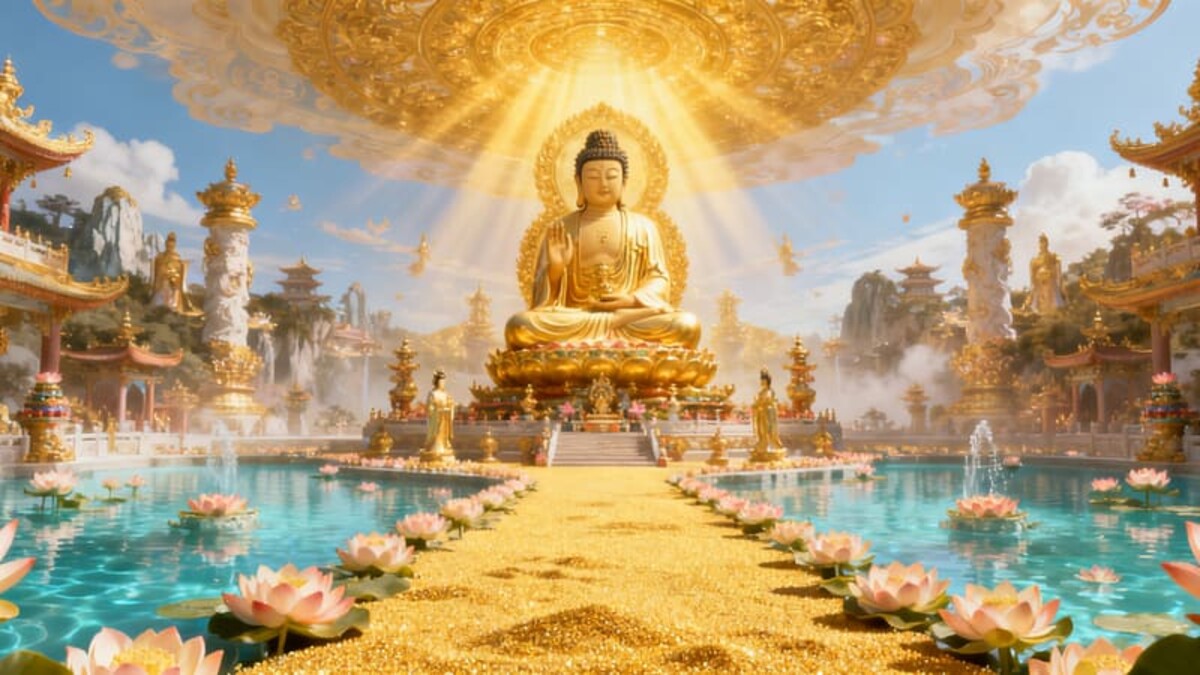
Adorned with infinite merits and splendor Seven tiers of balustrades, seven tiers of nets, seven tiers of trees Pools of seven jewels filled with water of eight meritorious qualities Ground covered with golden sand Heavenly music playing constantly, rain of mandala flowers day and night
There are no three lower realms (hell, hungry ghosts, animals). No suffering — only joy.
Beings born there will never regress; they will ultimately attain Buddhahood.
How to get there?
"Shariputra, one cannot be born in that land with few roots of goodness and merit... If a good man or woman hears of Amitabha Buddha and holds fast to his name for one day, two days, three days, four days, five days, six days, or seven days, with a unified and undistracted mind, then at the end of life, Amitabha Buddha will appear before them with the assembly of sages. With their mind not颠倒 (confused), they will be born in Amitabha Buddha's Land of Ultimate Bliss."
In short: sincerely recite "Amituofo" until your mind is undistracted, and Amitabha will come to guide you at life's end.
II. The Pure Land Is Not Geography — It Is a State of Mind
Many people understand the Pure Land as a physical location — somewhere to the west in the cosmos.
But "west" in Buddhism is not a compass direction. The west is where the sun sets — a symbol of returning home.
The core insight of Pure Land Buddhism:
When the Mind Is Pure, the Land Is Pure
If you wish to understand all Buddhas of the three times, you should observe the nature of the Dharma realm — everything is created by mind alone.
The state of your mind determines the world you experience:
- Mind full of anger → your world is a hell realm
- Mind full of insatiable hunger → your world is a hungry ghost realm
- Mind full of ignorance → your world is an animal realm
- Mind pure, joyful, compassionate → your world is a Pure Land
So the true meaning of reciting the Buddha's name is not to be heard by Amitabha. It is to use this repeated invocation to bring your mind back from distraction, anxiety, and fear — and rest it in purity.
When you truly recite with "unified, undistracted mind" — you are already in the Pure Land. No need to wait until after death.
III. Who Is Amitabha Buddha
"Amitabha" is the Sanskrit word meaning Infinite Light, Infinite Life.
The Forty-Eight Vows
Before becoming a Buddha, Amitabha was a monk named Dharmakara. He made 48 great vows, the core of which was:
I will establish a realm without suffering. Any being who sincerely wishes to come, I will guide there. If I cannot do this, I will not attain Buddhahood.
He has attained Buddhahood. Therefore, according to the sutra, this realm already exists.
"Guiding" Not "Saving"
Notice — Amitabha is not a "savior." He is a "guide."
The logic of Pure Land: you must take the steps yourself. Amitabha simply waits for you and points the way.
This aligns with Buddhism's core principle — no one can attain awakening for you. But you can accept help.
IV. The Modern Relevance of Buddha Recitation
1. One Phrase = One Psychological Anchor
Modern psychology has a concept called "anchoring" — having a stable reference point prevents emotional overwhelm.
"Namo Amituofo" is precisely such an anchor.
Anxious? Recite once. Afraid? Recite once. Mind scattered? Recite once.
Six syllables pull your mind back from chaotic thoughts and rest it on a stable point.
2. Faith, Vow, Practice — Three Elements
| Element | Meaning | Modern Equivalent |
|---|---|---|
| Faith | Believe the Pure Land exists | Believe the good is possible |
| Vow | Resolve to be born in the Pure Land | Set your direction clearly |
| Practice | Recite the Buddha's name | Take daily action toward your goal |
These three steps are a universal methodology for accomplishing anything:
Believe (the goal is achievable) → Resolve (set the direction) → Act (do something daily).
3. Undistracted Mind — The Rarest Skill of Our Age
In an era of information overload, "undistracted mind" has become almost a superpower.
Your attention is torn by countless messages — notifications, emails, videos, news feeds, work chats, family groups, past regrets, future anxieties...
Buddha recitation trains exactly this: focus.
Set aside ten minutes daily. Do one thing only — recite. No analysis, no understanding needed. Just recite. When your mind wanders, bring it back.
Isn't this mindfulness meditation? Yes. Pure Land Buddhism invented a concrete mindfulness method 2,500 years ago.
V. Integrating Pure Land Wisdom into Daily Life
You do not need to be a Buddhist to benefit from Pure Land practice:
1. Give Your Mind a Home
The core of Pure Land is giving your mind a place to rest.
Modern minds are homeless: scrolling social media, mind lives in the feed; working, mind lives in KPIs; socializing, mind lives in others' opinions. Nowhere is "home."
Find an anchor for your mind — a phrase, a piece of music, a quiet habit. When the mind starts wandering, return to this anchor.
2. Trust the Process
Pure Land emphasizes "faith" — not blind belief, but releasing the need to control and trusting the power of causes and conditions.
You have done what you can (practice). Your direction is clear (vow). Now trust that the result will come.
Not every problem requires you to personally solve it. Sometimes the most powerful action is — letting go.
3. Be Kind to Others
Amitabha's 48 vows are essentially a promise of compassion — I will help all beings end suffering and find joy.
In daily life, this translates to a simple principle: when you can help someone, help them. No expectation of return, no questions asked.
Because the Pure Land is not for one person — it is a place everyone reaches together.
A Final Thought
Pure Land is the most widely practiced form of Buddhism not because it is the most "advanced," but because it is the most "simple."
No need to read thousands of sutras. No need to master the Tripitaka. No need to meditate for decades. Just one phrase — "Namo Amituofo" — and a heart willing to settle.
In an age where everything is complex and everyone chases efficiency, this simplicity has become the rarest thing.
When you recite "Namo Amituofo," you are not asking for anything — you are reminding yourself: let go, return to the present, trust that all will be well.
In that single moment, the Pure Land is in your heart.
Yi Yi Ru Shi · Eastern Aesthetics · Instruments for the Soul
Explore more Eastern wisdom through our amulet collection — each piece a reminder to rest your heart.