Zhuangzi's Useless Tree
A while back, I was walking in the park and stopped under an old locust tree. The tree was nothing special. But I stood there, looked up, and felt quiet inside. Later I realized I was thinking of Zhuangzi's story about the carpenter who called a massive oak useless — and that's exactly why it had lived for thousands of years.
Zhuangzi's Useless Tree
A while back, I was walking in the park and stopped under an old locust tree. I stood there for a long time.
I can't say why. The tree was nothing special — sparse leaves, a crooked trunk, nothing like the neatly pruned ginkgo trees nearby. But I just stood there, looked up for a while, and felt quiet inside.
Later, I realized I was probably thinking of Zhuangzi's story.
Zhuangzi told a story about a carpenter.
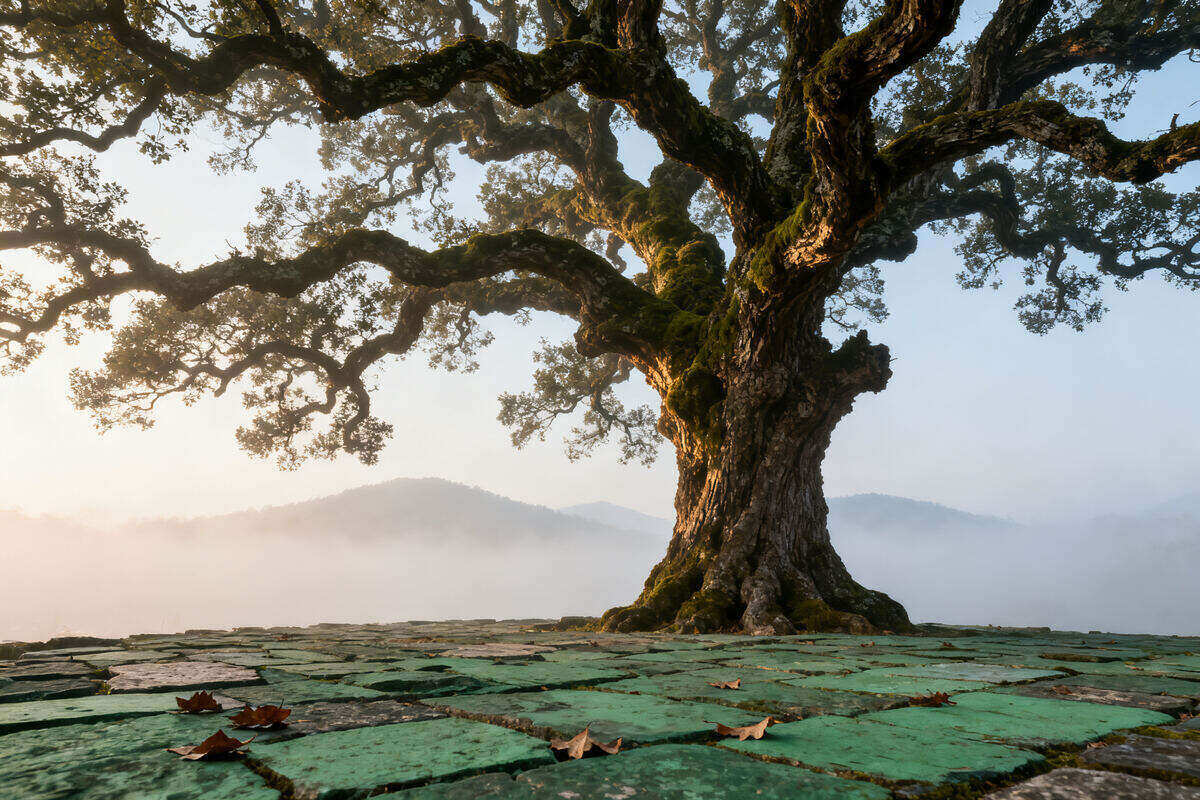
There was a carpenter named Shi who was walking past Quyuan with his apprentice when they came upon a massive oak tree. How big was it? Its shade could cover thousands of cattle, its trunk was so thick that a dozen people linking hands couldn't circle it, and its branches reached higher than the mountainside. A crowd had gathered, packed together like at a festival.
The carpenter glanced at it and walked on without a second look.
His apprentice caught up and asked, "Master, ever since I picked up an axe and followed you, I've never seen timber this fine. How can you just walk past it?"
The carpenter said, "That's trash wood. Make a boat and it'll sink. Make a coffin and it'll rot quickly. Make furniture and it'll fall apart. Make doors and it'll ooze sap. Make pillars and termites will eat it. It's useless timber, good for nothing. The only reason it's lived this long is precisely because it's useless."
That night, the carpenter had a dream.
The oak tree spoke to him: "What are you comparing me to? Those fruit trees? Apples, pears, oranges — as soon as the fruit ripens, people strip the branches, snap the limbs. They suffer because of their usefulness, so they die before their time. All things are like this — the useful ones are destroyed first."
"I've been pursuing uselessness for a long time. I nearly got chopped down several times, but finally I achieved it. For me, being useless is the greatest use of all. You're a dying carpenter — what would you know?"
The carpenter woke and told his apprentice about the dream.
The apprentice asked, "If it seeks to be useless, why did it grow into a sacred tree at the shrine? Doesn't that make it useful?"
The carpenter said, "Shut up. It merely attached itself to the shrine for protection. If it hadn't, wouldn't it have been cut down long ago? Its way of protecting itself is different from the norm. You try to judge it by ordinary standards — you're way off."
When I first read this story, it didn't hit me. Just another parable, I thought. I got the point.
But over time, the story started to hurt.
Think about that tree. It wasn't born useless. It must have tried to be useful in its youth — maybe it tried to grow straight, grow strong, become a beam or a pillar. But it discovered that once you become useful, you're in danger. Trees that become beams get cut down for houses. Trees that bear fruit get stripped bare.
So it chose a path nobody could understand — grow so massive that no one dares touch you, but be so apparently useless that no one wants to.
That's not escapism. That's deep wisdom.
Sometimes I think I'm a bit like that tree.
Not that I have great wisdom — just that I also waver between being "useful" and "useless."
From childhood, everyone teaches us to be useful. Study hard for good grades, because it's useful. Learn skills that produce results, because it's useful. Perform well at work, because it's useful. Even meditation, chanting, reading sutras — people tell you these are "useful" too. They reduce stress, improve focus, enhance relationships.
Everything has to be useful.
But Zhuangzi says, no. Usefulness itself is a kind of danger.
When you're too capable, everything falls on you. When you're too responsible, everyone leans on you. When you're too understanding, everyone pours their emotions onto you. You live your life as a useful tool, and gradually, you cease to be you.
I have a friend who's extremely capable. She can do anything, fix anything. Promotions came fast. But one day she told me she felt like a machine. Waking up every day to process problems, solve problems, then wait for the next problem. No time of her own, no space of her own. She didn't even dare to get sick, because "no one could fill in if she wasn't there."
She was too useful. But the price of being useful was that she burned herself out.
The "uselessness" Zhuangzi talks about isn't laziness, isn't giving up, isn't doing nothing.
That oak tree didn't do nothing. It grew for thousands of years. It pushed its roots deep into the earth and stretched its branches toward the sky. How many storms and lightning strikes did it survive to grow that large?
It just refused to live by other people's standards.
The carpenter said, "make a boat and it sinks, make a coffin and it rots, make furniture and it falls apart." But that tree never wanted to be a boat, a coffin, or furniture. It just wanted to be a tree.
That's what Zhuangzi means. You don't need to become something "useful" in other people's eyes. You just need to be yourself.
If you're a tree, be a tree well. If you're water, be water well. If you're a bird, just fly.
Usefulness is someone else's judgment of you. But how you live — that's your own business.
Holding my mala beads sometimes, I wonder: what's the use of chanting?
By worldly standards, there really isn't one. You can't eat it, can't spend it, can't put it on your resume. If someone asks what you did over the weekend and you say "I chanted at home for two days," most people will nod politely and think you're a bit strange.
But those quiet hours genuinely make me feel grounded. Not because I gained anything, but because during that time, I didn't need to be anything "useful." I just sat there, recited the Buddha's name, and existed.
Maybe that's "the usefulness of uselessness."
Not everything needs to produce a result. Not every minute needs an output. Not every version of you needs to be useful to someone.
Sometimes, just being here is enough.
A few days ago I walked past that old locust tree again and noticed it had sprouted new buds.
The ginkgo trees beside it were neatly pruned, but the old locust just grew freely, crooked and bent, however it pleased. When the wind blew, the leaves rustled like laughter.
I think it probably doesn't care whether anyone finds it "useful." It just lives, enjoys the sunlight and the rain, and that's enough.
Maybe we should all learn from that tree.
Three questions for myself, and for you reading this:
- Has there ever been a moment when you felt that being "too useful" was actually a burden?
- If you didn't need to be "useful" to anyone, how would you spend today?
- Is there a "useless tree" in your heart too, one that's always been there, but you've never dared to acknowledge?