You Are Not the Fish: Standing on the Bridge Over the Hao River
Zhuangzi said the fish were happy. Huizi said you are not a fish. Standing on the bridge, I finally understood: between compassion and wisdom, there is a bridge.
You Are Not the Fish: Standing on the Hao River Bridge, I Think I Understand Zhuangzi
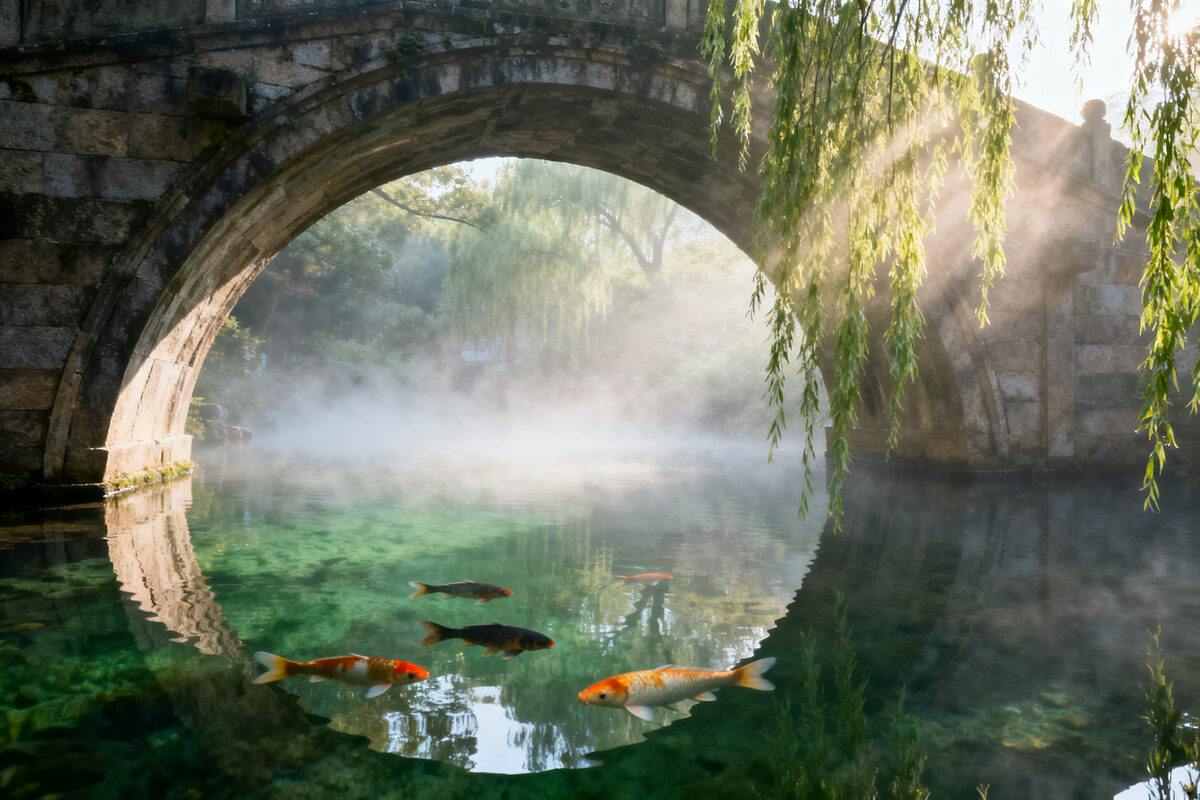
This afternoon I went for a walk in the park. When I reached the little stone bridge, there were fish underneath.
Not big ones. A few small crucian carp, darting between the water plants. The sunlight hit the water just right, and the fish cast shadows on the bridge pier, swaying back and forth.
I stood there watching for a long time.
And then I thought of Zhuangzi.
On the Hao River Bridge
More than two thousand years ago, two men stood on a bridge.
The river was called the Hao, and the bridge was called Haoliang. It probably wasn't a grand bridge — just an ordinary stone bridge in the countryside.
The two men: Zhuangzi and Huizi.
Zhuangzi looked down at the fish in the water and suddenly said:
"The minnows dart about freely — that is the joy of fish."
Just like that. Very casual. The way you might say "nice weather today."
But Huizi couldn't let it go.
Huizi was a logician. A philosopher in the way we'd understand it today. He heard this and his reflex kicked right in:
"You are not a fish — how do you know the joy of fish?"
Normally
Normally, this kind of conversation would just pass. You say the fish are happy, I say you're not a fish so how would you know, we laugh, go get lunch, done.
But Zhuangzi was different.
He replied:
"You are not me — how do you know I don't know the joy of fish?"
Huizi said: Fine. I'm not you, so I don't know what you know. But you're not a fish either, so you don't know what fish know. Perfect logic. I win.
Then Zhuangzi said one last thing.
He said: Wait. Let's go back to the beginning. You asked me "how do you know the joy of fish?" — the moment you asked that, you already acknowledged that knowing is possible. Your question "how do you know" contains a premise — that I could know.
"I know it standing here by the Hao River."
Honestly
Honestly, the first time I read this, I thought Zhuangzi was being slippery.
Huizi was making a logical argument, and Zhuangzi was... making what? An intuitive leap? A feeling? Something that doesn't need proof?
You're not a fish. What gives you the right to say fish are happy?
But this afternoon, standing on that little stone bridge, watching the fish in the water, I felt like I almost understood.
I watched those fish, swimming back and forth in the sunlight, tails flicking, water splashing. Are they happy? I can't prove it. I don't have a fish's brain. I don't understand fish nervous systems. I don't even know if the concept of "happiness" exists in a fish's world.
But in that moment, I was happy.
I watched the fish, and I felt that they were enjoying the afternoon too. This "feeling" doesn't need evidence. It's just something that happens naturally. Like when you see a child smile — you don't need to run a psychology experiment to prove the child is smiling because they're happy. You just know.
Zhuangzi's World
Zhuangzi lived during the Warring States period. What kind of era was that? Everyone fighting, today I destroy you, tomorrow you destroy me. The hundred schools of thought were all trying to figure out — how to govern, how to wage war, how to survive.
Zhuangzi didn't care about those things.
He was thinking: What is freedom? What is happiness? Why must we always use our heads and not our hearts?
He didn't have many friends. Huizi was one. Huizi belonged to the School of Names, specializing in logic. Everything had to be proven, analyzed, reasoned out. Zhuangzi was the opposite — he felt that nothing needed proving. A feeling is a feeling. Knowing is knowing.
That these two could be friends is pretty interesting.
One insisted on logic for everything, the other insisted nothing needs logic. But they could stand on a bridge and chat, could argue for ages about the happiness of fish. Their arguing wasn't fighting — it was more like a game. A game between two very smart people.
Huizi Wasn't Wrong Either
Thinking about it later, Huizi wasn't wrong either.
"You are not a fish, how do you know the joy of fish?" — The question itself is valid. We truly have no way of entering another being's inner experience. I can't even guess what my wife is thinking half the time, let alone a fish.
Behind this question lies a profound philosophical problem: Can we ever truly understand anything that is not ourselves?
Can you understand your cat? Can you understand a tree? Can you understand people from another country, another culture, another era?
Strictly speaking, no. You can only see from your own angle, guess using your own experience.
But Zhuangzi's point is — so what?
Even if you can't understand perfectly, the happiness you felt in that moment is real. Whether the fish is truly happy or not — that's not actually the important thing. What matters is that one afternoon, on the Hao River bridge, a person felt joy because he saw fish swimming.
That kind of happiness doesn't need proof.
Standing on the Bridge
I stood on that little bridge in the park today, watching fish for about ten minutes.
People walked by — walking dogs, jogging, pushing strollers. Nobody stopped to watch the fish. Everyone was busy.
I used to be like that. Busy.
Too busy to stand on a bridge and watch fish. Too busy to think that watching fish was anything but a waste of time. Too busy to think that "happiness" needed no conditions — that you didn't need money, or free time, or whatever.
But Zhuangzi said it more than two thousand years ago: Happiness doesn't need conditions. You stand on a bridge, you see fish swimming, you feel happy. That's it.
That simple.
When I Left
When I left, the sun was already sliding west.
The fish under the bridge were still swimming, the water plants still swaying, the shadows still flickering.
I tossed a few breadcrumbs into the water. The fish swarmed to eat, the surface churned. Then it was quiet again.
I thought, if Zhuangzi were standing next to me right now, he probably wouldn't say anything profound. He might just smile and say, "Come on, let's go home and eat."
Three questions for you:
1. Have you ever felt happy for no reason? What were you doing?
2. Do you think "knowing" something always requires evidence? Is there anything you "just know"?
3. If you passed by a bridge today and there were fish swimming below — would you stop and watch?