My Friend Says the Algorithm Knows Him Better Than His Mom. I Thought of Zhuangzi's Happy Frog
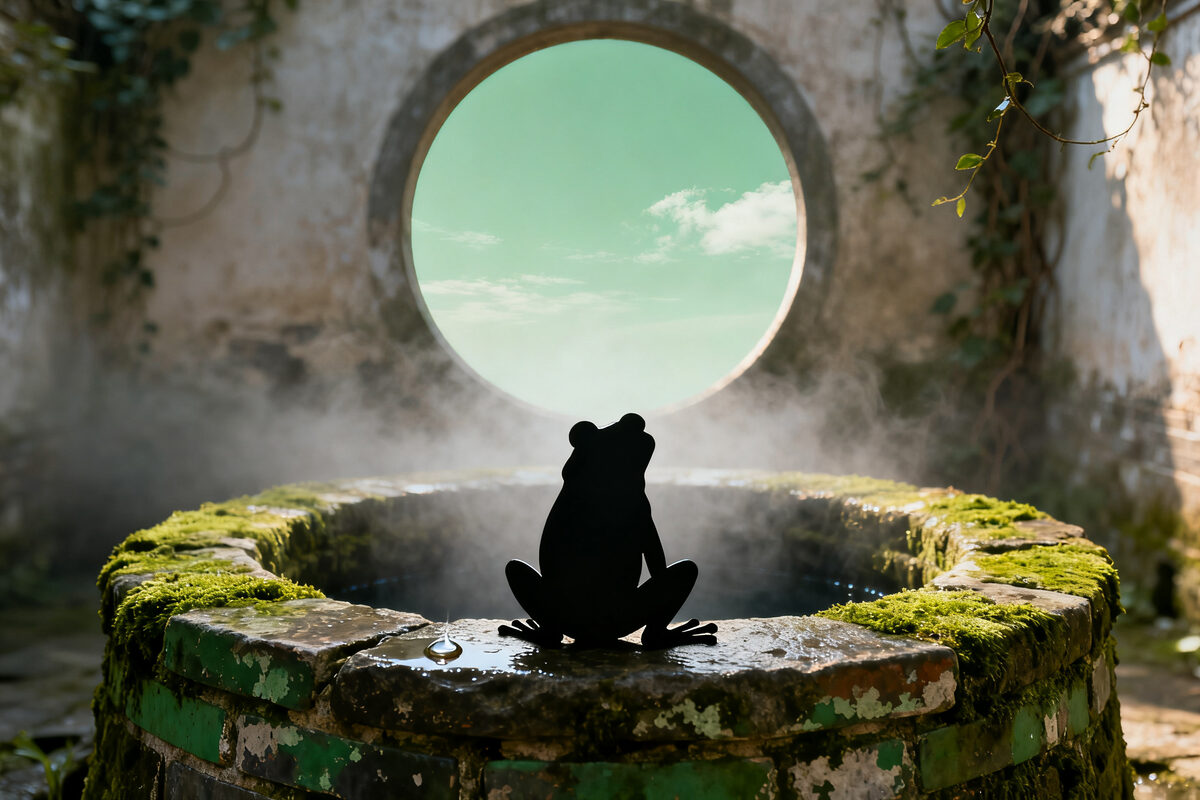
The water holds him just right. The mud covers his feet just right. No creature in the well is his equal. The frog never said one false thing — he just mistook a patch of sky the size of a well opening for the whole sky. 2,300 years later, the algorithm dug everyone a more comfortable well.
Last week at dinner, a friend showed me his phone, very proud.
"Look," he said. "The algorithm knows me better than my mom does. Everything it shows me is exactly what I want to see."
I leaned over. Fitness videos, basketball, political commentary that agreed with him completely, and the exact kind of car he likes. It really did know him. Like a room where the temperature is always just right.
I smiled and said nothing. But on the way home, I thought about a frog.
Not just any frog. The one in Zhuangzi's "Autumn Floods," the frog who lives at the bottom of a well. We all learn this story in school — "the frog at the bottom of the well," an insult for someone with a narrow view. That's what I used to think it meant too. But that night I took out the original text and read it again, and I realized Zhuangzi wasn't insulting the frog at all.
The way he writes that frog — the frog is happy.
A Happy Frog
Here's what happens. The well frog says to a turtle from the Eastern Sea:
"I'm so happy! I hop up and play on the well railing. When I'm tired, I rest on a broken brick in the wall. When I swim, the water comes up just to my armpits and chin. When I step in the mud, it covers exactly my feet. And when I look around at the shrimp, the crabs, the tadpoles — not one of them is my equal!"
Read it carefully. The frog doesn't say a single false thing.
The water really does hold him just right. The mud really does cover his feet. He really is the biggest creature in that well. Every one of his judgments is accurate — in his world.
That's the part that chilled me. The frog's mistake isn't lying. It isn't stupidity. His mistake is this: he took a patch of sky the size of a well opening and mistook it for the whole sky. And his way of verifying? Looking around. Checking the shrimp and crabs nearby. Yep, still better than all of them.
Using evidence from inside the well to confirm conclusions about the well. The loop is closed. Perfect. Airtight.
The turtle wants to see this happiness for himself. Zhuangzi writes: "Before his left foot could enter, his right knee was already stuck." So the turtle backs out. He doesn't laugh at the frog. He simply tells the frog about where he lives:
"A thousand li of distance is not enough to measure its width. A thousand fathoms of height is not enough to measure its depth." In the time of Yu, nine years of flood — the sea did not rise by an inch. In the time of Tang, seven years of drought — the sea did not fall by an inch. It does not change with the seasons. It does not shrink or swell with the rain. That is the joy of the Eastern Sea.
And the frog's reaction? Zhuangzi uses just eight characters:
"The frog was stunned, and quietly, silently, lost."
Stunned — and then something quieter than shame. For the first time he senses that all those "just rights" — the water just right for his armpits, the mud just right for his feet — were never made to fit him by the world. They were made to fit him by the well.
Our Water Also Comes Up Just Right
Now, back to my friend's phone.
I looked it up later. The term "filter bubble" was coined in 2011. The idea: algorithms learn from your clicks and feed you more and more of only what you love, until, like a silkworm, you wrap yourself in a cocoon of your own spinning.
- Presented as a discovery.
Zhuangzi wrote that frog more than 2,300 years ago.
What the algorithm does is exactly what the well does: it makes the water come up just to your armpits, makes the mud cover just your feet, makes sure that when you look around, every shrimp and crab you see is a size smaller than you. And in your feed, you really are the biggest creature. Every post whispers: you're right. You're right. Still right.
Even your outrage is fitted to size. You think you're fighting something. But anger is also feed in the well — it makes you stay, makes you return, tightens the well opening by one more inch.
I'm not saying algorithms are evil. The well isn't evil either. The water in the well is real. The mud is real. The happiness is real. The frog isn't lying to himself. He just doesn't know the sea exists.
The well was never the problem. The problem is — the frog at the bottom is doing well. So well that he has no reason at all to jump out.
If the well were cold and hungry, he'd have found a way out long ago. But the well is comfortable. That's the cruelest part of Zhuangzi's story: he didn't write a suffering frog. He wrote a happy frog. A happy frog is the hardest one to save.
Summer Insects and Well Frogs
There's another line in "Autumn Floods" that belongs with this story:
"You cannot discuss the sea with a well frog — he is limited by his space. You cannot discuss ice with a summer insect — he is limited by his time. You cannot discuss the Way with a narrow scholar — he is bound by his teaching."
When I was young, I read that line thinking it described other people. The frog, the insect, the bookish man — all far away from me.
I don't dare read it that way anymore.
Limited by space — the city I live in, the roads I walk. Limited by time — the few decades I'm alive, the era I happened to land in. Bound by teaching — the education I received, the beliefs I hold, my feed. I have all three. The difference between me and that frog is maybe just the diameter of the well.
And honestly, the frog has it better in one way: at least he can see his well opening. He looks up and sees that little circle of sky — he knows the sky is up there. Ours is sneakier. Our well opening is transparent, glued to our eyes. We carry it wherever we go and mistake it for the world itself.
The Turtle Didn't Laugh
The character I love most in this story is the turtle.
He hears the well is joyful and wants to see it — a turtle of the Eastern Sea, willing to visit a well. That alone is rare. He gets stuck, backs out, and doesn't stand at the rim mocking the frog: "Ha, you provincial thing."
He does something plainer. He describes his sea.
No judgment. No debate. No demanding the frog move. He simply sets the existence of the sea down beside the frog's world. What the frog does with it is up to him.
I think that's the most decent way to handle meeting someone unlike you. When you run into a person online whose views are the opposite of yours, the best move probably isn't dragging them into your well, or diving into theirs. It's what the turtle does: speak a little of the sea you've seen, then step back. Whether they listen is theirs. The purpose of the sea isn't to win arguments. The sea just exists, waiting for the day someone is "quietly, silently lost."
As for myself — my method is clumsy, and I'll tell you even if you laugh:
Every few days I deliberately open a video from someone I dislike, and force myself to finish it. Not to "balance" the algorithm — the algorithm can't be balanced, its memory is better than mine. It's to remind myself: there is something outside the well opening. Even if I finish the video more certain that I hate it, fine. At least this once, when I "looked around," I saw a shrimp bigger than me.
Also: paper books. Books are made by the publishing industry, and publishing is slow. Slow has its virtues — it doesn't have time to know me that well. A book that doesn't know me is a well where the water doesn't come up just right. You have to swim yourself. And when you swim, your arm brushes the wall — and the moment you touch the wall, you know the well exists.
Ending
As I write this, it's raining outside. The first autumn rain of November. Not heavy. It lands on the air conditioner unit, one drop, then another.
I turn my phone face-down and listen for a while. I think of what my friend said — "the algorithm knows me better than my mom" — and it occurs to me that maybe because the algorithm knows us so well, the things that don't know us have become precious. A rainstorm. A book we can't get into. A person we can't finish arguing with.
Not knowing you is the most extravagant thing in this era.
The well is still there. The water is still warm. Tomorrow I'll probably hop back in and play. But since coming back from Zhuangzi, I might look up, now and then.
Not to see the sea. Just... to remember to ask: is the sky really only this big?
Three questions for you, and for me:
- When was the last time you saw something that genuinely made you uncomfortable — and you didn't swipe away?
- Who was the last "shrimp bigger than you" in your feed?
- If the turtle described the sea to you today, what would you want it to say?