Cook Ding's Ox: A Butcher Defined "Flow State" 2,300 Years Ago
Psychology took decades to describe flow. Zhuangzi finished it twenty-three centuries ago with one ox and one blade — a knife used for nineteen years, still fresh from the whetstone, because it looked for gaps instead of hacking bone.
Today I want to write about a man who killed oxen for a living.
But first, me. Last Wednesday afternoon, I was working on something. When I finally looked up, the light outside the window had moved from one end of my desk to the other. More than two hours had gone by. My phone lit up several times during those hours. I never once checked it. "I" wasn't even there — not thinking about dinner, not thinking about the next task after this one. Just following the thing in my hands.
Later I mentioned this to a friend who studied psychology. She said: that's flow. The word is everywhere now — people in Silicon Valley train for it, athletes call it the zone. A Hungarian psychologist, Csikszentmihalyi, spent his whole life studying it, and his conclusion is a little counterintuitive: the happiest moments of a human life are not the ones lying down. They're the moments when you're fully absorbed in something difficult but doable — the self disappears, time speeds up, and when you finish you have more energy than when you started.
I told her: I've read about that state. Not in a psychology book. In the Zhuangzi. It's about a butcher.
The man who turned butchering into a dance
There's a passage in the chapter "The Secret of Caring for Life" that stayed with me the first time I read it. A cook named Ding was cutting up an ox for Lord Wenhui. The way Zhuangzi describes it is almost absurd — how his hands held, how his shoulder leaned, how his foot stepped, how his knee braced, all of it in rhythm; even the sounds of flesh separating from bone landed on the beat, matching the steps of an old dance, keeping time with ancient music.
Lord Wenhui stared and said: Amazing! How did your skill reach this level?
Cook Ding put down his blade and said something famous: "What I love is the Way; I've gone beyond mere skill."
The first time I read this, I assumed he was about to say "because I practiced so much." He wasn't. What he described was how the ox changed in his eyes: at the very beginning, he saw a whole ox; after three years, he no longer saw a whole ox; now, he said, "I meet it with my spirit rather than my eyes. The senses stop, and the spirit moves on." He follows the ox's natural structure, slipping the blade into the large gaps, avoiding tendons, steering around bone — "relying on what is naturally so."
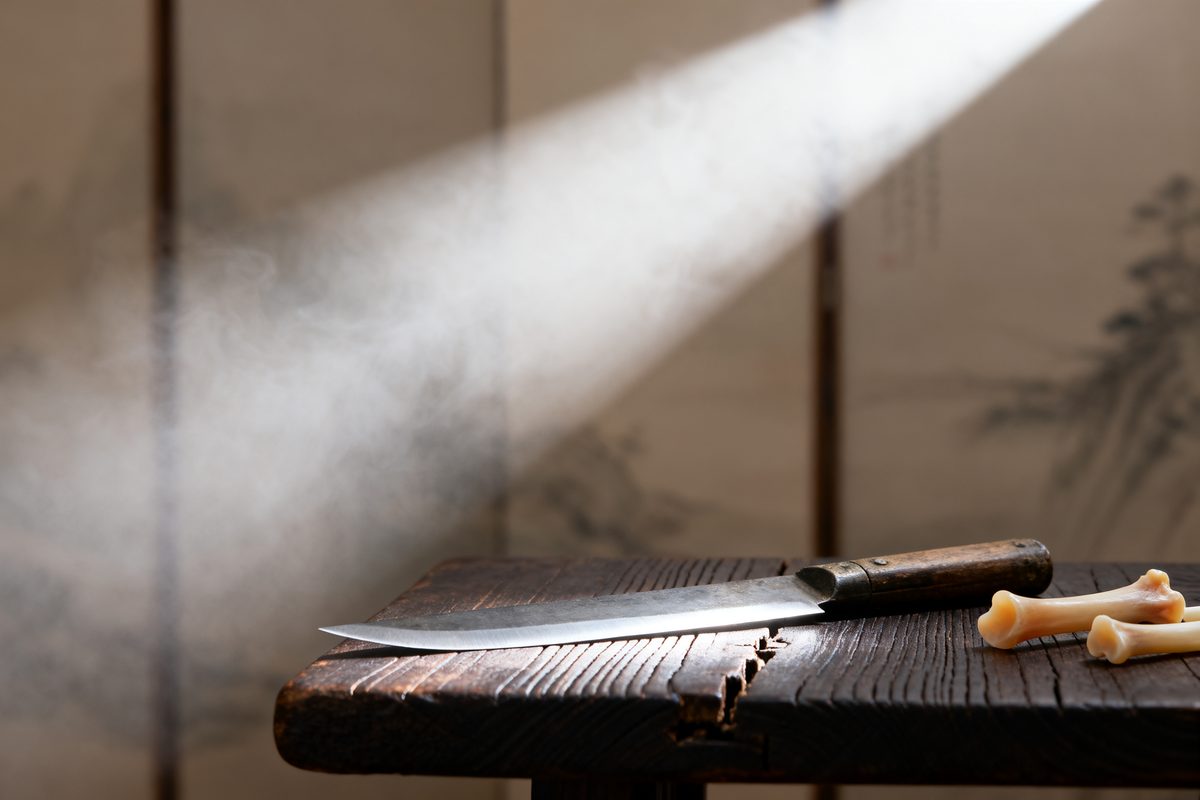
Then comes the line that made me sit still: a good cook changes his knife once a year, because he cuts. An ordinary cook changes his knife once a month, because he hacks. Ding's blade was nineteen years old. Thousands of oxen. And the edge still looked fresh from the whetstone.
Why? "The joints have gaps, and the edge of a blade has no thickness. When what has no thickness enters where there are gaps, there is plenty of room — the blade moves through with ease." That's where the Chinese idiom youren-youyu — "the blade roams with room to spare" — comes from. We've used it to praise people for over two thousand years, so smoothly that we forgot it was originally the feeling of a knife.
Most of the time, we're the one who changes knives every month
I stopped reading here for a while. What came to mind wasn't butchering. It was the way we work.
Most of the time, we're the ordinary cook. The thing in our hands has a grain — an order, a rhythm, tight parts and loose parts — but we don't look for it. We hack. With brute force, with late nights, with "just push through a little more." Before the bone cracks, the blade curls. That Monday tiredness, when I think about it now, is mostly not the tiredness of work. It's the tiredness of fighting — wrestling with the grain of the thing, wrestling with yourself, ninety percent of the strength spent on hacking.
Csikszentmihalyi interviewed rock climbers, surgeons, chess players. The way they described entering that state is nearly word for word what Cook Ding said: you stop checking the clock, you stop hearing the people around you, "there's no gap left between me and this thing." It took psychology decades and thousands of interviews to arrive at a description Zhuangzi finished twenty-three centuries ago, with one ox.
Two details that matter more than "room to spare"
The first. Cook Ding says that whenever he reaches a tangle of tendon and bone — "whenever I come to something knotted, I see it's hard, I brace myself, my gaze settles, my movements slow, and the blade moves ever so slightly" — his heart tightens, he grows watchful, his eyes stop, his hands slow down, and he cuts as lightly as possible.
This doesn't match how we imagine flow. We assume flow feels good all the way through. It doesn't. Anyone who has truly been in that state knows: at the hard part, it slows itself down. Like the steadiest driver isn't the one who's fast the whole way, but the one who slows down exactly where slowing is needed. Flow is not losing control. It's control changing form — from wrestling to following. When the grain gets difficult, he hands his rhythm over to the grain.
The second. When the ox is done — "it falls apart like a mound of earth collapsing to the ground" — what does Cook Ding do? He stands there holding his blade, looks around him, and lets the satisfaction fill him.
And then?
Then, four words: he wipes the blade and puts it away.
I've come to think those four words are the deepest part of the whole story. He doesn't linger. He takes the satisfaction, puts the blade away, and leaves the stage. Today's ox is finished; tomorrow has its own.
Psychology talks about flow as getting in. Zhuangzi added one more step: how to get out. And that step is precisely the hardest one for our era. So much of the "satisfaction" we're given now is designed by someone else — short video hands you one every fifteen seconds, a game hands you one every level, and there's a hook inside that pleasure, hooking you to stay. Cook Ding's satisfaction grew on its own, after he'd walked through an entire structure. When it grew, he put the knife away. He can't be kept hooked, because he is complete.
How does a story about killing an ox teach you to "nourish life"?
At the end, Lord Wenhui says: Wonderful! Listening to Cook Ding, I have learned how to nourish life.
When I was young I didn't get it: how does a butchering story become a lesson on health? Now I think I do. The chapter is literally titled "The Secret of Caring for Life." The "life" being cared for isn't the muscle you build in a gym. It's your blade. A blade doesn't force its way through bone; a person doesn't force their way through life. However dense your days are, there are gaps in them. Nourishing life isn't addition — what to eat, what to supplement, what to hang where. It's spending yourself sparingly: find the gap, go in, don't snap.
My friend said the flow research has one more half-sentence: what people fear most isn't difficulty. It's having nothing to do, and a scattered mind. Cook Ding would probably agree. When there's an ox, he cuts. When there's no ox, he stores his blade. He doesn't need to feel good all the time. He only needs to walk in the gaps, every time.
I'm still far from Cook Ding. Those two hours last Wednesday — it's less that I entered flow, and more that the thing happened to have a grain, and that day I was lucky enough to follow it for a stretch without picking a fight.
The blade is still that blade. The ox is still that ox.
Three questions, for you, and for me:
-
The last time you looked up and found hours had vanished — what were you doing? Where was the "gap" in it?
-
The thing in front of you right now: which part is bone, and which part is actually a gap — one you just haven't seen yet?
-
After finishing something, are you the person who stands a moment, satisfied, then wipes the blade and puts it away? Or the one who can't stop, reaching immediately for the next hit?