Why the Whole World Is Practicing Ba Duan Jin: A Lazy Person's Honest 30-Day Account
I never thought I'd become a morning exercise person. Then I saw the whole world doing Ba Duan Jin on TikTok. A Chinese practitioner rediscovering their own culture through foreigners. After 30 days, my shoulders loosened, my neck stopped cracking, even meditation felt more grounded.
Why the Whole World Is Practicing Ba Duan Jin: A Lazy Person's Honest 30-Day Account
To be honest, I never thought I'd become "a morning exercise person."
Before, when the alarm went off, the first thing I did was reach for my phone. Fifteen minutes of scrolling, then dragging myself out of bed at the very last second. Coffee down the hatch, but my brain still foggy. Shoulders hard as a board, neck cracking every now and then — that sound, I don't know if you've had it, but I'd been hearing it for three years. Got used to it.
The shift started with TikTok.
The Video That Changed Things
That night I was lying in bed scrolling (yes, phone before sleep again), and I came across a foreign guy — muscular type — doing Ba Duan Jin in his backyard. The comments blew up. All in English. "Is this real?" "My shoulder stopped hurting after a week." "Ancient Chinese people were onto something."
I thought: Ba Duan Jin? Isn't that what the elderly practice in parks?
Then another clip: a Silicon Valley programmer saying he gets up at 6 AM every morning to practice Ba Duan Jin, and it works better than meditation. His coworkers had all started too.
Scrolling further, a British woman said two months of Ba Duan Jin cured her years of insomnia.
I put the phone down.
Not because I was convinced, but because I felt a bit embarrassed. A Chinese practitioner, rediscovering something from their own culture through foreigners.
What Is Ba Duan Jin, Really
The next day I actually looked it up.
Ba Duan Jin — reportedly originated in the Song Dynasty, some say even earlier. Ba means eight, Duan means sections, Jin means brocade, as in "as elegant as silk." One complete set takes about twelve to fifteen minutes.
The eight movements each have poetic names:
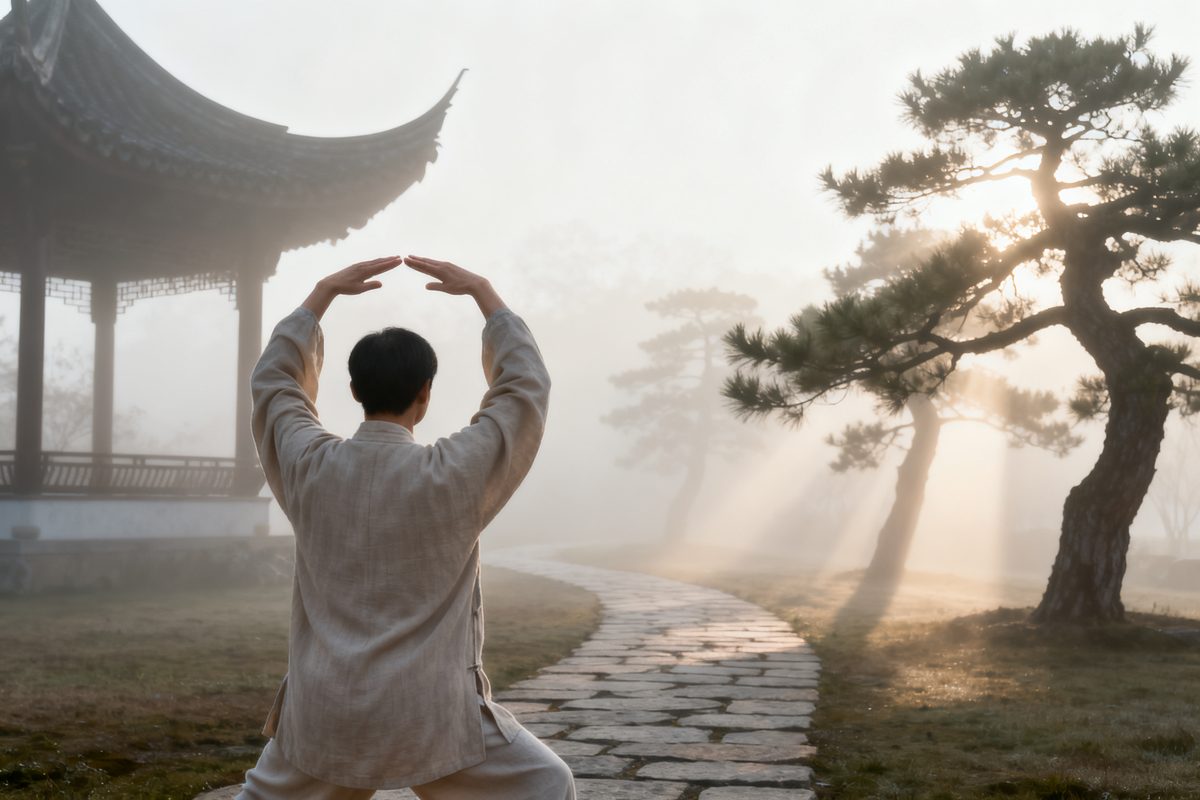
- Two Hands Hold Up the Heavens to Harmonize the Triple Burner
- Draw the Bow Like Shooting a Hawk
- Separate Heaven and Earth to Balance the Spleen and Stomach
- Look Backward to Relieve Exhaustion and Injury
- Sway the Head and Lower the Body to Dispel Heart Fire
- Touch the Feet to Strengthen the Kidneys and Waist
- Clench Fists and Glare to Boost Vitality
- Bounce on the Toes to Dispel All Illness
You see these names — "harmonize the Triple Burner," "dispel Heart Fire," "strengthen Kidneys" — they're all rooted in Traditional Chinese Medicine meridian theory. It's not simple stretching. It's a complete system for regulating qi and blood circulation.
But none of that matters. What matters is — does it actually work?
Day One: What the Heck
I found a twelve-minute instructional video from the Chinese General Administration of Sport and followed along.
First movement — "Two Hands Hold Up the Heavens" — basically interlace your fingers and push upward. Halfway through, my shoulder joint went pop, and then it ached like crazy.
"This counts as exercise?" I thought.
But after finishing all eight movements — about twelve minutes — I had a thin layer of sweat. Not the heavy sweat from running, just a slight dampness on the skin.
Then I went to pour water and noticed — my shoulders felt a bit looser.
Just a little.
But enough. I decided to try again the next day.
Day Seven: Some Strange Changes
A week later, I noticed a few things.
First, I started waking up earlier. Not because of the alarm — I just woke up naturally. Before, I'd stay in bed an extra twenty minutes. Now I was alert when it was time to get up.
Second, that crack in my neck — gone. I don't know when it disappeared, but it was definitely gone.
Third, when doing "Draw the Bow Like Shooting a Hawk," I could feel a line running from my shoulder blade down to my lower back. The Bladder meridian in Chinese medicine? I'm not sure. But the sensation was real — like a string that had been tight for a long time finally getting plucked.
Fourth, and most importantly — I started looking forward to those twelve minutes every morning.
This is very unusual for me. I'm someone who can't stick with anything. I've had three gym memberships and visited fewer than ten times total. Downloaded five meditation apps, never used any for more than three consecutive days.
But Ba Duan Jin is different. It's too short, too simple. You don't need workout clothes, a yoga mat, or any equipment. Wake up, stand in the living room in your pajamas, and begin.
A lazy person like me couldn't find an excuse to quit.
Day Fifteen: That Feeling of Qi
Around the two-week mark, while doing "Touch the Feet to Strengthen Kidneys and Waist" — basically bend forward and reach for your toes — I suddenly felt a wave of warmth rising from my lower back up along my spine.
Not imagination. A real temperature change. Warm in the lower back area.
I paused for a moment.
As a lay Buddhist practitioner, my approach to bodily sensations has always been "notice and let go, don't chase." So I didn't get excited, didn't think "wow, I've mastered qigong." Just noted: hmm, there's that feeling.
Later I mentioned it to a friend who studies TCM. She said it's perfectly normal. Ba Duan Jin is a form of Daoyin — through specific movements coordinated with breath, it guides the flow of qi and blood. That warmth in my lower back might be the Kidney meridian activating.
"Have you noticed you're less sensitive to cold lately?" she asked.
I thought about it. Actually, yes. Before, I was always the first to grab a jacket in an air-conditioned room. Now it felt fine.
Day Twenty: When Practice Meets Ba Duan Jin
Here's what's interesting — Ba Duan Jin started connecting with my daily meditation.
Before, when I sat in meditation, my biggest problems were numb legs and drowsiness. By the twenty-minute mark, either my legs went numb or my brain got foggy. Same with chanting — thoughts bouncing around like monkeys.
After practicing Ba Duan Jin, I noticed my body felt more stable during sitting meditation. Like the foundation had been reinforced. "Sinking qi to the dantian" — I used to only read about it. Now I had a faint sense of what it meant. Not mystical, just a feeling of the center of gravity dropping lower, becoming grounded.
Thoughts didn't decrease. But my body stopped fighting them.
This is hard to describe. It's like before, my body was a drafty house — thoughts blew through and carried things away. Now some cracks had been sealed. The wind was gentler. Thoughts still came and went, but less noisily.
I suddenly understood why Buddhist texts often mention "regulating the body" — when the body is unsettled, the mind struggles to settle.
Day Thirty: This Morning
Woke up naturally at six. Walked to the living room, faced the window.
Outside, the sky was just getting light. Grey-blue. Someone downstairs walking their dog.
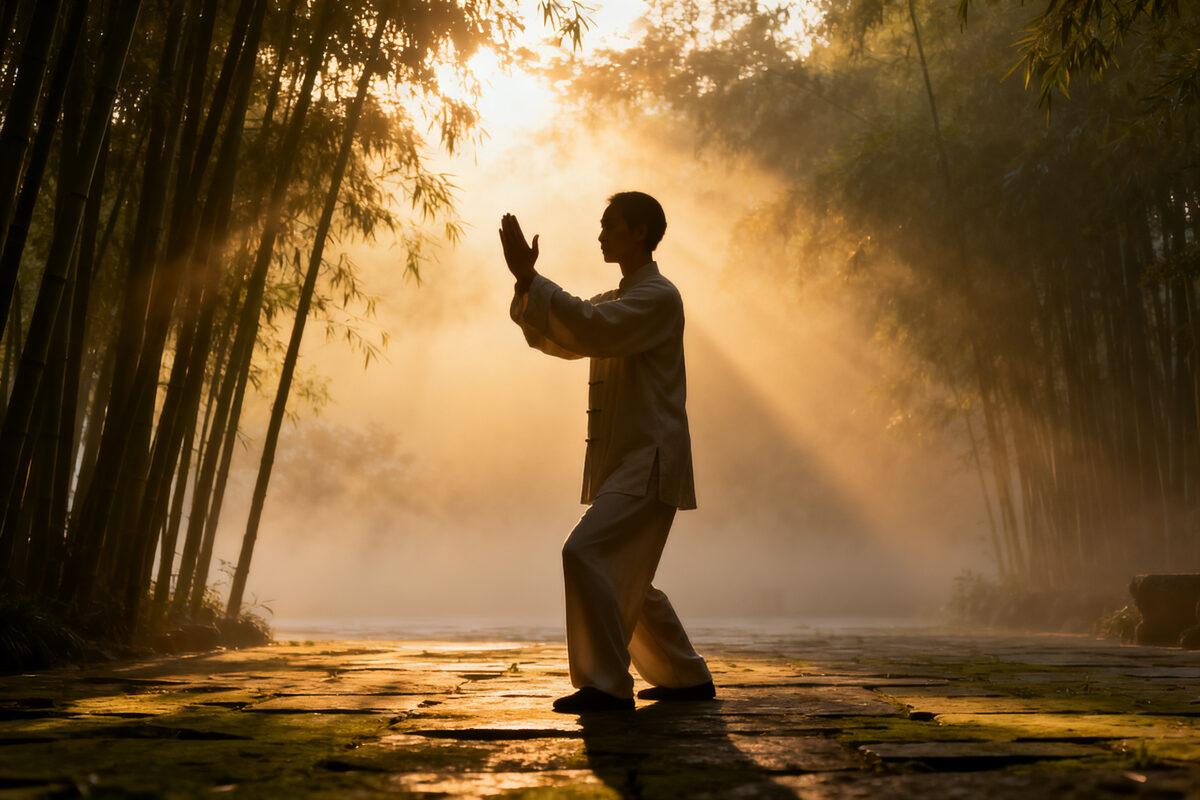
I stood still, took three deep breaths, and began the first movement.
Twelve minutes.
After the last movement — "Bounce on the Toes to Dispel All Illness" — when my heels landed, a subtle vibration rippled through my body, spreading upward from the soles of my feet.
Then stillness.
Outside, the sun came out. Light bounced off the glass of the building across the street — warm orange.
I stood there, thinking of nothing.
Maybe that's why those ancient practitioners kept doing it their whole lives — not for health benefits, not for longevity, not to live to a hundred. Just these twelve minutes, where you're with your body, with this morning.
Simple.
A Note at the End
I'm not recommending Ba Duan Jin. I'm not saying it's miraculous. Everyone's body is different. Everyone's path is different.
I just wanted to record one thing: a lazy, procrastinating person with zero interest in exercise managed to stick with something for thirty days.
The reason wasn't discipline. It wasn't willpower.
The reason might just be — it was simple enough, quiet enough, and good enough to make me want to come back the next day.
If you want to try, the official instructional video is free on Bilibili. Find a morning. Twelve minutes.
Give it a try.
Three questions for you:
- Has your body been trying to tell you something lately? Have you been listening?
- Is there something small you've been meaning to start but haven't? What's holding you back?
- If you had just twelve minutes a day for yourself, what would you do with them?