The Man Who Lived in a Tree
The Tang poet Bai Juyi visited a Zen master who lived in a tree. The master said the tree was safe — it was Bai Juyi who was in danger. A truth a three-year-old can speak, but an eighty-year-old cannot live.
The Man Who Lived in a Tree
A few days ago, I was flipping through an old book and came across the story of the Tang dynasty poet Bai Juyi visiting the Zen master known as Bird's Nest. I just stopped and sat there for a moment.
It wasn't that I was struck by some profound truth. It was the image itself — so strange, so funny, and somehow so quieting.
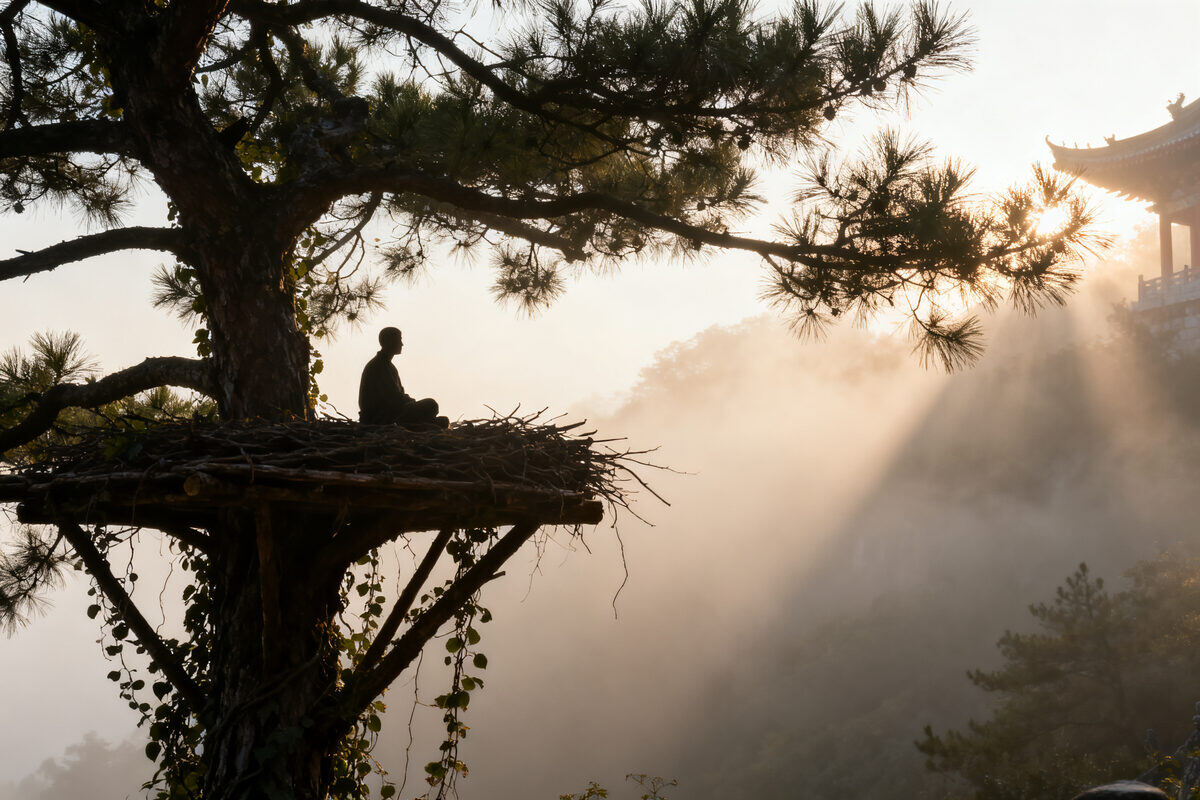
Picture this: a governor of Hangzhou, a high-ranking imperial official, arrives in a sedan chair with his full entourage, procession and all, traveling deep into the mountains to seek out a famous monk. When he gets there, he discovers the monk doesn't live in a temple. He doesn't even live in a hut. He lives in a tree. Not a proper treehouse — just a rough platform made of branches wedged into a large pine, like a bird's nest. That's why people called him the Bird's Nest Zen Master.
Bai Juyi stands at the base of the tree, looking up. I imagine him thinking: This is incredibly dangerous.
He calls up: "Master, your dwelling is very dangerous."
The Zen Master pokes his head out from the branches and says something I had to read several times:
"Your danger is far greater than mine."
Bai Juyi doesn't understand. "I am the governor of this region. What danger could I possibly be in?"
The Zen Master replies: "Firewood and flame entangle, thoughts never cease — is that not dangerous?"
What he meant was: You spin through the world of fame and fortune every day. Desire and anxiety burn you without stopping. How is that not dangerous?
I was holding a cup of cold tea when I read those words. Outside my window, someone was renovating — the electric drill going off again and again. My phone screen lit up with a work group message. My mind was juggling three things at once: something due this afternoon, something stupid I said yesterday, and the milk in the fridge that was about to expire.
And suddenly, I understood.
The danger the Zen Master was talking about wasn't the kind where you fall from a tree. It's an invisible danger — the kind where your mind is always burning, always running, never able to stop.
I looked up more about this Bird's Nest Zen Master later. His Dharma name was Daolin, and he ordained at age nine. In his younger years, he studied in the capital of Chang'an, reading vast numbers of sutras and commentaries — a genuinely learned monk. But eventually, he left behind all those grand temples and came to live in a pine tree on Mount Qinwang in Hangzhou.
He stayed there for over forty years.
I keep thinking about it: someone who had read so many scriptures, why would he choose to live in a tree?
It's not that the scriptures were useless. It's more like maybe, after reading them all, he realized that the real work wasn't in books. Like a chef who's read ten thousand cookbooks — eventually, you have to get back in front of the stove. The sutras are maps, but the road beneath your feet has to be walked yourself.
Living in a tree wasn't about being contrarian. I imagine it was because that tree was quiet enough. No temple politics, no followers making requests, no one needing him to do anything. Just one person, one tree, the mountain wind, the pine branches swaying gently.
I can't even imagine that life. Not because I don't want it — because I'm afraid of it. I'm used to having a roof, the internet, food delivery, a schedule for tomorrow. Put me in a tree, and I'd probably lie awake the first night worrying that my phone had no signal.
But then again — was that "nest" in the tree really more dangerous than my room with heating and WiFi?
He might fall. That's a danger to the body. But me? My mind goes from the moment I open my eyes to the moment I close them, with barely a second of complete stillness. Worrying, planning, remembering, comparing, regretting, hoping — they take turns like a windmill that never stops. My body sits in a safe chair, but my mind is dangling over a cliff edge.
The Zen Master was right. Firewood and flame entangle, thoughts never cease. That is the real danger.
There's more to the story.
Bai Juyi, apparently moved by what the Zen Master said, asks the question every Buddhist student eventually asks:
"What is the essential meaning of the Buddha's teaching?"
In other words: Can you give me the one-line version? What's the core, the heart of it all?
The Zen Master's answer is so simple that Bai Juyi felt he was being dismissed:
"Do no evil, and do good."
Bai Juyi was one of the smartest literary minds of the Tang dynasty. He could read at age three, wrote the famous line "wildfire cannot destroy it all, the spring wind blows and it grows again" at sixteen, and passed the imperial exams at twenty-eight. He was clearly not satisfied.
He said: "Even a three-year-old child could say that."
The Zen Master looked at him and said slowly:
"A three-year-old child can say it, but an eighty-year-old man cannot do it."
Reading that line felt like having cold water poured over me. Not an uncomfortable cold — the kind that wakes you up.
Because I know this truth too. Not since I was three, exactly, but for as long as I can remember, I've known "do good, don't do bad." It's a statement so obvious that no one would disagree. But the distance between "knowing" and "doing" might be farther than the distance from the Earth to the Moon.
Yesterday I knew I shouldn't lose my temper with my family — I still did. I knew I shouldn't scroll my phone until midnight — I still did. I knew I should sit quietly for a few minutes each morning — I stayed in bed instead. Every single item on the list, I "know." Every single one, I "don't do."
Isn't that exactly what the Zen Master was saying? A three-year-old can say it. An eighty-year-old can't do it.
Where exactly does the problem lie?
I think about it, and maybe the problem is "knowing" itself.
We mistake knowing for doing so easily. We read a book, find it very insightful, and imagine our level of understanding has risen. After a lecture, we feel enlightened, as if we've been completely transformed. But the next morning, everything is the same. Still anxious, still angry, still afraid.
"Knowing" is one thing. "Becoming" is another.
What's missing in between is practice. And practice isn't a one-time event — it's every day, every moment.
The Bird's Nest Zen Master didn't just know a truth and move into a tree and call it done. He lived in that tree for forty years. Forty years. Not forty days, not forty months. Forty years of living that radically simple life, day after day.
He wasn't performing asceticism. He was using his entire life to embody a simple truth: real safety isn't in external stability, but in inner stillness. Houses collapse. Trees break. There is no absolutely safe place in the world. But if the mind stops running, stops burning, stops panicking — then nowhere is dangerous.
Bai Juyi had territory, rank, and poetic fame. But until he met the Zen Master in the tree, he may never have stopped to ask himself: Am I safe? Is my mind safe?
This story reminds me of a friend.
A few years ago, he was a product manager at an internet company. Good salary, paying off a Beijing mortgage, working until eleven every night. One day at his desk, his heart suddenly started racing. He went to the hospital and found out it was an anxiety disorder. The doctor told him to rest. He said he couldn't — a product was launching Monday.
He eventually quit. Not from some grand epiphany — he just couldn't keep going. He went back to his small hometown and opened a tiny secondhand bookstore. When I visited him once, he was sitting at the shop entrance, sunbathing, a cat sleeping beside him. He said something I've never forgotten:
"When I was at my desk before, I was afraid every day. Afraid of what, I couldn't even say. Just afraid. Now I sit here, and I'm not afraid anymore."
I asked him: "Do you regret it? The income is so different."
He thought for a moment and said: "I used to make a lot of money, but my heart was so poor inside. Now I don't have much money, but my heart feels full."
I don't know if he understood what the Bird's Nest Zen Master meant. But in his own way, he climbed down from his own dangerous "tree."
By now, the renovation noise outside has stopped. The sun has shifted west, and light comes through the other window, landing on the corner of my desk. That cup of cold tea is still beside my hand, completely cold now.
Sometimes I think each of us has two people living inside. One is Bai Juyi — clever, capable, understanding everything, standing at the foot of the tree looking up at that person in the branches, thinking how dangerous it is. The other is the Zen Master — needing nothing, feeling safe precisely because he's in the tree.
Most of the time, Bai Juyi wins. We want security, stability, certainty, control. We build ever-stronger houses, buy more insurance, save more money. But the hole inside never seems to fill. Because what makes us uneasy isn't external danger — it's the fire inside that has never gone out.
The Bird's Nest Zen Master wasn't telling us all to go live in trees. He was just reminding us, in his own way: What you think is safety might not be real safety. What you think is danger might not be real danger.
Real safety is when the mind stops running.
That simple.
Simple enough that a three-year-old can say it.
Simple enough that an eighty-year-old still can't do it.
Three questions I'm sitting with today:
- What is the fire in my mind burning right now?
- If all my external "safety" disappeared tomorrow, what would I have left?
- What is something I've known for a long time but still haven't done?