The Buddha and the Poisoned Arrow: Pull It Out First, Ask Questions Later
A man struck by a poisoned arrow refuses treatment until he knows who shot it and what it's made of. The Buddha used this story to teach: solve the suffering at hand first.
A Young Man and His Thousand Questions
One day, a young man named Māluṅkyāputta arrived at Jeta's Grove.
He hadn't come to practice the Dharma. He'd come for answers.
He said: "Bhagavan, if you won't answer my questions, I won't become your disciple."
His questions were many—
Is the world finite or infinite?
Are the soul and the body the same thing, or are they separate?
Does a person exist after death?
Does a Tathāgata exist after death?
Each one was a grand philosophical question that scholars had debated for centuries.
The Buddha looked at him and was silent for a moment.
Then he told a story.
The Story of the Poisoned Arrow
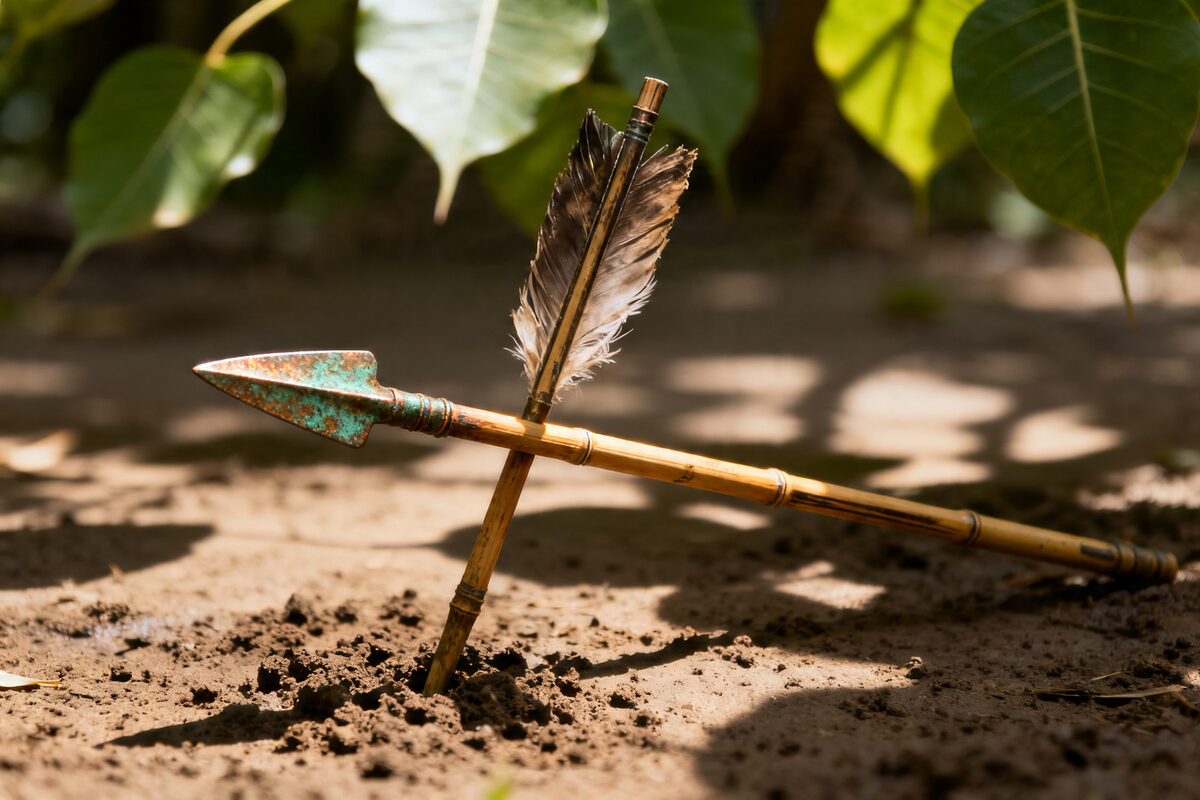
A man was walking through the wilderness when, without warning, a poisoned arrow struck him.
His family panicked. They immediately sent for a skilled physician.
But the wounded man made an astonishing decision.
He said: "Wait. Before you remove this arrow, I need to know—"
"Who shot this arrow?"
"What caste does he belong to? Is he a Brahmin, a Kshatriya, or a Shudra?"
"What is his name? How tall is he? What does he look like?"
"What material is the arrow made of? Is it reed or bamboo?"
"What metal is the arrowhead? Iron or copper?"
"What is the bowstring made of? Sinew or plant fiber?"
"What kind of bird's feathers are on the arrow?"
His family begged him: "Let the doctor remove the arrow first! We can find out all these things later!"
He refused.
He said: "I will not accept treatment until I have the answers."
So his family scattered to search.
Some went to find information about the archer. Others went to investigate the arrow's materials. Still others tried to identify the feathers.
Minutes passed. Then hours.
The poison kept spreading.
Before any answer came back, the man died.
The Buddha's Turning Point
When the story was finished, the Buddha turned to Māluṅkyāputta.
He asked:
"Before he died, did that man get his answers?"
Māluṅkyāputta said, "No, Bhagavan."
The Buddha said:
"It is the same with you. Whether the world is finite or infinite, whether the soul exists or not—aging, sickness, and death are right in front of you. Sorrow, lamentation, and despair are right in front of you."
"Before you find those answers, your life will already be over."
Those words struck Māluṅkyāputta like an arrow.
The Heart of Buddhism: Not Philosophy, but Medicine
The Buddha said his teaching does only one thing—
Point out suffering, and then end it.
Like a doctor treating a poisoned patient: the priority isn't debating molecular structures of toxins. It's—pull out the arrow, administer the antidote, now.
The Four Noble Truths are the Buddha's "diagnosis":
- Dukkha: You are in pain. Acknowledge it.
- Samudaya: Find the source of the poison.
- Nirodha: Know that recovery is possible.
- Magga: Follow the prescription.
Modern Reflection: Are You Also "Refusing to Pull the Arrow"?
Honestly, we all have a poisoned arrow stuck in us somewhere.
We've just gotten very good at pretending it isn't there.
Information Anxiety
We bookmark hundreds of articles. We sign up for dozens of courses. We buy stacks of books.
We tell ourselves: "Once I know enough, I'll take action."
But the truth is—information is infinite, and the window for action is not.
Decision Paralysis
"Should I learn Python or JavaScript?"
"Should I start a business or keep my job?"
"Should I study English first or get a certification?"
We spend so much time trying to choose the best path that we forget—any path, walked with commitment, beats standing still.
The Cult of "Readiness"
"I'll start when I'm ready."
"I'll act when I feel up to it."
"I'll decide when I'm absolutely certain."
—All of these are studying the arrow's material instead of pulling it out.
The poison is spreading.
You don't need a perfect plan. You need immediate action.
You don't need all the answers. You need to take the first step.
Questions for Reflection
One. Is there an "unpulled arrow" in your life right now? What have you been "preparing" for instead of facing it directly?
Two. Do you often get trapped in the cycle of "figure it out first, then act"? Has that cycle given you security—or just delay?
Three. If the Buddha were sitting in front of you right now, what do you think he would say?